


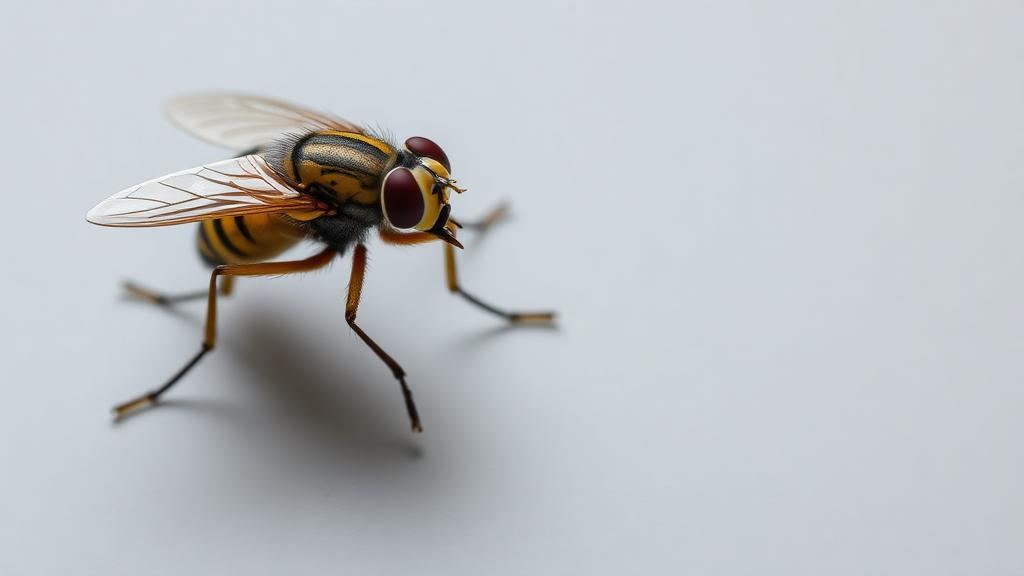
A team of chemists and biologists from universities in Egypt and Saudi Arabia has designed a small family of synthetic sulfur-containing molecules that can do two very different jobs at once: wipe out the larvae of a flesh-feeding fly and shut down multidrug-resistant bacteria. The work, published in the journal 3 Biotech, describes four novel benzenesulfonamide derivatives built through a classic carbon-carbon bond-forming reaction and then interrogated with an unusually thorough battery of tests, ranging from light microscopy of dying insect tissue to computer simulations of how the molecules dock into bacterial enzymes. The results point to one compound as a strikingly potent larvicide and another as a promising lead against Gram-negative pathogens, the category of bacteria that public health agencies consider among the most difficult to treat.
The chemistry behind the study rests on the Claisen-Schmidt condensation, a base-catalyzed reaction that joins an aromatic aldehyde with a ketone-bearing precursor to form conjugated enone linkages. Using this approach, the researchers assembled derivatives labeled 2 through 5, each carrying the benzenesulfonamide scaffold decorated with different heterocyclic appendages, including pyrazole rings fused or hybridized with pyrrolidine and thiophene units. The sulfonamide group itself has a storied history in medicine, having anchored the first generation of synthetic antibiotics in the 1930s, and it remains a versatile pharmacophore because its polar chemistry allows it to form hydrogen bonds with biological targets. By varying the heterocyclic partners attached to this core, the team could probe how subtle structural changes alter biological activity, a strategy known as structure-activity relationship exploration.
The larvicidal half of the study targeted Wohlfahrtia magnifica, the spotted flesh fly, whose larvae are obligate parasites that invade the living tissue of warm-blooded animals and cause a devastating condition known as traumatic myiasis. The disease inflicts severe losses in livestock and occasionally affects humans, and control options are narrowing as conventional insecticides lose efficacy and face regulatory restrictions. When the researchers exposed W. magnifica larvae to the compounds at a concentration of 25 milligrams per gram, the thienyl-pyrazole-hybridized derivative 5 emerged as the clear winner, driving cumulative mortality to approximately 92 percent by the fourth day of treatment. The other derivatives showed weaker effects, underscoring how the thiophene-pyrazole combination appears to be the key structural feature for insecticidal potency in this series.
What makes the study particularly compelling is the microscopic evidence of how the winning compound kills. Histopathological examination of treated larvae revealed extensive breakdown of the cuticle, the tough outer armor that insects depend on for protection and water balance. Beneath the surface, the muscle architecture collapsed, with myofibrils, the contractile fibers of larval muscle, fragmenting into disorganized debris. The mitochondria, the organelles that power cellular metabolism, swelled severely, a hallmark of energy failure and irreversible cellular stress. Perhaps most striking was the fate of the collagen-like extracellular matrix that supports larval tissues: quantitative assessment showed its abundance plummeting from roughly 80 percent in untreated specimens to below 15 percent after treatment, indicating a progressive disintegration of the structural scaffolding that holds the insect’s body together.
To determine whether the dying cells were undergoing programmed cell death, the team turned to acridine orange, a fluorescent dye that binds nucleic acids and reveals nuclear morphology under ultraviolet light. Staining of treated larvae showed condensation and fragmentation of nuclei in a treatment-dependent pattern, the classic cytological signature of apoptosis. This finding suggests that compound 5 does not simply poison larvae indiscriminately but triggers an organized self-destruction program within their cells, a mechanism that could be exploited to design more targeted and environmentally selective pest control agents in the future.
The antibacterial arm of the study focused on a different threat: multidrug-resistant Gram-negative pathogens. Here the ranking flipped. The pyrrolidine-pyrazole hybrid, compound 2, displayed selective and dose-dependent inhibition of Klebsiella pneumoniae, producing inhibition zones between 15 and 28 millimeters with a minimum inhibitory concentration of 10 milligrams per milliliter, and also curbed Escherichia coli with zones of 9 to 16 millimeters and an MIC of 25 milligrams per milliliter. Notably, the compound showed no activity against Staphylococcus aureus, a Gram-positive species, meaning its spectrum is confined to the outer-membrane-bearing bacteria that are hardest to attack with existing drugs. Klebsiella pneumoniae in particular has become one of the world’s most alarming reservoirs of resistance genes, capable of transferring drug tolerance to other species, so any new chemical scaffold with activity against it attracts immediate attention.
Scanning electron microscopy provided visual confirmation of the antibacterial mechanism at the cellular level. Treated bacterial cells exhibited rupture of the cell envelope and wholesale structural collapse, images consistent with a compound that damages the membrane and wall architecture rather than merely slowing growth. To pin down the molecular target, the researchers ran in vitro enzyme assays against two essential bacterial enzymes: DNA gyrase B and topoisomerase IV. These enzymes belong to the type II topoisomerase family and are responsible for managing the topological stress of DNA replication and transcription; they are the targets of fluoroquinolone antibiotics, against which resistance has spread widely. Compound 2 inhibited E. coli DNA gyrase B with an IC50 of 3.188 micromolar and topoisomerase IV with an IC50 of 14.288 micromolar, demonstrating genuine enzymatic inhibition rather than nonspecific toxicity.
Computational modeling then connected the biochemical data to atomic-scale structure. Molecular docking simulations placed compound 2 firmly within the ATP-binding cavities of both enzymes, yielding docking scores of minus 10.88 kilocalories per mole for DNA gyrase B and minus 9.98 kilocalories per mole for topoisomerase IV. Scores in this range indicate energetically favorable binding poses, and the fact that the compound engages both members of the topoisomerase family is significant because dual targeting makes it harder for bacteria to develop resistance through a single mutation. The docking results align with the enzyme assays, giving the inhibition data a plausible structural explanation and providing a template for future medicinal chemistry optimization.
Before any compound can move toward drug development, it must pass a gauntlet of predicted properties collectively known as ADMET profiling, covering absorption, distribution, metabolism, excretion, and toxicity. In silico analysis of the derivatives indicated good oral bioavailability, with a predicted human intestinal absorption rate of 94.87 percent for the lead compound, alongside a favorable drug-likeness profile and an acceptable safety window with respect to the hERG potassium channel, a common early warning screen for cardiac toxicity risk. These computational predictions do not replace laboratory pharmacokinetic testing, but they suggest that the scaffold is worth advancing rather than fundamentally flawed in its drug-like character.
The study’s dual findings, a potent larvicidal compound and a multi-target antibacterial lead emerging from the same synthetic series, illustrate the value of systematic heterocycle design around a proven pharmacophore. Compound 5 now stands as a candidate for further development against myiasis-causing flies, while compound 2 offers a starting point for optimizing inhibitors of bacterial DNA gyrase and topoisomerase IV at a time when Gram-negative resistance continues to erode the clinical utility of older antibiotic classes. The authors, led by Ahmed Abdou O. Abeed of Assiut University and Mustafa A. Fawzy of Taif University, acknowledge funding from Taif University’s Deanship of Graduate Studies and Scientific Research. As with all early-stage discovery work, the path from laboratory potency to practical insecticide or antibiotic is long, requiring toxicity studies in animal models, formulation development, and resistance selection experiments, but the combination of histological, ultrastructural, biochemical, and computational evidence assembled here gives both lead compounds a well-documented foundation for the next phase of evaluation.
Subject of Research: Synthesis and dual larvicidal and antibacterial evaluation of novel benzenesulfonamide derivatives
Article Title: Novel benzenesulfonamide derivatives as larvicidal and antibacterial agents: insights from histopathological studies, molecular docking, and ADMET profiling
Article References: Abeed, A. A. O., Fawzy, M. A., Abd El-Aziz, F. E.-Z. A., Alsharif, H., Afifi, T. H., Shikhoun, M. E. H., Ahmed, H. A., Nossier, E. S., & Kishk, F. N. M. (2026). Novel benzenesulfonamide derivatives as larvicidal and antibacterial agents: insights from histopathological studies, molecular docking, and ADMET profiling. 3 Biotech, 16(10), Article 450. https://doi.org/10.1007/s13205-026-05060-y
Image Credits: AI Generated
DOI: 10.1007/s13205-026-05060-y
Keywords: benzenesulfonamide, larvicidal agents, Wohlfahrtia magnifica, antibacterial activity, DNA gyrase B, topoisomerase IV, Klebsiella pneumoniae, Escherichia coli, molecular docking, ADMET profiling, histopathology, antimicrobial resistance
Cite Scienmag News
Kristina Jarvis. (October 1, 2026). Sulfonamide Compounds Kill Flesh-Eating Fly Larvae and Drug-Resistant Bacteria in Dual-Action Study. Scienmag. https://scienmag.com/sulfonamide-compounds-kill-flesh-eating-fly-larvae-and-drug-resistant-bacteria-in-dual-action-study/
Kristina Jarvis. "Sulfonamide Compounds Kill Flesh-Eating Fly Larvae and Drug-Resistant Bacteria in Dual-Action Study." Scienmag, 1 October 2026, https://scienmag.com/sulfonamide-compounds-kill-flesh-eating-fly-larvae-and-drug-resistant-bacteria-in-dual-action-study/. Accessed 1 October 2026.
Kristina Jarvis. "Sulfonamide Compounds Kill Flesh-Eating Fly Larvae and Drug-Resistant Bacteria in Dual-Action Study." Scienmag. October 1, 2026. https://scienmag.com/sulfonamide-compounds-kill-flesh-eating-fly-larvae-and-drug-resistant-bacteria-in-dual-action-study/


