


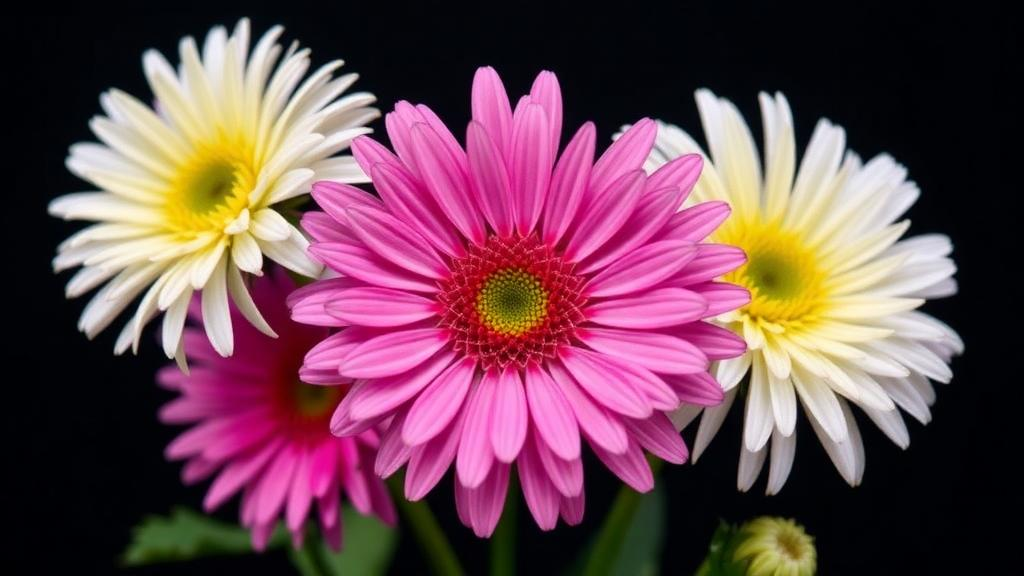
Chrysanthemums are among the most commercially important ornamental flowers on Earth, gracing bouquets, gardens, and windowsills across continents. Yet behind their dazzling diversity of colors and forms lies a stubborn breeding bottleneck: crossing them successfully is notoriously difficult. A new study from researchers at the ICAR-Indian Agricultural Research Institute in New Delhi, published in Discover Plants, has now mapped the reproductive biology of fourteen diverse chrysanthemum genotypes in unprecedented detail, identifying the precise windows when pollen release and stigma receptivity overlap and pinpointing which varieties make the best parents. The findings promise to give breeders a practical roadmap for producing novel hybrids with far greater efficiency.
The challenge stems from the chrysanthemum’s peculiar genetics. Modern cultivars carry an allohexaploid genome, meaning they possess six sets of chromosomes derived from different ancestral species, combined with extreme heterozygosity and sporophytic self-incompatibility, a system that prevents self-fertilization. These factors conspire to produce irregular hybridization and poor seed set, frustrating conventional breeding programs. Compounding the difficulty, the chrysanthemum flower head, or capitulum, contains two distinct floret types: pistillate ray florets at the periphery and bisexual disc florets at the center. The bifurcated stigmas of the ray florets typically become receptive before the flower fully opens, favoring cross-pollination, but successful fertilization demands that viable pollen arrive exactly when the stigma is ready.
To untangle this timing puzzle, the research team grew fourteen genotypes sourced from Indian and international breeding programs, including varieties from CSIR-NBRI Lucknow, Punjab Agricultural University, and ICAR-IARI’s own collections, alongside exotic material maintained in the institute’s germplasm repository. During the peak flowering seasons of 2023-24 and 2024-25, they bagged flower buds before anthesis to prevent contamination from stray pollen, then monitored them at intervals of thirty minutes to one hour from early morning until late afternoon. The results were strikingly consistent: no anther dehiscence occurred before 9:15 in the morning or after 2:30 in the afternoon. Instead, pollen release concentrated in a sunny midday window between 11:00 AM and 1:30 PM, with total dehiscence lasting between four and four hours forty-five minutes across genotypes.
Not all varieties performed equally during this critical period. Pusa Aditya recorded the longest peak dehiscence period at two hours and thirty minutes, followed by Flirt, Pusa Chitraksha, Pusa Shwet, Red Spoon, and Sensation, each sustaining maximum pollen shedding for two hours and fifteen minutes. At the other end, Aprajita Yellow managed only one hour forty-five minutes of peak release. The researchers attribute these differences to floral development and environmental responsiveness, noting that the cool mornings and high humidity of the northern Indian plains delay dehiscence, while bright late-morning sunshine accelerates it. For breeders, the message is clear: collect pollen during the midday peak, and choose male parents like Pusa Aditya that keep shedding longest.
On the female side, the team assessed stigma receptivity using the hydrogen peroxide test, a rapid method in which peroxidase enzymes on a receptive stigma break down hydrogen peroxide and release visible oxygen bubbles. Scoring receptivity on a four-point scale under a stereo zoom microscope, they found that moderate to high receptivity of the outer ray florets persisted for roughly three days, from the fourth through the sixth day after emasculation, in Flirt, Pusa Shwet, and Pusa Guldasta. Flirt and Pusa Shwet reached their maximum receptivity on the fifth day, Pusa Guldasta between the fifth and sixth, and Sensation and Ragini on the sixth. Aprajita Yellow, by contrast, never achieved the highest receptivity score, marking it as a less reliable female parent. Crucially, the window of peak stigma receptivity coincided with active anther dehiscence, confirming a favorable natural overlap for controlled pollination.
The study then turned to pollen architecture, examining sixty grains per genotype under a Hitachi field emission scanning electron microscope. Chrysanthemum pollen proved uniformly tricolporate, bearing three colpi and pores, with an echinate exine studded by conical spines with wide bases and blunt to pointed tips. Based on the ratio of polar length to equatorial diameter, which ranged from 0.96 to 1.06, grains were classified as oblate-spheroidal, spheroidal, or prolate-spheroidal, all characteristic of the Asteraceae family. Pusa Aditya and Red Spoon produced the largest grains, measuring roughly 33 micrometers in polar length, while spine length varied from 4.21 micrometers in Pusa Sona to 5.56 micrometers in Lal Pari. Although these morphological traits are largely conserved, the size variation may influence pollen hydration, germination, and pollen tube growth, subtly shaping reproductive performance.
Germination experiments revealed which genotypes carry the most vigorous pollen. After screening five liquid media combinations, the team identified a formulation containing 15 percent sucrose and 15 percent polyethylene glycol 4000, supplemented with boric acid, potassium nitrate, magnesium sulphate, and calcium nitrate at pH 5.8, as the most effective. Sucrose supplies energy for pollen tube growth, while PEG maintains the osmotic balance the tubes require. Using this medium, germination rates ranged dramatically from just 7.28 percent in Aprajita Yellow to 45.64 percent in Red Spoon, with Lal Pari at 45.10 percent and Ragini at 41.49 percent close behind. The sixfold spread underscores how much inherent pollen vigor varies even within a single ornamental species.
Viability testing added another layer of insight. The researchers compared three staining methods: 2,3,5-triphenyl tetrazolium chloride, Lugol’s iodine solution, and acetocarmine. Acetocarmine produced the highest apparent viability at 75.81 percent, followed by Lugol’s at 61.25 percent and TTC at 56.10 percent. But the higher numbers were misleading. Lugol’s stains starch reserves and acetocarmine stains nuclei and cytoplasm, so both can mark structurally intact grains as viable even when they have lost the metabolic capacity to germinate. TTC, by contrast, is reduced to a red formazan compound only by active dehydrogenase enzymes in living, metabolically functional pollen. Because TTC results aligned closely with actual in vitro germination, the team concluded it is the most reliable indicator of functional viability, a finding with direct practical value for breeders screening candidate pollen parents.
When all the reproductive traits were integrated, a clear hierarchy of parental value emerged. Red Spoon, Pusa Aditya, and Ragini consistently ranked among the top performers across anther dehiscence, pollen size, germination, and viability, making them ideal pollen parents. Flirt, Pusa Guldasta, Pusa Shwet, and Sensation offered prolonged stigmatic receptivity, providing a wider fertilization window and marking them as desirable female parents. Mean pollen viability ranged from 46.19 percent in Aprajita Yellow to 78.96 percent in Ragini, with Pusa Aditya and Red Spoon statistically comparable to the leader, further cementing their status as elite breeding material.
Beyond the immediate practical guidance, the study fills a genuine knowledge gap in ornamental crop science. Systematic data on the synchronization of reproductive events in chrysanthemum has remained scarce, even as the crop’s global value continues to climb. By defining the optimal pollen collection window, identifying genotypes with extended receptivity, and validating a reliable viability assay, the researchers have converted reproductive biology from an obstacle into a tool. For a flower whose dazzling variety was built over centuries through hybridization, mutation, and selection, this work offers a scientifically grounded way to accelerate the next generation of chrysanthemum cultivars, ensuring that breeders spend less time on failed crosses and more time creating the colors and forms that captivate gardeners worldwide.
Subject of Research: Reproductive biology and pollen traits affecting hybridization efficiency in chrysanthemum
Article Title: Assessment of reproductive traits influencing breeding efficiency in chrysanthemum (Chrysanthemum morifolium Ramat.)
Article References: N, S., UN, S., Banyal, N., Tiwari, A. K., MB, A. K., Kumar, S., Talukdar, A., & Kumar, G. (2026). Assessment of reproductive traits influencing breeding efficiency in chrysanthemum (Chrysanthemum morifolium Ramat.). Discover Plants, 3(1), Article 427. https://doi.org/10.1007/s44372-026-00911-7
Image Credits: AI Generated
DOI: 10.1007/s44372-026-00911-7
Keywords: chrysanthemum, reproductive biology, anther dehiscence, stigma receptivity, pollen viability, pollen germination, pollen morphology, plant breeding, hybridization, floriculture, TTC staining, Asteraceae
Cite Scienmag News
Alan Morgan. (October 1, 2026). Timing Is Everything: Scientists Decode the Reproductive Secrets That Could Supercharge Chrysanthemum Breeding. Scienmag. https://scienmag.com/timing-is-everything-scientists-decode-the-reproductive-secrets-that-could-supercharge-chrysanthemum-breeding/
Alan Morgan. "Timing Is Everything: Scientists Decode the Reproductive Secrets That Could Supercharge Chrysanthemum Breeding." Scienmag, 1 October 2026, https://scienmag.com/timing-is-everything-scientists-decode-the-reproductive-secrets-that-could-supercharge-chrysanthemum-breeding/. Accessed 1 October 2026.
Alan Morgan. "Timing Is Everything: Scientists Decode the Reproductive Secrets That Could Supercharge Chrysanthemum Breeding." Scienmag. October 1, 2026. https://scienmag.com/timing-is-everything-scientists-decode-the-reproductive-secrets-that-could-supercharge-chrysanthemum-breeding/


