


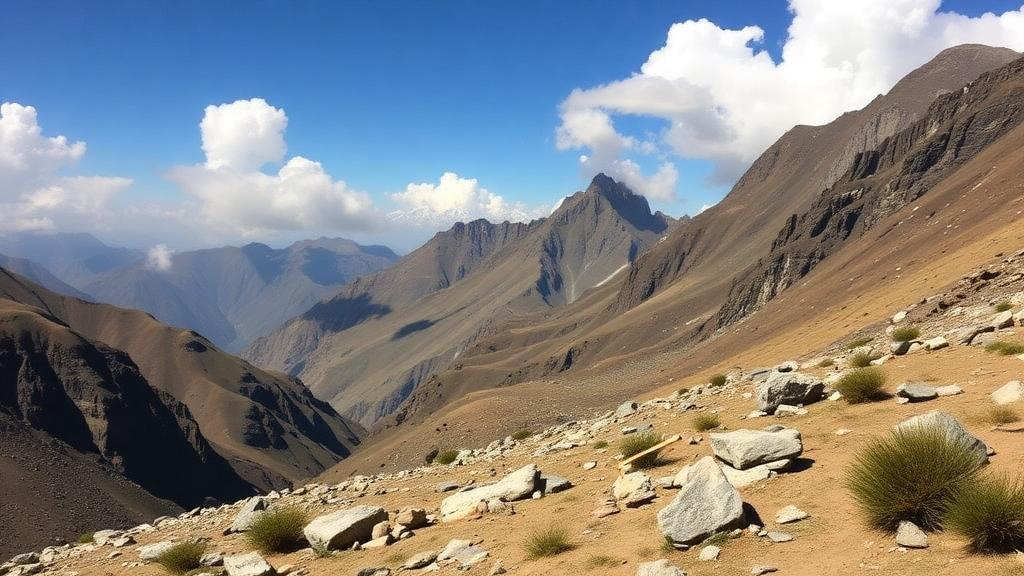
High in the far-western hills of Nepal, the monsoon no longer arrives when it is supposed to. Farmers in Bajhang District, a rugged expanse of some 3,400 square kilometres stretching from mid-hill valleys at around 900 metres to glaciated ridges above 7,000 metres, describe a rainy season that has been compressed from weeks of gentle rain into brief, violent downpours separated by dry spells. A new study published in the journal Regional Environmental Change argues that these disruptions are not merely an environmental story. They are rewriting the temporal architecture of subsistence farming itself, and the ways people cope reveal adaptation as something woven into daily life rather than delivered by policy.
The research, led by Anindita Sarkar of the Center for Development Research at the University of Bonn together with colleagues in Germany, Nepal and India, combined four decades of satellite-based climate analysis with extensive fieldwork across nine villages in the Seti River basin. Precipitation records from the CHIRPS dataset and temperature data from TerraClimate covered 1984 to 2023, while land-cover change was tracked using European Space Agency satellite data from 1992 and 2022. Between April and May 2025, the team conducted twenty focus group discussions with 284 participants, split evenly between men and women, alongside semi-structured interviews with farmers, irrigation users, local officials and returnee migrants.
The quantitative findings are subtle but consequential. Annual rainfall in Bajhang, averaging roughly 1,262 millimetres, shows no statistically significant long-term trend. Yet the seasonal distribution is shifting in ways that matter enormously for rainfed agriculture. April rainfall has increased significantly, driven by intense pre-monsoon convective storms known as Nor’westers that can flatten standing crops and erode topsoil. December rainfall has declined significantly, leaving early winters drier. Meanwhile, July and August, the wettest months at more than 300 millimetres each, show declining trends, hinting at a shortening monsoon. Post-monsoon rainfall in October and November is extraordinarily variable, making the timing of the entire agricultural year less predictable.
Temperature tells a clearer story. Annual mean temperatures have sat consistently above the long-term average of about 14.3 degrees Celsius since the early 2000s, with the fastest warming in February, March and October at up to 0.07 degrees per year. Mann-Kendall trend tests confirm statistically significant warming during the monsoon and post-monsoon months, particularly September and October. In high-elevation villages such as Daarya, farmers report that winter snowfall has all but vanished. Where snow once lingered until February or March, rivers now run dry by early spring, cutting the pre-monsoon streamflow that feeds canals and springs and undermining wheat and barley cultivation.
The researchers call the resulting condition agroecological misalignment: a widening gap between inherited agrarian calendars and the climate that actually materialises. Crop-by-crop analysis shows the mismatch clearly. Lowland rice, transplanted in June and July, depends on sustained monsoon rainfall to keep paddies flooded, making it acutely vulnerable to late or excessive rain. Wheat and barley, sown after the monsoon, now grow through increasingly dry winters and ripen earlier under spring temperatures above 20 degrees, shortening the grain-filling period and depressing yields. Perhaps most strikingly, the traditional labour sequencing, in which barley in the high hills ripened after wheat in the valleys, has collapsed. In some years both crops now ripen simultaneously, and wheat harvest overlaps with rice field preparation, creating simultaneous labour peaks that households cannot cover.
The social consequences are visible from orbit. ESA land-cover data show that fallow or abandoned cultivable land expanded by roughly 24.3 square kilometres between 1992 and 2022, while total cropland remained nearly stable, indicating gradual de-intensification rather than permanent conversion. Terraces once planted with barley and wheat are left uncultivated for entire seasons. The drivers are intertwined: rainfall has become unreliable, male labour has migrated to India and the Gulf, cultural norms restrict women from ploughing, and mechanisation is either unaffordable at around 1,000 Nepalese rupees per hour or physically impossible on narrow, stony highland terraces. Land is culturally retained rather than sold, so households simply wait, sometimes for the seasonal return of migrant men, before ploughing can begin.
Traditional crops are disappearing with the old climate. Barley, buckwheat and even apple orchards planted over the past two decades under development programmes are failing as winters warm and snowfall declines. Farmers describe apple blossoms dropping and fruit shrivelling before ripening. These losses carry cultural weight beyond agronomy: buckwheat and barley were embedded in rituals, diets and collective memory, and their decline is experienced as a loss of identity as much as income. Some households have switched to potatoes, millet or wheat, and warmer conditions have even encouraged experiments with broadcast rice in areas where it was once unthinkable.
The burden of this reordering falls unevenly. With men gone, women now manage most farming tasks while continuing to shoulder livestock care, domestic work and caregiving, without corresponding access to credit, equipment or extension services. The study’s authors resist the term feminisation of agriculture, which implies expanded authority; what they document instead is responsibility without power. One creative response is a renewed form of parma, the traditional non-monetised labour exchange, now organised among upper-caste women as care-based reciprocity. Meanwhile, land abandoned by upper-caste households has opened selective, precarious tenancy opportunities for Dalit families, who lease land informally with no written contracts, gaining access to cultivation without security of tenure. Dalit women in particular face compounded burdens, returning to villages to manage leased farms while raising children under conditions of informal tenancy.
Underlying all of this is what the researchers term institutional thinness. Irrigation governance is informal and shaped by local power relations and elite capture, with communities left to dig their own channels. Climate information exists but is not trusted or usable: farmers hear weather updates on the radio but never adjust their farming accordingly, and there is no early warning system for rainfall. Government soil scientists visit but never follow up. Remittances are consumed rather than reinvested in farms, and cheap imported rice has depressed farm-gate prices, further weakening incentives for local production. Formal adaptation frameworks such as Nepal’s National Adaptation Plan exist on paper, but their implementation is mediated by fragmented governance and local hierarchies, leaving women and marginalised castes to carry increasing agricultural responsibility without institutional support.
The study’s central argument is that adaptation in places like Bajhang should not be measured against the arrival of climate-smart infrastructure or early warning systems. It is already happening, continuously, through seasonal fallowing, crop switching, informal labour exchange, residue burning and migration, practices that are not transitional failures but a stabilised, everyday adaptation regime. Migration and climate change reinforce each other in a loop: climatic uncertainty pushes men out, labour shortages then weaken irrigation maintenance and collective farming, deepening vulnerability to the next shock. The policy implication is sobering. The challenge is not simply to deliver better technologies, but to address the governance inequalities that determine whose knowledge counts, whose priorities shape institutional responses and who ultimately pays for climatic uncertainty. Until then, mountain farmers will keep adapting the only way they can, one uncertain season at a time.
Subject of Research: Climate change adaptation as everyday practice in mountain farming communities of Bajhang District, Nepal
Article Title: Reimagining adaptation as everyday practices: agroecological misalignment, institutional thinness, and shifting socio-cultural norms in climate-vulnerable mountain agrarian peripheries of Nepal
Article References: Sarkar, A., Kumar, A., Osemwegie, I., Akhtar, F., Kumar, N., Shrestha, S., & Borgemeister, C. (2026). Reimagining adaptation as everyday practices: agroecological misalignment, institutional thinness, and shifting socio-cultural norms in climate-vulnerable mountain agrarian peripheries of Nepal. Regional Environmental Change, 26(3), Article 185. https://doi.org/10.1007/s10113-026-02669-w
Image Credits: AI Generated
DOI: 10.1007/s10113-026-02669-w
Keywords: climate change adaptation, Nepal, Himalaya, monsoon variability, agroecology, subsistence farming, migration, gender, caste, irrigation, land abandonment, institutional governance
Cite Scienmag News
Sloane Callahan. (October 1, 2026). In Nepal’s Mountains, Climate Adaptation Happens One Day at a Time. Scienmag. https://scienmag.com/in-nepals-mountains-climate-adaptation-happens-one-day-at-a-time/
Sloane Callahan. "In Nepal’s Mountains, Climate Adaptation Happens One Day at a Time." Scienmag, 1 October 2026, https://scienmag.com/in-nepals-mountains-climate-adaptation-happens-one-day-at-a-time/. Accessed 1 October 2026.
Sloane Callahan. "In Nepal’s Mountains, Climate Adaptation Happens One Day at a Time." Scienmag. October 1, 2026. https://scienmag.com/in-nepals-mountains-climate-adaptation-happens-one-day-at-a-time/


