


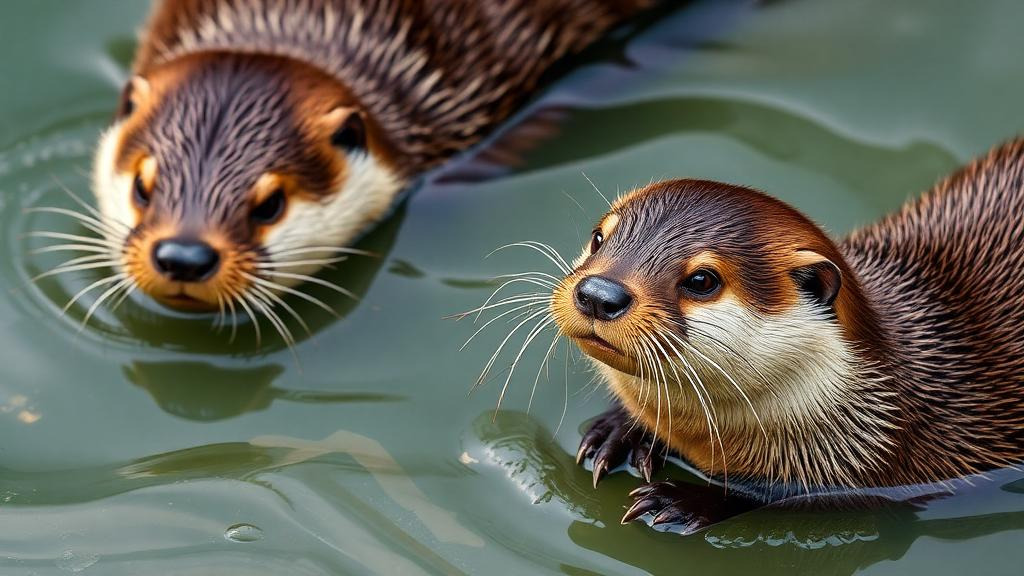
Along a 39-kilometre stretch of the Karnali River in western Nepal, a team of researchers has been reading the messages that smooth-coated otters leave behind. Not literal messages, but spraints: the faecal deposits that these social, group-living mustelids place at communal latrine sites scattered along the riverbanks. Those deposits, it turns out, are far more than waste. They are communication hubs, dietary records and, increasingly, early-warning signals of how one of South Asia’s most threatened river systems is coping with mounting human pressure. A new study published in Ecology and Evolution offers the first systematic look at where these vulnerable predators choose to mark their territory and what they are eating in the lower Karnali, and the results carry a warning about fishing gear that few expected.
The smooth-coated otter (Lutrogale perspicillata) is listed as Vulnerable on the IUCN Red List and as Endangered on Nepal’s National Red List of Mammals. Across its range, which stretches from the lowland rivers of the Indian subcontinent to Southeast Asia, the species has been squeezed by habitat loss, degradation of prey resources, direct persecution and illegal trade. In Nepal, the animal is recorded from the major river systems, including the Karnali, but remains sparsely distributed across the Terai lowlands and poorly documented outside a handful of surveyed stretches. Because otters sit at or near the top of the aquatic food web, changes in their distribution and diet integrate shifts across the entire riverine ecosystem, making them practical sentinels for tracking river health.
The research team, working with approval from Nepal’s Department of National Parks and Wildlife Conservation and Bardiya National Park, surveyed both banks of the lower western branch of the Karnali River below Chisapani Bridge. The stretch cuts through a Terai floodplain mosaic of braided channels, sand bars, riverine forests and grasslands that also support gharial and Gangetic river dolphins. Fieldwork ran from early January to late February 2024, deliberately timed before the monsoon so that floodwaters would not wash away the indirect signs the survey depended on. The river was divided into consecutive one-kilometre segments, and at the midpoint of each segment on both banks, the team established nested sampling plots measuring 100 metres by 10 metres.
The survey covered 70 transects in total. Latrine sites turned up at just 15 plots, roughly 21 percent of those examined, meaning that for every transect with otter evidence, about three had none. In all, the researchers documented 32 latrine sites, some inside the nested plots and others beyond them. The distances of these sites from the active river channel ranged from 13 to 1,021 metres, with a median of 200 metres. A striking pattern emerged when the team correlated spraint counts with distance from the water: the farther a latrine sat from the active channel, the more spraints it contained. The positive correlation, quantified with Spearman’s rank correlation coefficient of 0.531, suggests that otters favour marking sites where deposits are less likely to be erased by daily water-level fluctuations or shoreline wash.
Substrate mattered too. Sandy banks supported the highest and most variable spraint counts, averaging 4.75 per site, compared with means of just 2.00 at stone and mould sites. Statistical testing confirmed that spraint counts were significantly higher on sand than on stone. The finding echoes work from India’s Cauvery River system, where loose sand was a defining feature of otter sites used for grooming and territorial marking. Sand appears to offer a better grooming surface for these semi-aquatic carnivores and improves the persistence and detectability of their marks, a combination that makes sandy banks disproportionately important for otter communication along the Karnali.
To understand what drives latrine placement, the researchers measured a battery of environmental variables at each plot: bank height and slope, river velocity measured with a floating stick, river width recorded with a laser rangefinder, the presence of braided bars and retaining walls, vegetation cover, escape cover distance, proximity to settlements and graded levels of human disturbance. After screening out collinear predictors using variance inflation factors, ten variables entered a generalised linear model with a binomial error structure. Six predictors emerged as statistically significant, and all pointed in the same direction: latrine occurrence declined with increasing distance to escape cover, increasing distance from settlements, increasing river width, faster flow velocity, the presence of islands and the presence of retaining walls.
Model simplification sharpened the picture. From 176 candidate models restricted to a maximum of three predictors, two competitive models survived Akaike’s information criterion corrected for small sample size. Both contained distance to settlement and river width, each carrying the maximum summed Akaike weight of 1.00. The effect sizes were substantial. A one-standard-deviation increase in distance from settlements was associated with roughly 53 percent lower odds of latrine occurrence, while the same increase in river width corresponded to about 92 percent lower odds. In plain terms, otters mark most intensively near human settlements and along narrower, slower sections of the river, where stable marking surfaces and predictable access points between channel and bank are easiest to find.
The proximity-to-settlement result deserves careful reading. It should not be interpreted as a preference for disturbance, the authors caution, but as evidence that otter marking activity overlaps with river sections that experience fishing, foot traffic, livestock use and riverbank modification. That overlap sets the stage for conflict, and the dietary analysis supplied a dramatic confirmation of just how entangled the two species’ fortunes have become. When the researchers dissected 32 spraint samples under a binocular microscope, comparing scales and bones against reference slides prepared from fish caught in cast nets and mounted in permanent slides, fish remains appeared in nearly every sample, 31 of 32, or 96.88 percent. Crab remains appeared in 18.75 percent of samples and bird remains in a single sample, confirming the species’ predominantly piscivorous diet with opportunistic forays beyond fish.
Within the fish component, Labeo dero dominated, appearing in 65.62 percent of spraints, followed by Tor putitora at 31.25 percent. Both are locally important food fishes that communities along the Karnali harvest for subsistence, meaning otters and people are drawing on the same prey base. But the most alarming laboratory finding had nothing to do with prey at all: fishing net material was found wrapped within 15 of the 32 spraints examined. This is direct evidence that otters are regularly interacting with gill nets, most likely while removing or consuming entangled fish. Elsewhere in the species’ range, smooth-coated otters have been reported taking fish directly from nets and damaging gear, fuelling negative perceptions among fishers. Abandoned and lost nets compound the hazard, entangling and injuring wildlife long after they stop catching fish for anyone.
The study arrives at a moment of real conservation opportunity. Rajapur and Tikapur municipalities have jointly declared Nepal’s first Fish Sanctuary, covering 3.9 square kilometres in the very stretch of river the researchers surveyed, a move intended to rebuild prey populations and regulate fishing pressure. The authors argue that practical action should include reducing destructive fishing practices and the safe disposal of damaged nets, implemented through local governments in collaboration with community-based organisations and the river-dependent Tharu and Sonaha communities. Their broader message is that otter conservation cannot be confined to remote, apparently undisturbed river sections, because the animals themselves mark, forage and raise their young in the human-dominated reaches where rivers are most at risk. In the spraints of the Karnali’s otters, scientists have found both a baseline for protecting a Vulnerable species and a blunt record of the pressures bearing down on one of Nepal’s great rivers.
Subject of Research: Latrine site selection and diet of the smooth-coated otter in the Karnali River, Nepal
Article Title: Determinants of Smooth‐coated Otter (Lutrogale perspicillata) Latrine Occurrence and Diet in the Karnali River, Nepal
Article References: Kathariya, R., Sapkota, R. P., Sada, R., Kapali, A., Kathariya, M., & Thapa, K. (2026). Determinants of Smooth‐coated Otter ( Lutrogale perspicillata ) Latrine Occurrence and Diet in the Karnali River, Nepal. Ecology and Evolution, 16(9), Article e74322. https://doi.org/10.1002/ece3.74322
Image Credits: AI Generated
DOI: 10.1002/ece3.74322
Keywords: smooth-coated otter, Lutrogale perspicillata, Karnali River, Nepal, latrine site selection, spraint analysis, diet composition, river conservation, human-wildlife conflict, fishing nets, habitat modelling, freshwater biodiversity
Cite Scienmag News
Margaret Porter. (October 1, 2026). Otters Reveal Hidden River Health Secrets Along Nepal’s Karnali. Scienmag. https://scienmag.com/otters-reveal-hidden-river-health-secrets-along-nepals-karnali/
Margaret Porter. "Otters Reveal Hidden River Health Secrets Along Nepal’s Karnali." Scienmag, 1 October 2026, https://scienmag.com/otters-reveal-hidden-river-health-secrets-along-nepals-karnali/. Accessed 1 October 2026.
Margaret Porter. "Otters Reveal Hidden River Health Secrets Along Nepal’s Karnali." Scienmag. October 1, 2026. https://scienmag.com/otters-reveal-hidden-river-health-secrets-along-nepals-karnali/


