


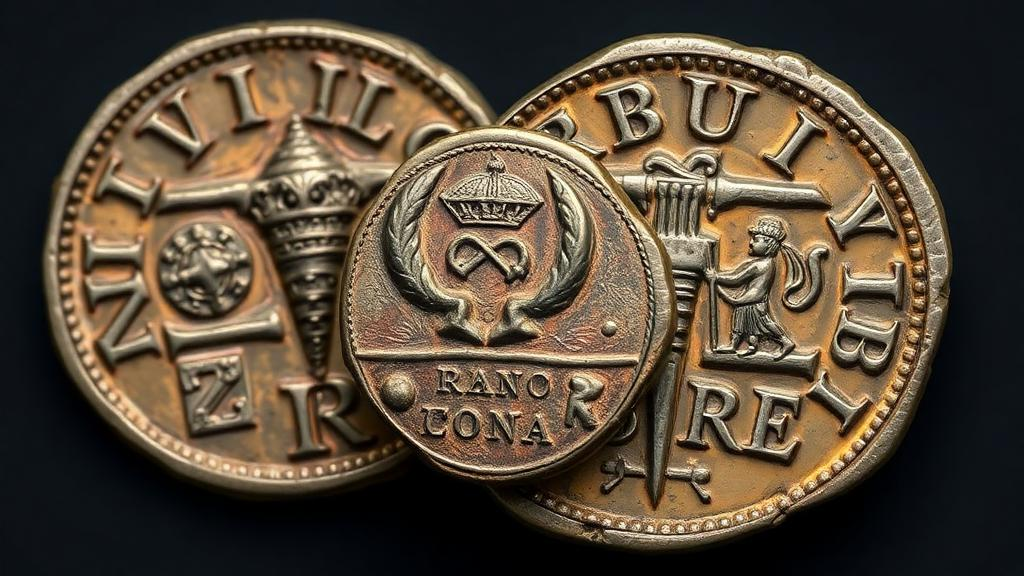
A hoard of twenty Anglo-Saxon coins unearthed beneath a walled garden near the Vatican has provided the first physical evidence of Rome’s medieval English quarter, and it is rewriting what historians thought they knew about how foreigners were treated in the papal city. The coins, nineteen silver pennies and a single rare halfpenny, were minted in England over roughly four decades in the names of Edward the Elder (899–924) and his grandsons Æthelstan (924–39) and Eadred (946–55). Their presence in the soil of Rome, scattered and fused in small clusters after a millennium underground, suggests that English currency circulated openly in a city where documents had long implied only papal coinage was permitted. For researchers Francesca Tinti of the University of the Basque Country and Rory Naismith of the University of Cambridge, who were invited to study and interpret the finds, the discovery confirms that the Schola Saxonum, the so-called Little England by the Tiber, was a thriving, privileged expat community rather than a mere pilgrims’ hostel.
The story of the discovery begins in 2020, when archaeologists started excavating deep beneath the garden of the Palazzo della Rovere, close to St Peter’s Basilica. The site made global headlines in July 2023 with the announcement of the ruins of Emperor Nero’s theatre, but the medieval layers above the Roman remains have now yielded a discovery of equal significance for early medieval history. Alongside the twenty Anglo-Saxon coins, the excavation produced ten coins from the Roman period and from tenth-century Italy, as well as abundant evidence of craftwork involving leather, bone and metal. Fourteen of the Anglo-Saxon pennies were recovered from rubbish pits in two clusters of six to eight coins, now fused together into solid masses by centuries in the ground, while the remaining six were scattered nearby. The area of craft activity alone covered at least 3,000 square metres, roughly half a football pitch, hinting at the scale of the settlement of which it formed part.
Naismith, Professor of Early Medieval English History at Cambridge, is candid about the coins’ modest appearance but emphatic about their significance. More Anglo-Saxon coins from this period have now been found in Rome than papal coins, a fact he describes as bizarre on the surface but deeply revealing underneath: a very large amount of money was flowing into Rome from England at this time. By examining the dies and designs, the researchers were able to trace the coins’ origins to specific English regions, including East Anglia, Kent, London and the West Midlands. The halfpenny stands out as a particularly rare survival for the period, and its importance lies in what it implies about the local economy. Halfpennies were the small change of trading hubs, the kind of denomination that changes hands constantly in markets where everyday goods are bought and sold, not the currency of ceremonial gifts or royal alms.
Before this excavation, knowledge of the English quarter rested almost entirely on written sources. Medieval texts refer to an Anglo-Saxon quarter in this area from the second half of the eighth century, record two ninth-century fires, and describe a church dedicated to the Virgin Mary where the expats worshipped. Tradition even held that Burgred, King of Mercia from 852 to 874, was buried there after being driven from his kingdom by the Vikings. The quarter lay within the Leonine City, the strip of land between the Vatican and the River Tiber that was enclosed by walls following a pirate raid in the 840s. Though still on the periphery of Rome at the time, the area occupied a finger of land pointing directly at St Peter’s and benefited from nearby bridges that made crossing the Tiber convenient. Tinti, a visiting research fellow at Clare Hall, Cambridge, admits that she and her colleagues had spent most of their careers hoping that material remains of the English quarter might one day come to light.
The distribution of the coins is central to the researchers’ argument that they testify to everyday commerce rather than a buried treasure. Because the coins were found individually or in small clusters, scattered through rubbish pits rather than deliberately deposited as a single hoard, they look like money lost by craftspeople and shoppers in the course of daily life. Crucially, the excavation found no evidence of silver bullion being melted down on the site, so the team is confident the coins were not being converted into local currency but were simply being spent. Combined with the leather-working, bone-working and metal-working debris, the picture that emerges is of a bustling district that was far more than a place for pilgrims to rest and pray. Naismith suggests the community probably numbered in the hundreds, living there on a permanent basis, keeping a miniature Anglo-Saxon town running on the banks of the Tiber, complete with craftsmen who might plausibly have arrived from Winchester, London or York to set up shop.
The most provocative implication of the finds is that they challenge a long-held assumption that the papacy forbade the use of foreign currency in Rome. Documents from the city in this period generally refer only to papal coinage, and other texts record foreigners preparing to exchange their travel money before arriving. A ninth-century letter, for example, preserves the anxieties of a Frankish abbot fretting about the need to change currency as he planned a trip to Rome. Yet English coins were evidently changing hands freely in the shadow of St Peter’s, and one of the newly identified coins is itself Papal, suggesting the two currencies circulated side by side. Naismith notes that no other foreign coins from this period appear in the excavations: there are very few from the Frankish world or even from northern Italy. Whatever arrangement allowed the English money to circulate, it seems to have been a very specific privilege granted to the English alone.
Other foreign communities did maintain institutions near St Peter’s, including the Franks, Lombards and Frisians, but the Anglo-Saxons left the most traces behind and appear to have enjoyed special treatment. Tinti emphasises that the English were unique in the effort they made to reach Rome at all, undertaking a genuinely dangerous journey in which many died on the way, only to arrive and find themselves singled out. It was already known that they held the privilege of burying their dead in the area; the coins now suggest they were also permitted to use their own currency. For Anglo-Saxon kings, having their coinage in use so close to the shrine of the Apostle carried significant prestige, while simultaneously demonstrating to subjects back home that their rulers could facilitate pilgrimages and secure spiritual benefits for both king and kingdom.
The special relationship between England and Rome had deep roots. It stretched back to the late sixth century, when Pope Gregory I dispatched a mission to convert the Anglo-Saxons, an act of papal initiative that Naismith says made the English devoted to Rome from that point onward. The ties became increasingly formalised from the late eighth century, when Offa of Mercia (757–96) instituted an annual payment of 365 gold pieces to the papacy to keep the candles burning in Rome’s churches. In the late ninth century, Alfred the Great was sending frequent alms to the city, and in 883, according to Alfred’s biographer Asser, Pope Marinus I freed the Schola Saxonum from every tribute and toll at Alfred’s request. The researchers caution that this exemption does not prove Alfred personally secured the currency arrangement, but it remains a possibility, and it is now certain that his son’s coins were in use in Rome. The tenth century saw the growth of Peter’s Pence, by which every household in England, at least notionally, gave a penny as alms for Rome, and in 1027 King Canute travelled to the city in part to continue negotiating financial benefits for English pilgrims.
The physical legacy of the quarter survives in the modern city in unexpected ways. The embankment road between the Tiber and the Vatican, the Lungotevere in Sassia, takes its name directly from the Schola Saxonum, and the Santo Spirito in Sassia hospital continues the charitable function that the area once provided to Anglo-Saxon visitors. The excavation itself was directed by the Soprintendenza Speciale di Roma under the scientific supervision of Renato Sebastiani and Alessio De Cristofaro, with fieldwork carried out by MDM Archeologia srls and coordinated by Marzia Di Mento, in collaboration with Filippo Salamone, Flavia Botrugno and Laura Stamerra, and a preliminary study of the Anglo-Saxon coins conducted by Cecilia de Leone. The findings, presented in a chapter co-written by Di Mento, Naismith, Pica, Salamone and Tinti, appear in a new Italian-language volume entitled Rome and the Others (300–1000): Foreigners in the City between Conflicts and Integration.
Beyond its technical interest for numismatists and archaeologists, the discovery speaks to a larger truth about the early medieval world. The Anglo-Saxons, often imagined as isolated islanders at the edge of Europe, were in fact firmly embedded in its networks of faith, diplomacy and trade. Tinti observes that the English were particularly keen on consulting the papacy, even when the Popes themselves sometimes struggled to understand what was happening in their far-off island. Naismith puts it more vividly: the bonds with Rome were kept strong for hundreds of years, through thick and thin, and the coins show how deep that relationship went. It was not merely kings dispatching money and forgetting about it, he argues, but people travelling to Rome in large numbers and building a home away from home on the banks of the Tiber, spending their English pennies in the markets of a quarter that the Pope himself appears to have favoured.
Subject of Research: Anglo-Saxon coins and craft evidence from the Schola Saxonum in early medieval Rome
Article Title: Anglo-Saxon expats got special treatment in Rome’s “Little England”, coin discovery reveals
Article References: Anglo-Saxon expats got special treatment in Rome’s “Little England”, coin discovery reveals. (n.d.). Original publication
Image Credits: AI Generated
DOI: Not provided
Keywords: Anglo-Saxon, Schola Saxonum, Rome, medieval coins, papacy, numismatics, pilgrimage, Edward the Elder, Alfred the Great, Leonine City, craft and trade, Vatican excavation
Cite Scienmag News
Courtney Benton. (October 1, 2026). Anglo-Saxon Coins Found in Rome Reveal Privileged Medieval English Quarter. Scienmag. https://scienmag.com/anglo-saxon-coins-found-in-rome-reveal-privileged-medieval-english-quarter/
Courtney Benton. "Anglo-Saxon Coins Found in Rome Reveal Privileged Medieval English Quarter." Scienmag, 1 October 2026, https://scienmag.com/anglo-saxon-coins-found-in-rome-reveal-privileged-medieval-english-quarter/. Accessed 1 October 2026.
Courtney Benton. "Anglo-Saxon Coins Found in Rome Reveal Privileged Medieval English Quarter." Scienmag. October 1, 2026. https://scienmag.com/anglo-saxon-coins-found-in-rome-reveal-privileged-medieval-english-quarter/


