


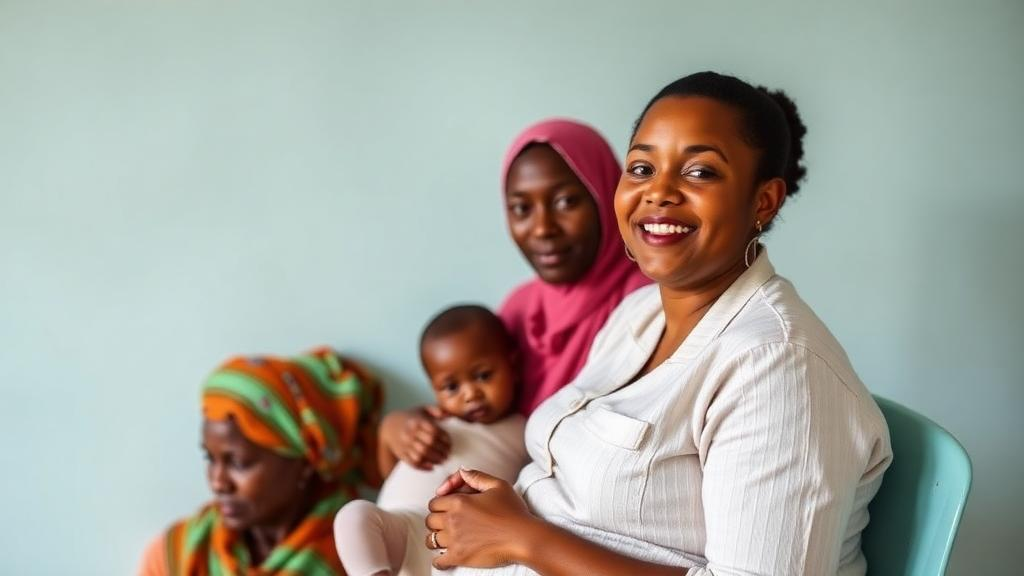
Getting pregnant women through the clinic door is only half the battle. A new analysis of a large group antenatal care program in rural Tanzania reveals that even when nearly every expectant mother attends her recommended visits, the actual care she receives can differ dramatically depending on which health facility she walks into. The study, published in BMC Health Services Research, examined routine implementation data from the Mlinde Mama Project in Geita Region and found that while attendance metrics looked uniformly excellent across six public facilities, the delivery of essential preventive and diagnostic interventions varied so widely that two women with identical needs could receive strikingly different standards of care based on geography alone.
The research team, led by Augustino Hellar of Prime Health Initiative Tanzania together with collaborators from the Tanzanian Ministry of Health, Jhpiego, and regional authorities, took advantage of an unusual opportunity: a complete census of antenatal care delivery rather than a sample. Between January 2023 and August 2024, all 5,936 pregnant women who enrolled in group antenatal care, often abbreviated G-ANC, across six public health facilities in Geita Region were included in the analysis. These facilities spanned the typical tiers of the Tanzanian health system, comprising two dispensaries, two health centers, and two district hospitals. The women were organized into 149 group cohorts, a model in which small groups of expectant mothers attend antenatal sessions together, combining clinical assessment with peer learning and discussion.
Group antenatal care has attracted growing interest across low- and middle-income countries because it promises to improve both the experience and the quality of care. Instead of the traditional one-on-one consultation, women in a G-ANC cohort meet repeatedly with the same facilitators and peers, which proponents argue increases satisfaction, knowledge retention, and retention in care. Tanzania’s Mlinde Mama Project embedded this model into routine government services rather than running it as a standalone research intervention, which is precisely what makes the new findings valuable. When a model moves from a carefully resourced pilot into the everyday machinery of a health system, its performance becomes a test of the system itself.
The headline numbers from the analysis were genuinely encouraging. Coverage of four or more antenatal care visits ranged from 90.2 to 95.0 percent across the six facilities, facility-based delivery ranged from 94.1 to 97.7 percent, and malaria testing reached 91.5 to 95.5 percent of enrolled women. Blood pressure monitoring was recorded for every single participant at every facility, a perfect 100 percent. These figures suggest that the group care model, when integrated into routine services, can achieve and sustain very high levels of service utilization, confirming that the attendance half of the maternal health equation is being solved at these sites.
But the picture changed sharply when the researchers looked beyond utilization to what clinicians actually delivered during those visits. Coverage of three or more doses of intermittent preventive treatment for malaria in pregnancy, the standard sulfadoxine-pyrimethamine regimen known as IPTp3+, ranged from 60.1 percent at the lowest-performing facility to 86.3 percent at the best, a gap of more than 26 percentage points for an intervention that protects both mother and fetus from a potentially devastating infection. Iron and folate supplementation, a cornerstone of prenatal nutrition, ranged from 75.0 to 92.7 percent. Most striking were the diagnostic services: HIV and syphilis testing coverage spanned from 59.9 to 95.0 percent, and urine testing, which screens for conditions such as pre-eclampsia risk and urinary tract infections, ranged from a troubling 30.1 percent to 62.7 percent. In other words, at one facility fewer than one in three women received a urine test that guidelines recommend for all.
To synthesize these differences, the team calculated a composite facility performance score as the mean coverage across nine selected indicators. The scores ranged from 80.1 to 91.9 percent, with Bwanga Health Center ranking highest and Butengorumasa Dispensary lowest. Health centers demonstrated the strongest overall performance across most indicators, outperforming both the smaller dispensaries and, in several respects, the district hospitals. Statistical testing using Pearson’s chi-square confirmed that the variation in coverage of the nine composite indicators across facilities was significant, with p-values below 0.05, meaning the differences were unlikely to be products of chance.
The pattern of variation carries important technical implications for how maternal health programs are monitored. Attendance-based metrics, such as the proportion of women completing four antenatal visits, are the traditional currency of maternal health surveillance because they are easy to measure and track. Yet the Geita data demonstrate that these metrics can mask profound differences in effective coverage, the proportion of the population actually receiving the interventions they need. A woman can attend every scheduled session and still leave without syphilis screening, without her full course of malaria prophylaxis, or without anemia assessment. Effective coverage, a concept increasingly emphasized by global health measurement initiatives, requires looking at what happens inside the consultation, not merely whether the consultation occurred.
Why would facilities within the same region, operating under the same national guidelines and implementing the same group care model, diverge so widely? The study did not formally test explanatory mechanisms, but the structure of the findings offers clues. Interventions requiring reliable supply chains, such as sulfadoxine-pyrimethamine for malaria prophylaxis and rapid diagnostic tests for HIV and syphilis, showed the largest gaps, while interventions depending only on clinical skill and a blood pressure cuff achieved universal coverage. This suggests that stock-outs, laboratory capacity, and equipment availability, rather than staff knowledge or patient demand, may drive much of the variation. Facility tier also mattered, with health centers occupying a sweet spot of sufficient resources without the patient volumes and staffing pressures that may strain larger district hospitals.
The authors argue that their findings support a shift in how antenatal programs are managed: facility-level performance monitoring should track the content of care alongside attendance, supported by supportive supervision and continuous quality improvement cycles. Because the analysis drew on routinely collected implementation data rather than a bespoke research dataset, the approach is inherently scalable; health managers could, in principle, reproduce these composite scorecards using existing health management information systems. The study also carries a caution about interpretation, since it reflects a single region and a program supported by external funding from the Gates Foundation, and the authors note that the published version is an early-release article subject to further editorial refinement.
For the global maternal health community, the message from Geita is both sobering and actionable. Tanzania has made substantial progress in getting pregnant women into contact with the health system, and the near-universal blood pressure monitoring and delivery coverage documented here show that the system can perform at scale. The unfinished agenda is consistency: ensuring that the woman at the lowest-performing dispensary receives the same malaria prophylaxis, the same syphilis test, and the same urine screening as the woman at the best-performing health center. Closing that gap does not require new medical discoveries, only the disciplined application of measurement, supervision, and supply chain management to interventions that are already proven, affordable, and sitting on national guidelines waiting to be delivered.
Subject of Research: Facility-level variation in the delivery of essential antenatal care interventions during routine group antenatal care implementation in Tanzania
Article Title: Beyond attendance: facility-level variations in the delivery of essential antenatal care interventions during routine group antenatal care implementation in Tanzania: a secondary analysis
Article References: Beyond attendance: facility-level variations in the delivery of essential antenatal care interventions during routine group antenatal care implementation in Tanzania: a secondary analysis. (n.d.). https://doi.org/10.1186/s12913-026-15769-4
Image Credits: AI Generated
DOI: 10.1186/s12913-026-15769-4
Keywords: antenatal care, group antenatal care, Tanzania, maternal health, effective coverage, health facility performance, quality of care, malaria in pregnancy, IPTp, health services research, implementation science, Geita Region
Cite Scienmag News
Ophelia Keating. (September 30, 2026). High Attendance Isn’t Enough: Tanzanian Clinics Vary Sharply in the Antenatal Care Women Actually Receive. Scienmag. https://scienmag.com/high-attendance-isnt-enough-tanzanian-clinics-vary-sharply-in-the-antenatal-care-women-actually-receive/
Ophelia Keating. "High Attendance Isn’t Enough: Tanzanian Clinics Vary Sharply in the Antenatal Care Women Actually Receive." Scienmag, 30 September 2026, https://scienmag.com/high-attendance-isnt-enough-tanzanian-clinics-vary-sharply-in-the-antenatal-care-women-actually-receive/. Accessed 30 September 2026.
Ophelia Keating. "High Attendance Isn’t Enough: Tanzanian Clinics Vary Sharply in the Antenatal Care Women Actually Receive." Scienmag. September 30, 2026. https://scienmag.com/high-attendance-isnt-enough-tanzanian-clinics-vary-sharply-in-the-antenatal-care-women-actually-receive/


