


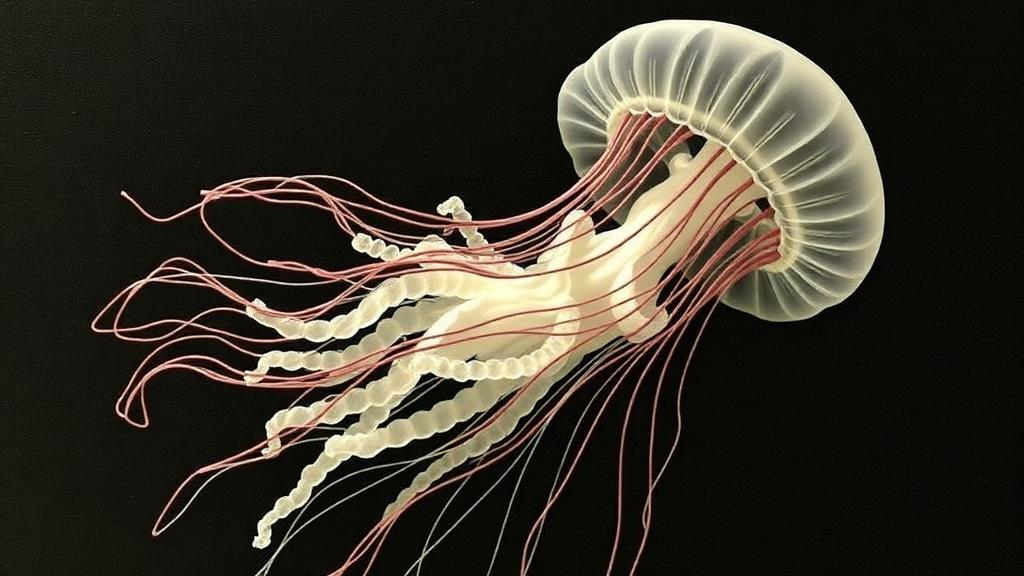
For more than a century, the dazzling illustrations of Ernst Haeckel have divided opinion in the scientific world. His plates of radiolarians and medusae, reproduced endlessly in books and posters, have been celebrated as artistic masterpieces and condemned as embellished fabrications. Critics have long claimed that Haeckel invented species, lost his type specimens, or drew creatures that never existed. Now a new study published in The Science of Nature has delivered the most direct rebuttal yet, using the physical remains of a deep-sea jellyfish collected by the HMS Challenger expedition to show that Haeckel’s illustrations rested on meticulous, empirically grounded histological analysis.
The study, conducted by Bernhard L. Bock of the Institute for Zoology and Evolutionary Research at Friedrich Schiller University Jena, centers on Atolla wyvillei, a scarlet, bioluminescent deep-sea medusa first described by Haeckel in 1880 and named in honor of Sir Charles Wyville Thomson, the chief scientist of the Challenger expedition. Housed at the Phyletisches Museum Jena, the surviving type specimen has now been reexamined and documented with high-resolution imaging for the first time. More remarkably, the research reveals a previously unknown series of 29 microscope slide sections of a second syntype, discovered in the holdings of the Ernst-Haeckel-Haus in Jena, that directly connects Haeckel’s published plates to laboratory work performed on the original specimens.
The story begins with the Challenger expedition itself, the first scientific voyage to explore the deep sea on a global scale. Between 1872 and 1876, a crew of nearly 250 sailors, engineers, and officers, accompanied by a small scientific team, visited more than 500 stations across nearly 80,000 miles of ocean. They measured depths and temperatures, collected water samples, and dredged the seafloor, ultimately gathering more than 100,000 samples and specimens. The expedition permanently disproved Edward Forbes’s azoic hypothesis, which had held that no life could exist below 300 fathoms, and revealed an immense diversity of deep-sea organisms. It also discovered the Mariana Trench and the Challenger Deep, the deepest known point of the seabed, and even compiled the world’s oldest collection of micrometeorites using magnets to sample dredged sediments.
The expedition’s scientific output was staggering: a 50-volume report totaling nearly 30,000 pages, published between 1885 and 1895 by more than 75 contributing authors, describing around 4,700 new species. A set of these samples was sent to Jena, where Haeckel, already a leading authority in marine zoology, produced extensive illustrated monographs on radiolarians and deep-sea medusae. In total, Haeckel contributed 2,790 pages and 230 plates, nearly 10 percent of the entire publication. His plates, drawn largely with the camera lucida by himself and his lithographer Adolf Giltsch, remain among the most recognizable images of the entire expedition, and many were later adapted for his famous Kunstformen der Natur, a work that influenced artists from Kandinsky to Klimt and Munch.
Yet Haeckel’s methods attracted fierce criticism during his lifetime and afterward. Detractors argued that he fabricated non-existent taxa, lost primary type material, or produced illustrations useless for science. Much of the controversy has focused on his embryological drawings, but the charges bled into assessments of his entire body of work. The new study addresses these critiques head-on by physically reevaluating the type material of A. wyvillei. The surviving syntype, preserved in 70 percent ethanol, has shrunk to 40 millimeters in diameter, a reduction of 20 to 41 percent from the measurements Haeckel recorded for the Station 157 specimens, leaving it structurally resembling, as the author notes, a potato chip. Shrinkage artifacts are visible in the tentacles, lobes, umbrella, and gonads.
The decisive discovery came in 2025, when a small box containing microscope slide sections labeled in Haeckel’s handwriting as Atolla Wyvillei Discomedusae was found in the Ernst-Haeckel-Haus. The 29 slides, embedded in Canada balsam and bearing handwritten annotations describing each anatomical cut, were in poor condition, with cracked mounting medium, loose coverslips, and fragmented specimens. After careful restoration, the slides were examined and matched against Haeckel’s published descriptions. The orientations he noted for Plate 29 of the Challenger report, including radial, horizontal, and tangential sections, correspond precisely with the inscriptions on the slide cardboard, confirming that these slides represent at least one of the original individuals Haeckel examined and cementing their status as part of the syntype series.
This physical evidence demonstrates that several of Haeckel’s published observations could only have been made under a microscope, using histological sections to view the ovaries, distinct tissue layers such as epidermis, mesoglea, and muscle fibers, and the tiny sensory structures called rhopalia. Haeckel credited his preparator Reinhold Teuscher with making the sections, and his own remarks reveal the difficulty of the work: he succeeded only with considerable trouble in determining the rhopalia’s existence, and their anatomical nature could not be resolved because of their small size and the poor preservation of the umbrella margin. The number of rhopalar pedalia in the preserved type, 22, matches what the slides would be expected to show, though the historical cuts failed to intersect the sense clubs precisely.
The study also situates Haeckel’s illustrations within the broader visual culture of nineteenth-century marine biology. Comparing his plates with those of contemporaries such as Alfred Goldsborough Mayer, whose Medusae of the World relied heavily on simplified line drawings that highlighted only key diagnostic features, reveals a fundamental methodological difference. Haeckel’s plates overflow with detail and lettering, choreographed almost like a Baroque high altar, in a tradition of scientific realism aimed at enabling systematic comparison of sets of objects. His compositions move logically from whole-specimen overviews to cutaway views and magnified anatomical details, using stippling and hatching to convey three-dimensional structure. Drawing, the study argues, is fundamentally an exercise in abstraction, and Haeckel’s approach fully conformed to the scientific standards of his era, at a time when photography was expensive, logistically difficult for gelatinous specimens, and not yet widespread in natural science.
The author acknowledges the limits of the reevaluation. More than 150 years of storage have degraded the material, only one complete specimen of the former type-series survives, precluding new histological preparations, and the precise details of Haeckel’s preparation workflow remain unrecorded. The exact influence of Giltsch on the final plates also remains unquantified. Cautious extrapolation is therefore required when evaluating Haeckel’s broader output, and the study does not erase the legitimate debates surrounding his embryological figures. But for A. wyvillei, the verdict is clear: the species can be readily identified and distinguished from other members of the genus based on Haeckel’s work, and his illustrations were grounded in real morphological and histological examination rather than invention.
The broader implications reach into modern biodiversity science. The Challenger samples remain an indispensable historical collection, and historical baseline data from the expedition are now critical to understanding how modern ocean acidification is affecting marine ecosystems. The discovery underscores the hidden value of smaller institutional archives such as the Phyletisches Museum Jena, whose unexamined holdings may contain further unrecognized type specimens. An illustrated catalogue of the museum’s type collection is planned to give researchers broader access. As the study concludes, identifying and systematically reevaluating missing type material can resolve persistent systematic questions and recover invaluable cultural assets, ensuring that the legacy of the Challenger expedition, and of the controversial genius who illustrated it, continues to inform ocean science today.
Subject of Research: Historical reexamination of Ernst Haeckel's type specimens and illustrations of the deep-sea jellyfish Atolla wyvillei from the HMS Challenger expedition
Article Title: Portrayal of the deep sea: Haeckel’s Atolla wyvillei, the challenger expedition, and the boundaries of science and illustration
Article References: Bock, B. L. (2026). Portrayal of the deep sea: Haeckel’s Atolla wyvillei, the challenger expedition, and the boundaries of science and illustration. The Science of Nature, 113(5), Article 109. https://doi.org/10.1007/s00114-026-02154-8
Image Credits: AI Generated
DOI: 10.1007/s00114-026-02154-8
Keywords: Ernst Haeckel, Atolla wyvillei, HMS Challenger expedition, deep-sea jellyfish, scientific illustration, type specimens, histology, marine biology, history of science, taxonomia, museum collections, Coronatae
Cite Scienmag News
Drew Townsend. (September 30, 2026). Haeckel’s Deep-Sea Jellyfish Vindicated: New Evidence Shows His Famous Plates Were Grounded in Real Science. Scienmag. https://scienmag.com/haeckels-deep-sea-jellyfish-vindicated-new-evidence-shows-his-famous-plates-were-grounded-in-real-science/
Drew Townsend. "Haeckel’s Deep-Sea Jellyfish Vindicated: New Evidence Shows His Famous Plates Were Grounded in Real Science." Scienmag, 30 September 2026, https://scienmag.com/haeckels-deep-sea-jellyfish-vindicated-new-evidence-shows-his-famous-plates-were-grounded-in-real-science/. Accessed 30 September 2026.
Drew Townsend. "Haeckel’s Deep-Sea Jellyfish Vindicated: New Evidence Shows His Famous Plates Were Grounded in Real Science." Scienmag. September 30, 2026. https://scienmag.com/haeckels-deep-sea-jellyfish-vindicated-new-evidence-shows-his-famous-plates-were-grounded-in-real-science/


