


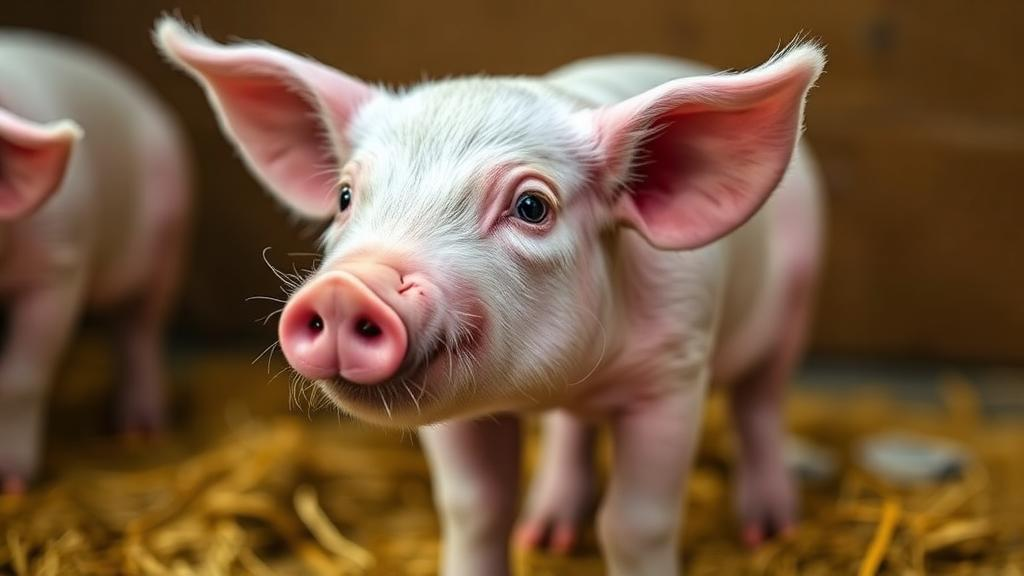
Chinese researchers have pieced together the first chromosome-level reference genome of the Pudong White Pig, the only indigenous pig breed in China with a completely white coat and a breed officially listed as endangered. The achievement, published in BMC Genomics, gives scientists and breeders a high-quality genetic blueprint for a rare animal whose population has dwindled to precarious levels, and it opens a new window on the genomic diversity that Chinese native pigs carry but that global reference genomes have largely missed.
The team, led by Jun Gao and Lingwei Sun of the Institute of Animal Science and Veterinary Medicine at the Shanghai Academy of Agricultural Sciences, with corresponding authors Caifeng Wu and Jianjun Dai, built the assembly from scratch using PacBio third-generation long-read sequencing combined with Hi-C technology. Long reads capture stretches of DNA far longer than older short-read methods, which is essential for resolving repetitive regions, structural variants, and other difficult stretches of the genome. Hi-C then provides the crucial scaffolding step: by chemically fixing chromosomes inside the cell nucleus and sequencing the physically adjacent DNA fragments, Hi-C data reveal which sequences belong to the same chromosome and how they are ordered, allowing the contigs to be anchored into complete chromosome-scale assemblies.
After a de-redundancy step to remove duplicated sequences, the assembled Pudong White Pig genome totaled approximately 2.68 gigabases, in line with the expected size of the pig genome. The quality metrics that matter most to genome builders told a favorable story: the new assembly showed higher sequence integrity and fewer genomic gaps than Sscrofa11.1, the Duroc-derived reference genome that is currently the most widely used standard in pig genomics. That comparison is significant because reference genomes shape nearly every downstream analysis, from mapping reads in association studies to calling variants; gaps and missing segments in a reference can hide biologically important variation, particularly for breeds that diverged from the reference animal’s lineage long ago.
A reference genome for a single breed, however, only tells part of the story. To capture the fuller spectrum of pig genetic diversity, the researchers constructed a pan-genome from 30 domestic and international pig breeds. A pan-genome represents the union of all genomic content across a set of individuals, distinguishing the core sequences shared by all breeds from the accessory sequences present in only some. In this analysis, the team identified a total of 135,859 non-reference sequences, or NRSs, stretches of DNA that simply do not exist in the standard reference genome. These absent sequences can include functional genes, regulatory elements, and structural variants that influence traits ranging from disease resistance to reproduction, which is precisely why they are invisible to studies that rely on a single reference.
Stringent quality control filtering validated 65,193 of those non-reference sequences, with a combined length of 108.33 megabases, roughly 4 percent of the pig genome’s total size. That is a substantial amount of genetic material that the standard reference fails to capture. Within this validated set, the researchers identified 594 non-reference sequences specific to Shanghai’s indigenous pig breeds, found across the four Shanghai native pig populations included in the pan-genome analysis. These breed-specific insertions represent a molecular signature of local genetic heritage, shaped by centuries of adaptation to the climate, feeding practices, and selection pressures of the Yangtze River delta region.
Some of these sequences land in scientifically intriguing places. One insertion site, specific to Shanghai indigenous pigs, sits at the BMPR1B gene, which is linked to reproductive performance in Taihu lake pigs, a famous group of Chinese native breeds renowned for their exceptional fecundity. The presence of a breed-specific insertion at a locus associated with such an economically vital trait suggests that local breeds may harbor unique regulatory or coding variation affecting litter size, variation that commercial reference genomes cannot reveal. For breeders working to conserve and improve native stocks, pinpointing such loci is a first step toward understanding and potentially exploiting the genetic basis of traits that make indigenous pigs valuable.
The analysis also revealed a striking pattern in the distribution of non-reference sequences: a hotspot region concentrated in the central portion of chromosome X, spanning roughly the 59 to 89 megabase interval. Hotspots of this kind can indicate regions of unusual structural dynamism, perhaps shaped by selection, recombination patterns, or the history of the X chromosome in domestication. Because the X chromosome plays a distinctive role in inheritance and can carry loci affecting fertility and other traits, a concentrated reservoir of reference-missing sequence there is a finding that will likely prompt closer examination in future studies of pig genetics and breeding.
Beyond the pan-genome work, the assembly allowed the team to confirm a previously reported splice mutation at position 41,486,012 on chromosome 8 of the Sscrofa11.1 reference genome. This locus is central to the genetics of coat color: at this site, both the Pudong White Pig and the Shanghai White breed carry the same dominant white genotype characteristics seen in the Landrace and Yorkshire breeds, the two dominant commercial white pig lines worldwide. The confirmation ties the Pudong White Pig’s defining visual trait to a known molecular mechanism and demonstrates that the new assembly can be used to validate and contextualize variants originally discovered on the older reference, an important cross-check for the genomics community.
The broader significance of the work lies in what it provides for conservation and breeding. The Pudong White Pig is endangered, and endangered livestock breeds face a double risk: the loss of the animals themselves and the loss of the genetic adaptations they carry, adaptations that may prove valuable as agriculture confronts disease pressure, climate change, and shifting market demands. A chromosome-level reference genome is a permanent, digital record of that heritage. It enables accurate genotyping of remaining herds, supports marker-assisted selection and genomic selection programs aimed at rebuilding population numbers without losing genetic diversity, and allows researchers to detect inbreeding and manage breeding pairs to maximize retained variation.
The study also adds to a growing recognition that global livestock genomics needs more than one reference per species. As this work shows, a single Duroc-based reference leaves out more than 100 megabases of real, validated sequence found across just 30 breeds, including hundreds of sequences unique to Shanghai’s native pigs. The Pudong White Pig assembly, funded by China’s National Key R&D Program and the Shanghai Agricultural Science and Technology Innovation Project, and conducted with ethics approval from the Shanghai Academy of Agricultural Sciences, offers a template for similar efforts: combine long reads with Hi-C, anchor every chromosome, then embed the result in a multi-breed pan-genome to reveal what single references miss. For a white-coated survivor of Shanghai’s agricultural landscape, the new genome is both a scientific milestone and a lifeline.
Subject of Research: Chromosome-level de novo genome assembly and pan-genome analysis of the endangered Shanghai Pudong White Pig
Article Title: Chromosome-level genome assembly of the Shanghai Pudong White Pig (Sus scrofa domesticus)
Article References: Gao, J., Sun, L., Cao, M., Tu, W., Zhang, H., Zhang, S., Xu, J., He, M., Zhang, D., Wu, C., & Dai, J. (2026). Chromosome-level genome assembly of the Shanghai Pudong White Pig (Sus scrofa domesticus). BMC Genomics. https://doi.org/10.1186/s12864-026-13407-1
Image Credits: AI Generated
DOI: 10.1186/s12864-026-13407-1
Keywords: Pudong White Pig, genome assembly, PacBio sequencing, Hi-C, pan-genome, non-reference sequences, Sus scrofa domesticus, endangered livestock breed, BMPR1B, dominant white coat color, chromosome X, BMC Genomics
Cite Scienmag News
Juliet Wilcox. (September 30, 2026). Endangered White Pig From Shanghai Gets a Complete Chromosome-Level Genome. Scienmag. https://scienmag.com/endangered-white-pig-from-shanghai-gets-a-complete-chromosome-level-genome/
Juliet Wilcox. "Endangered White Pig From Shanghai Gets a Complete Chromosome-Level Genome." Scienmag, 30 September 2026, https://scienmag.com/endangered-white-pig-from-shanghai-gets-a-complete-chromosome-level-genome/. Accessed 30 September 2026.
Juliet Wilcox. "Endangered White Pig From Shanghai Gets a Complete Chromosome-Level Genome." Scienmag. September 30, 2026. https://scienmag.com/endangered-white-pig-from-shanghai-gets-a-complete-chromosome-level-genome/


