


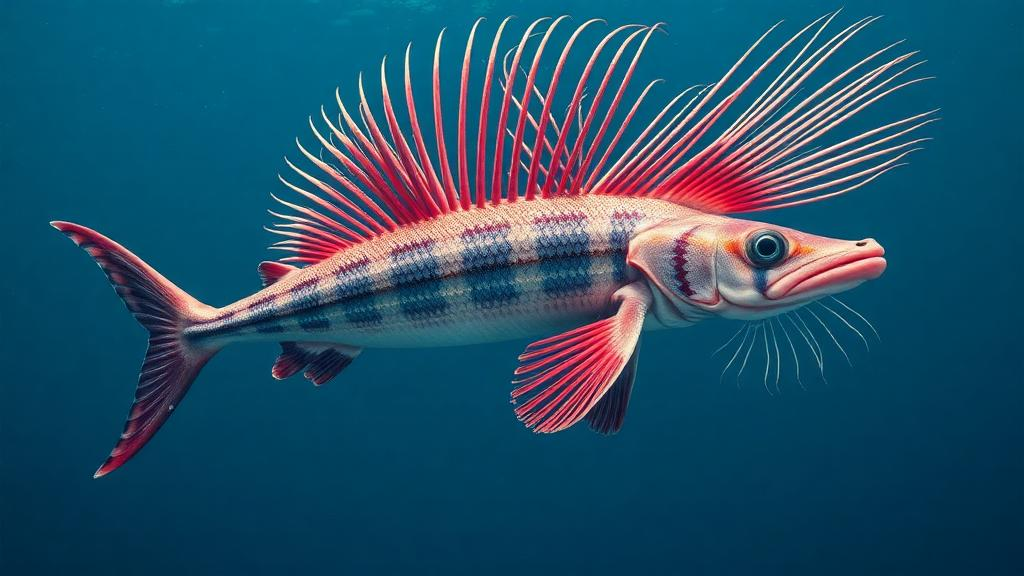
Few fish are as shrouded in mystery as the oarfish, the ribbon-shaped giant of the deep ocean that has washed ashore for centuries and fueled legends of sea serpents. Now researchers at Cornell University have worked out, for the first time, the anatomy behind the animal’s most distinctive behavior: a style of swimming in which the body stays remarkably still while a long dorsal fin does nearly all of the work. The study, published in the journal Ichthyology and Herpetology, describes a muscular and skeletal system that allows each of the oarfish’s hundreds of dorsal fin rays to rotate independently through a full circle, moving something like a joystick at the base of every ray. That arrangement, the authors report, is what generates the traveling waves along the fin membrane that quietly propel one of the ocean’s largest and least-seen bony fishes.
Oarfish are enormous, reaching lengths that can exceed several meters, and they are rarely encountered alive by humans. Their bodies are long and laterally compressed, and running along the top of the body is a continuous dorsal fin supported by hundreds of bone-like fin rays connected by a thin, webbed membrane. When the fish swims in its characteristic mode, these rays move in coordinated, wave-like patterns, rippling the membrane and pushing water in a way that drives the animal forward or backward. Because the propulsion comes from the fin rather than from side-to-side bending of the trunk, the oarfish can travel without the large body undulations that most elongated fishes depend on, a capability with important consequences for how it hunts and avoids detection in the open water column.
Part of the reason the fin rays have remained so poorly understood is the fragility of the animals themselves. When oarfish die, their long bodies tend to break into segments, and intact specimens suitable for detailed anatomical work are exceptionally rare. That scarcity has left scientists with a limited picture of how the fish’s unusual propulsion actually works at the tissue level. The Cornell team overcame this obstacle by combining several lines of evidence: careful dissections, histological sectioning of tissues, x-rays of a specimen held at the Smithsonian Institution, computed tomography scans made at Cornell, and frame-by-frame analyses of movies showing the dorsal fin rays in motion. Together, these methods allowed the researchers to reconstruct the anatomy of a structure that few laboratories have ever been able to examine in depth.
What the dissections and scans revealed is an architecture unlike anything described before in such detail. Each fin ray is attached at its top to the thin fin membrane. Below, at the base of the ray, the anatomy becomes more elaborate: the ray connects to cartilage, to a series of muscles, and to a ball-and-socket joint. It is this joint that grants each ray its remarkable freedom of movement, allowing it to swivel through a complete rotation rather than merely swinging back and forth in a single plane. In effect, every one of the hundreds of rays is a small, individually controlled actuator, and the fin as a whole functions as a dense array of independently steerable oars, which is fitting for a fish named for the implement it so closely resembles in action.
The coordinated motion of these rays is what turns the fin into an engine. By rotating in sequence, the rays create waves that travel along the connecting membrane, and those waves push against the water to generate thrust. The system is not limited to a single direction of travel. A section of the membrane can wave toward the posterior of the animal while another section simultaneously waves toward the anterior, allowing the oarfish to fine-tune its propulsion with a subtlety that conventional body-driven swimming cannot match. This means the fish can generate forward and backward thrust, and modulate each along different parts of the fin, all without moving its trunk laterally.
Willy Bemis, a retired Cornell University ichthyologist and one of the study’s authors, placed the finding in the context of how long-bodied fishes normally move. Most fishes with elongated bodies swim like eels, he explained, propelling themselves through a series of undulations that press water back and forth. Oarfish can do that as well, but they also do something remarkable: they use the dorsal fin to propel themselves without moving their bodies laterally. According to Bemis, the animals are continuously able to change the pattern of the dorsal fin rays and to do so very quickly, and the fin rays are, in his words, incredibly mobile. That combination of speed and flexibility in reconfiguring the wave patterns gives the oarfish a level of locomotor control that sets it apart from nearly every other fish of comparable size.
The biological payoff of this system appears to be stealth. Because the fin-driven mode of swimming does not require vigorous bending of the whole body, the oarfish can move through the water while presenting a much quieter profile than an eel-like swimmer of the same dimensions. The researchers note that this lets the animal silently stalk prey without having to swim hard to propel its entire body. For a large predator living in the open ocean, where there is little cover and where prey may be alert to disturbances, the ability to approach slowly and quietly using only a rippling fin could be a decisive advantage. It may also help explain why oarfish are so seldom seen making sudden, conspicuous movements when encountered by divers or remotely operated vehicles.
The research did not begin as a purely zoological inquiry. Rob Shepherd, a roboticist at Cornell, became interested in the oarfish’s unusual locomotion while working on a project to design a large yet quiet swimming robot, supported by a grant from the Office of Naval Research. The machine he envisioned would serve as an ocean monitoring platform, housing a range of instrumentation, and would need to swim silently forward and backward to monitor ocean health without scaring off fish and other aquatic creatures. The Navy shared an interest in such a platform. Recognizing that the oarfish had already solved, through millions of years of evolution, the problem of large-scale, low-disturbance propulsion, Shepherd consulted Bemis, and the collaboration that followed produced the anatomical study now published.
The intersection of the two disciplines is part of what makes the work notable. Engineers building bioinspired underwater vehicles have long drawn on the swimming of fishes, but most designs have focused on body undulation or on the motion of tail fins and pectoral fins. The oarfish offers a different template: a long, continuous fin along the back, driven by hundreds of independently rotating rays, capable of producing waves in either direction along its length. Translating that arrangement into a robotic actuator array could yield vehicles that maneuver precisely at low speed, hold position, and travel in reverse, all while generating minimal hydrodynamic noise. For an ocean monitoring platform meant to observe marine life rather than disturb it, those are exactly the properties a designer would want.
For now, the study stands as the first full anatomical description of the system that makes the oarfish’s swimming possible, documenting the chain from fin membrane to cartilage, muscle, and ball-and-socket joint that gives each ray its joystick-like rotation. It also underscores how much remains to be learned about large deep-sea animals simply because intact specimens are so hard to obtain. The oarfish, an animal that has haunted maritime folklore for centuries, turns out to carry in its dorsal fin a propulsion mechanism of remarkable sophistication, one that a team of anatomists and roboticists has only now begun to describe, and one that may soon ripple outward from ichthyology into the design of the next generation of quiet underwater machines.
Subject of Research: The anatomy and mechanics of oarfish dorsal fin ray rotation and its role in fin-driven swimming and bioinspired underwater robotics
Article Title: Researchers uncover the mechanics behind the oarfish's unusual swimming style
Article References: Researchers uncover the mechanics behind the oarfish's unusual swimming style. (n.d.). Original publication
Image Credits: AI Generated
DOI: Not provided
Keywords: oarfish, fin rays, dorsal fin, swimming mechanics, Cornell University, Ichthyology and Herpetology, ball-and-socket joint, bioinspired robotics, underwater robot, deep-sea fish, locomotion, marine science
Cite Scienmag News
Violet Maxwell. (September 30, 2026). Oarfish anatomy revealed: joystick-like fin rays power the giant fish’s strange swimming. Scienmag. https://scienmag.com/oarfish-anatomy-revealed-joystick-like-fin-rays-power-the-giant-fishs-strange-swimming/
Violet Maxwell. "Oarfish anatomy revealed: joystick-like fin rays power the giant fish’s strange swimming." Scienmag, 30 September 2026, https://scienmag.com/oarfish-anatomy-revealed-joystick-like-fin-rays-power-the-giant-fishs-strange-swimming/. Accessed 30 September 2026.
Violet Maxwell. "Oarfish anatomy revealed: joystick-like fin rays power the giant fish’s strange swimming." Scienmag. September 30, 2026. https://scienmag.com/oarfish-anatomy-revealed-joystick-like-fin-rays-power-the-giant-fishs-strange-swimming/


