


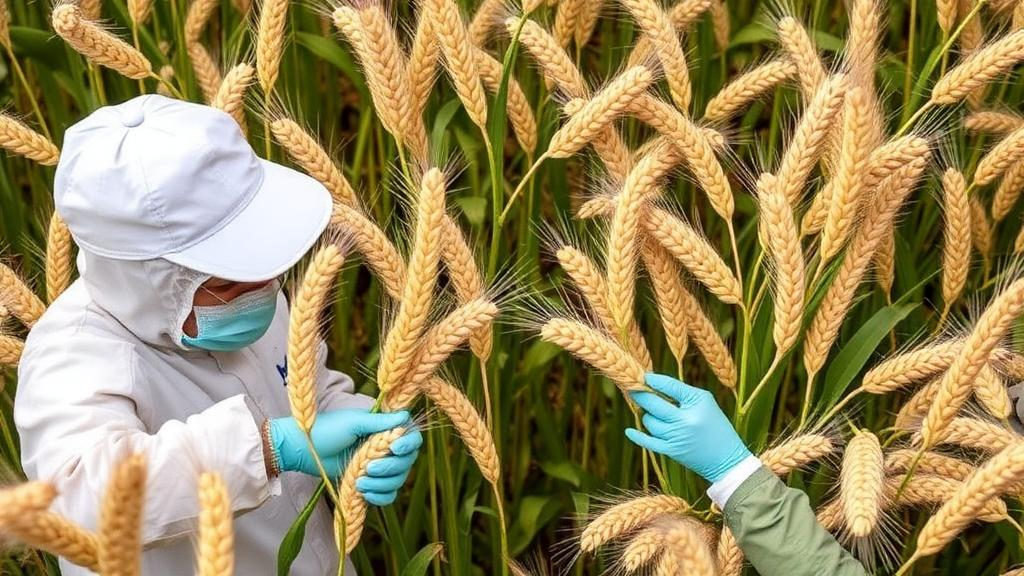
Every year, an invisible army of fungi, insects, and weeds wages war on the fields that feed China, and every year an equally invisible defense system pushes back. For the first time, researchers have put a hard national number on just how much that defense is worth. A nationwide evaluation coordinated by China’s National Agricultural Technology Extension Service Center (NATESC) has concluded that in 2024, the control of diseases, insect pests, and weeds contributed an average of 30.56 percent of the production of the country’s three staple grain crops: wheat, rice, and maize. Translated into tonnage, the recovered yield losses amounted to nearly 198 million tons of grain in a single year, with 39.21 million tons recovered in wheat, 73.92 million tons in rice, and 84.43 million tons in maize. The findings, published in the open-access journal Crop Health, offer the most comprehensive quantification yet of what plant protection actually delivers to national food security.
The scale of the undertaking sets this study apart from earlier estimates. In 2024, the evaluation covered 149 locations spread across 144 counties, cities, and districts in 15 provinces, spanning virtually all of the major growing regions for each of the three crops. For wheat, the assessment drew on data from Hebei, Anhui, Shandong, Henan, and Hubei, the five dominant wheat-producing provinces. Rice evaluations ran across ten provinces, from Heilongjiang in the northeast to Guangdong in the south, while maize assessments covered seven provinces including the major corn belt provinces of Jilin and Heilongjiang. Each participating county functioned as an independent experimental unit, chosen to represent the distinct cultivation systems and pest pressures of its region.
The methodological core of the evaluation is elegantly simple: create a gradient of pest damage and measure what happens at each step. In every county, five treatments were established. In the first, pests were controlled under the strict supervision of a plant protection technician, representing the best achievable outcome. In the second, control followed unified rules applied across an area, and in the third, farmers controlled pests using whatever methods they freely adopted, reflecting everyday practice. The final two treatments served as controls: one in which diseases, insect pests, and weeds were all left uncontrolled, and one in which only diseases and insects were left alone while weeds were managed. The unmanaged plots, each covering one-fifteenth of a hectare with a single replicate, were expected to suffer the most severe damage possible.
From these plots, the researchers derived three key quantities. The maximum loss rate compares the yield of strictly protected plots with the yield of completely unprotected plots, revealing the full destructive potential of the local pest complex. The actual loss rate measures the gap between strictly protected plots and each of the other treatments, showing what really happened under a given management regime. The difference between these two figures yields the recovery loss rate, which is precisely the contribution rate of plant protection: the share of potential yield that pest control clawed back. Because crops are distributed unevenly across regions with different damage levels, the team used a weighted averaging scheme, scaling county-level rates up to provinces by the proportion of cultivated area each county represented, and then scaling provinces up to the national level the same way. The overall national figure of 30.56 percent was calculated by weighting each crop’s rate by its share of the pooled cultivation area, which in 2024 stood at 24.41 percent for wheat, 29.91 percent for rice, and 45.68 percent for maize.
The crop-by-crop results reveal striking differences in how much plant protection matters. Rice, consistently the most pest-battered of the three staples, showed a national contribution rate of 35.62 percent, with provincial values ranging from 20.13 to 46.33 percent. Maize followed at 28.63 percent, with provincial rates between 20.08 and 35.61 percent. Wheat, which faces a somewhat narrower spectrum of major pests, registered 27.99 percent. Perhaps more telling than the national averages is what happened when control quality varied. For wheat, contribution rates under strict supervision were 11.73 percentage points higher than under traditional farmer-directed control, and unified control outperformed farmer practice by 5.36 points. For rice, the corresponding advantages were 6.69 and 5.43 percentage points; for maize, strict and unified control reached 30.40 and 29.47 percent respectively, against just 22.54 percent for traditional practice. In every crop, the hierarchy was the same: strict control beat unified control, which beat whatever farmers did on their own.
That consistent pattern carries a clear policy message. The gap between what is achievable and what is routinely practiced represents millions of tons of grain lost not to pests themselves, but to imperfect control of pests. The authors argue that closing this gap requires strengthening technical guidance for farmers and expanding unified control programs, in which professional organizations apply coordinated treatments across contiguous areas rather than leaving each household to improvise. Notably, the evaluation counted control measures implemented across the entire growing season, beginning with seed treatments applied before sowing, rather than restricting the accounting to a few critical growth stages. Preventive measures such as chemical seed treatments deployed against wheat stripe rust and crown rot, and protections applied during rice seedling nursery cultivation, all feed into the final contribution rates, meaning the figures capture a full-season defense rather than a single heroic spray.
One of the most consequential findings concerns a group of pests that often receives less attention than dramatic disease outbreaks: weeds. By comparing the two control treatments, one unprotected against everything and one protected only against weeds, the team isolated the yield toll of weed competition alone. The losses averaged 8.11 percent in wheat, 14.34 percent in rice, and 14.74 percent in maize, but the regional variation was enormous. Wheat fields in Anhui lost up to 13.47 percent of yield to weeds, while rice fields in Heilongjiang suffered losses as high as 33.65 percent, and maize fields in the same province lost up to 32.61 percent. The authors report that weed damage has tended to worsen in recent years, with 2024 losses exceeding those recorded in 2023 for all three crops, although they caution that some of this difference may reflect changes in the locations under evaluation. It was precisely this growing threat that prompted the addition of the weed-specific control treatment starting in 2023.
The geography of weed pressure tells its own story. In both rice and maize, weed infestations are most severe in the northeastern region, where weeds are the primary source of yield loss in local fields. In the Huang-Huai region, by contrast, maize fields lost only 7 to 11 percent to weeds, outside of Heilongjiang and Jilin, a difference the authors attribute partly to the height that maize plants reach later in the season, which shades out competing weeds. In wheat, damage was similar in Shandong and Henan but greater in Anhui, where a rice-wheat rotation system is practiced, a pattern observed in both 2023 and 2024. Neighboring provinces tended to show similar weed pressure, as seen in Jiangsu and Zhejiang, and in Jiangxi and Hunan, both double-cropping rice regions where staggered planting seasons create continuous windows for weed establishment.
The 2024 results also fit into a three-year arc of increasingly refined national accounting. The first evaluation in 2022, which excluded weeds and rodents, estimated an overall contribution rate of just 20.31 percent, with 24.20 percent for wheat, 19.46 percent for rice, and 18.84 percent for maize. In 2023, the addition of a blank control treatment produced a more realistic figure of 30.59 percent. The 2024 wheat rate of 27.99 percent proved remarkably stable compared with 2023’s 27.58 percent, but the rice rate fell from 40.58 to 35.62 percent, a shift the authors attribute primarily to changes in which provinces were included. Anhui, for instance, suffered severe rice stem borer and weed damage in 2024 and posted a contribution rate of 65.72 percent, but its data were not used in the national rice calculation because neighboring Jiangsu and Zhejiang were included instead. In regions where single- and double-cropping rice coexist, such as Jiangxi and Hunan, interyear fluctuations were pronounced, reflecting the spatiotemporal complexity of pest occurrence across overlapping cultivation systems.
The authors are candid about the limits of their method. Some blank control plots were small, and because control plots were sometimes located close to treated plots, pests occasionally spilled over from protected areas into unprotected ones, potentially blunting the measured damage and slightly understating the true contribution of plant protection. Reducing these edge effects will be a priority in future evaluations. Even so, the headline numbers stand as a landmark quantification. China’s Grain Security Guarantee Law now explicitly enshrines pest prevention and control, and the promotion of green and unified control strategies, as legal pillars of national food production. This study provides the empirical backbone for that policy: nearly a third of the country’s wheat, rice, and maize harvest exists only because someone fought for it, and the fight, done strictly and in a coordinated fashion, is demonstrably worth millions of tons more than the fight done casually. As weed pressure climbs and pest complexes shift with changing cultivation patterns, the annual accounting that NATESC has pioneered is likely to become an indispensable instrument for measuring, and improving, the return on one of agriculture’s oldest investments.
Subject of Research: Quantifying the contribution of pest control to wheat, rice, and maize production in China
Article Title: Evaluation of pest control contributions to the production of three major grain crops in China
Article References: Evaluation of pest control contributions to the production of three major grain crops in China. (n.d.). https://doi.org/10.1007/s44297-025-00060-5
Image Credits: AI Generated
DOI: 10.1007/s44297-025-00060-5
Keywords: China, grain crops, wheat, rice, maize, pest control, plant protection, yield loss, weed damage, food security, unified control, NATESC
Cite Scienmag News
Alan Morgan. (September 30, 2026). Pest Control Saved China Nearly 198 Million Tons of Grain in 2024. Scienmag. https://scienmag.com/pest-control-saved-china-nearly-198-million-tons-of-grain-in-2024/
Alan Morgan. "Pest Control Saved China Nearly 198 Million Tons of Grain in 2024." Scienmag, 30 September 2026, https://scienmag.com/pest-control-saved-china-nearly-198-million-tons-of-grain-in-2024/. Accessed 30 September 2026.
Alan Morgan. "Pest Control Saved China Nearly 198 Million Tons of Grain in 2024." Scienmag. September 30, 2026. https://scienmag.com/pest-control-saved-china-nearly-198-million-tons-of-grain-in-2024/


