


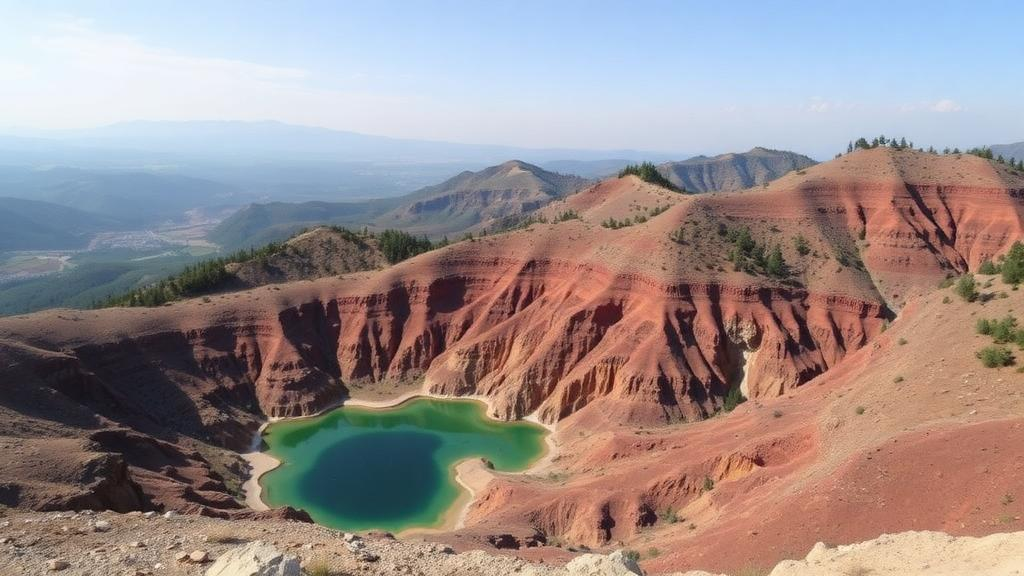
Deep beneath the rolling plains of Central Anatolia, hot water is quietly circulating through a labyrinth of faults and fractured rock, and a new study has finally begun to read its chemical fingerprints. Researchers Eda Aydemir Polat and Şehnaz Şener of Süleyman Demirel University have carried out an integrated geochemical investigation of the Boğazlıyan Geothermal Field in Turkey’s Yozgat Province, combining decades-old geothermometer equations with cutting-edge multicomponent geochemical modeling. Their conclusion is both cautionary and promising: the field likely hosts deeper, hotter reservoirs than surface chemistry alone would suggest, but those signals are being systematically obscured by cold groundwater infiltrating the system. The work, published in Hydrogeology Journal, offers a transferable playbook for exploring structurally complicated geothermal fields around the world, particularly in low-enthalpy settings where traditional tools often produce contradictory answers.
Boğazlıyan sits within a tectonically active corridor of Central Anatolia, a region shaped by active faulting, diverse rock types, and a long history of fluid–rock interaction. The system is classified as low-enthalpy, meaning its waters are warm rather than steam-dominated like the spectacular high-temperature fields of Iceland or New Zealand. That classification, however, has historically made Boğazlıyan easy to underestimate. Despite clear geothermal potential, the conditions of the reservoir remained insufficiently constrained, especially the temperatures at which deep fluids last equilibrated with the surrounding rocks. Understanding those temperatures is not an academic nicety; reservoir temperature is one of the most important variables determining whether a geothermal field can support district heating, greenhouse agriculture, or even electricity generation, and misjudging it can waste millions in exploration drilling.
To untangle the system, the researchers turned to a layered toolkit. First came classical chemical geothermometers, the workhorse equations of geothermal exploration for half a century. Instruments such as the silica, sodium–potassium, and sodium–potassium–calcium geothermometers rely on temperature-dependent mineral reactions: as water warms underground, it dissolves and re-precipitates specific minerals in proportions that record the ambient temperature. If a water sample has remained chemically closed since it left the hot reservoir, these equations can reconstruct that reservoir temperature from a simple bottle of surface water. The method’s elegance has made it standard practice from the Great Rift Valley to the Philippine arc, but it comes with a crucial assumption that the water has not been altered on its way up.
That assumption is precisely where Boğazlıyan defies convention. Field sampling of geothermal wells and cold springs across the area revealed strikingly contrasting hydrochemical facies, reflecting circulation pathways steered by faults and fractures rather than by a single coherent aquifer. Deep fluids that have interacted with magmatic and evaporitic formations coexist side by side with shallow waters dominated by simple carbonate dissolution. The resulting hydrogeochemical mosaic means that a sample collected at the surface may represent anything from a genuine slice of deep reservoir fluid to a heavily diluted cocktail of hot water and recent cold recharge. When the researchers ran the classical geothermometers on their samples, the predictions scattered widely, and the team identified chemical immaturity of the waters, essentially an insufficient degree of equilibration with reservoir minerals, as the key factor limiting their reliability.
The quartz and chalcedony geothermometers, which track the solubility of silica phases, painted a more coherent picture, pointing to moderate reservoir temperatures consistent with a low-enthalpy system. But the real analytical power came from a more modern technique: multicomponent geochemical modeling. Instead of trusting a single mineral reaction, this approach, rooted in foundational work by Reed and Spycher in the 1980s, computes the saturation state of many minerals simultaneously across a range of plausible temperatures. When a water sample is truly in equilibrium with a reservoir rock assemblage, a cluster of mineral saturation indices converges toward zero at a specific temperature. That convergence point is the best estimate of the reservoir temperature, and because it requires agreement among numerous independent mineral systems, it is far more resistant to the noise caused by partial re-equilibration, degassing, or dilution than any single-element geothermometer.
Applying this multicomponent machinery to the Boğazlıyan waters, the simulations narrowed the scattered classical estimates into a consistent temperature range, demonstrating the decisive advantage of equilibrium-based approaches in structurally complex terrains. The modeling effectively filters out the spurious signals that plague immature waters, asking not what one mineral pair implies but what temperature could plausibly satisfy the entire chemical system at once. For a field like Boğazlıyan, where fluids from different depths and geological units intermingle, this convergence-based reasoning transforms a confusing scatter of numbers into a defensible estimate. The approach also aligns with a growing international trend: recent studies in India, China, Poland, and the western United States have similarly shown that optimized multicomponent geothermometry outperforms classical tools in medium- and low-enthalpy systems.
Yet even the refined temperature estimates told only half the story. The researchers paired their geothermometry with SiO₂–enthalpy mixing analysis, a technique that plots dissolved silica against the heat content of water to quantify how much cold groundwater has blended into a rising thermal plume. The results were unambiguous: cold-water inflows strongly mask the chemical and thermal signals of the deep reservoir. In practical terms, the warm springs and wells at Boğazlıyan are not delivering undiluted reservoir fluid; they are diluted mixtures in which a substantial fraction of low-silica, low-enthalpy cold water suppresses the temperature indicators. A naive reading of the surface chemistry would therefore systematically understate the resource, potentially leading developers to dismiss a field that could, at depth, be considerably hotter than the springs suggest.
The combined picture that emerges is one of coexistence: deeper, hotter reservoir compartments sitting beneath shallower, cooler fluid domains, with mixing along fault-controlled pathways blurring the boundary in every sample that reaches the surface. This layered architecture is a direct consequence of the region’s active tectonics, which provide both the conduits for deep fluid ascent and the fracture networks through which cold meteoric water can invade. The authors are careful to note an important limitation of the study: no direct reservoir temperature measurements were available for independent validation, so the temperature estimates rest entirely on the geochemical evidence. Nevertheless, the internally consistent range produced by the multicomponent simulations, cross-checked against silica geothermometers and mixing models, represents the most comprehensive conceptual interpretation of the Boğazlıyan system to date.
What makes the study resonate beyond Central Anatolia is its methodological message. Around the world, hundreds of low-enthalpy geothermal fields are being evaluated as countries race to decarbonize heating, which accounts for roughly half of global energy demand. Many of these fields share Boğazlıyan’s complications: immature waters, mixed fluid sources, and structurally controlled circulation that renders classical geothermometry unreliable. The study demonstrates that the solution is not to abandon chemical thermometry but to embed it in a framework where multiple independent lines of evidence must agree before a temperature estimate is accepted. In that sense, the Turkish team’s integrated characterization is less a single-field case study than a warning and a recipe: trust no single thermometer, quantify the dilution, and let the full mineral system speak. As exploration expands into increasingly complex terrains, that discipline may determine which hidden reservoirs are found, and which are written off because their hot waters arrived at the surface quietly, chilled and camouflaged by cold.
Subject of Research: Geochemical estimation of reservoir temperatures in the Boğazlıyan low-enthalpy geothermal field, Central Anatolia, Turkey
Article Title: Integrated geochemical characterization and multicomponent modeling for reservoir temperature estimation in the Boğazlıyan Geothermal Field (Central Anatolia, Turkey)
Article References: Aydemir Polat, E., & Şener, Ş. (2026). Integrated geochemical characterization and multicomponent modeling for reservoir temperature estimation in the Boğazlıyan Geothermal Field (Central Anatolia, Turkey). Hydrogeology Journal. https://doi.org/10.1007/s10040-026-03170-8
Image Credits: AI Generated
DOI: 10.1007/s10040-026-03170-8
Keywords: geothermal energy, geochemistry, multicomponent geothermometry, fluid mixing, reservoir temperature, Central Anatolia, Turkey, hydrogeochemistry, low-enthalpy systems, fault-controlled circulation, silica geothermometers, Hydrogeology Journal
Cite Scienmag News
Violet Maxwell. (September 30, 2026). Hidden Heat Beneath Turkey: Geochemical Sleuthing Reveals a Masked Geothermal Reservoir in Central Anatolia. Scienmag. https://scienmag.com/hidden-heat-beneath-turkey-geochemical-sleuthing-reveals-a-masked-geothermal-reservoir-in-central-anatolia/
Violet Maxwell. "Hidden Heat Beneath Turkey: Geochemical Sleuthing Reveals a Masked Geothermal Reservoir in Central Anatolia." Scienmag, 30 September 2026, https://scienmag.com/hidden-heat-beneath-turkey-geochemical-sleuthing-reveals-a-masked-geothermal-reservoir-in-central-anatolia/. Accessed 30 September 2026.
Violet Maxwell. "Hidden Heat Beneath Turkey: Geochemical Sleuthing Reveals a Masked Geothermal Reservoir in Central Anatolia." Scienmag. September 30, 2026. https://scienmag.com/hidden-heat-beneath-turkey-geochemical-sleuthing-reveals-a-masked-geothermal-reservoir-in-central-anatolia/


