


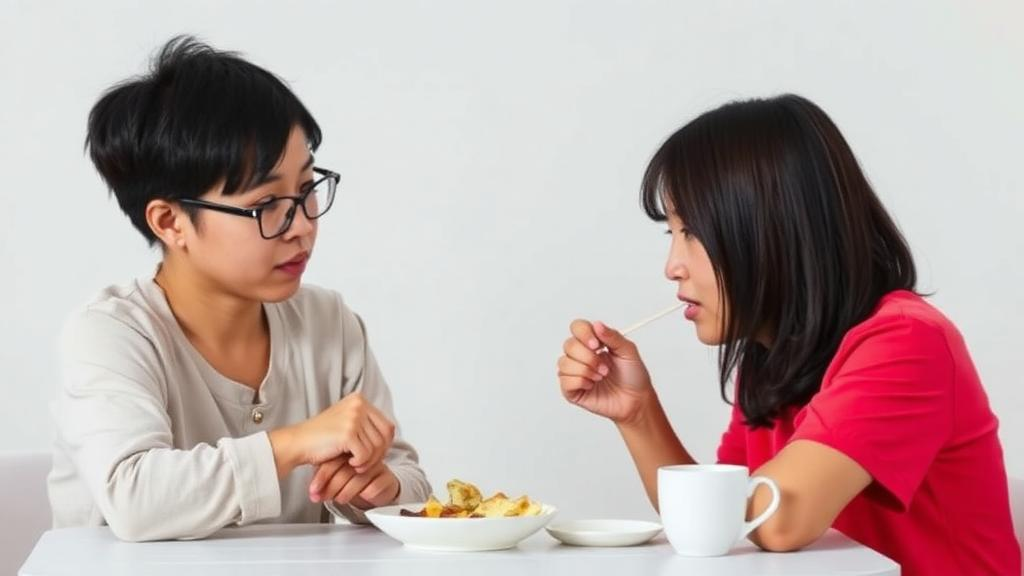
When psychologists try to understand why some young people develop troubled relationships with food, the family home is one of the first places they look. Decades of research have linked harsh, cold, or intrusive parenting to disordered eating, the spectrum of unhealthy attitudes and behaviors around food that falls short of a full clinical diagnosis but can still cause real harm. Yet most of these studies share a hidden assumption: that each parenting behavior, such as rejection or overprotection, acts independently, its effect measurable in isolation from everything else happening in the household. A new study of Chinese college students challenges that assumption, and its central finding is striking. It is not hovering parents who appear to put young adults at risk of disordered eating. It is rejecting ones.
The research, published in the Journal of Eating Disorders by Chenfan Yang and Nurul Fazzuan Khalid of Universiti Sains Malaysia, took what statisticians call a person-centered approach. Instead of asking how a single parenting dimension correlates with eating outcomes across a whole sample, the researchers asked a more realistic question: how do paternal and maternal rejection and overprotection actually combine within individual families? Guided by the Developmental Psychopathology framework, which emphasizes that risk emerges from configurations of factors rather than isolated variables, they used latent profile analysis, a technique that sorts people into unobserved groups based on patterns in their responses.
The sample comprised 1,198 Chinese college students, 45.3 percent of them female, with an average age of 19.14 years, recruited from five colleges through stratified cluster sampling. Each participant completed the short form of the Egna Minnen av Barndoms Uppfostran, a Chinese-language questionnaire known as the s-EMBU-C that measures remembered parenting along the dimensions of rejection and overprotection separately for fathers and mothers. Disordered eating was assessed with the EAT-19, a brief screening instrument capturing attitudes and behaviors characteristic of eating pathology. Crucially, the researchers did not simply run the analysis once and accept the result. They employed a split-half cross-validation procedure, dividing the sample and testing whether the same profiles emerged independently in each half, a safeguard against statistical artifacts that many similar studies skip.
Four distinct and replicable parenting profiles emerged from the data, and their composition tells a story about contemporary Chinese family life. The smallest group, accounting for 5.8 percent of students, was labeled Dual-Risk: these were families in which both rejection and overprotection were extremely high, a combination of emotional coldness and intrusive control. The Moderate group, 30.5 percent of the sample, showed high rejection paired with moderate overprotection. The Healthy group, 29.5 percent, reported low levels of both dimensions. But the most common profile, encompassing 34.2 percent of participants, was the one the researchers called Helicopter: low rejection combined with elevated overprotection. More than a third of the students in the study described parents who were deeply involved and protective but not hostile or dismissive.
When the researchers compared disordered eating scores across these four profiles, the differences were statistically robust, with an analysis of variance yielding F(3, 1194) = 14.46 and p < .001. The severity ranking was unambiguous: students from Dual-Risk families reported the highest levels of disordered eating, followed by those from Moderate families. Students from Helicopter and Healthy families, however, showed similarly low levels. In other words, overprotection on its own, even at intense levels, was not associated with elevated eating-related risk. What mattered was rejection. Families defined by emotional rejection, whether or not they were also overprotective, were the ones linked to disordered eating vulnerability.
This finding cuts against a popular narrative. Helicopter parenting has become a catch-all villain in discussions of young adult wellbeing, blamed for everything from anxiety to fragile self-esteem. The new results suggest that in the Chinese context, at least where disordered eating is concerned, the alarm about intensive parental involvement may be misplaced. A parent who monitors closely, restricts autonomy, and involves themselves heavily in their child’s life does not, on this evidence, raise the risk of disordered eating so long as the emotional climate remains warm and accepting. The toxic ingredient is the experience of feeling rejected, unloved, or dismissed, and the study suggests that interventions should prioritize addressing rejection-centric family climates over merely curbing intensive involvement.
The study also examined whether sociodemographic characteristics predicted which parenting profile a student belonged to, using multinomial logistic regression. Only one factor emerged as significant: only-child status. Students without siblings were substantially more likely to belong to the Helicopter profile than students with siblings, with odds ratios of 0.60 to 0.61, meaning non-only children had roughly 40 percent lower odds of membership in that group. This makes intuitive sense in the context of China, where the legacy of the one-child policy means that an enormous generation of parents concentrated their attention, resources, and anxieties on a single offspring. Intensive, protective parenting may be less a pathology than a structural consequence of family composition.
The methodological rigor of the study deserves attention, because person-centered research is vulnerable to overfitting. Latent profile analysis can sometimes produce groups that look meaningful in one sample but dissolve in another, reflecting sampling noise rather than genuine family types. By requiring the same four profiles to replicate across randomly split halves of the sample, Yang and Khalid strengthened the case that these configurations represent something real about how parenting dimensions cluster in Chinese families. The disaggregation of parenting into four separate dimensions, paternal rejection, maternal rejection, paternal overprotection, and maternal overprotection, also allowed the analysis to capture asymmetries between mothers and fathers that composite scores would have erased.
There are, of course, limits to what a cross-sectional survey can establish. The study measured students’ recollections of parenting and their current disordered eating at the same point in time, so it cannot prove that rejection causes eating problems; it is possible that young people who struggle with food and body image retrospectively perceive their parents as more rejecting. Self-report questionnaires are also subject to memory biases and cultural norms about what one admits on a survey. The sample, while large and drawn from five colleges, consists of university students, and findings may not generalize to adolescents or to young people outside higher education. The authors published their work as an open-access article, and the version released in September 2026 is an early citable edition subject to final editorial updates.
Even with those caveats, the practical implications are considerable. Disordered eating is increasingly prevalent among Chinese college students, and prevention programs often target parenting, advising parents to loosen their grip. This study suggests that message may need recalibrating. If overprotection alone carries little risk, then resources aimed at reducing parental involvement could be redirected toward the emotional quality of the parent-child relationship, specifically toward reducing rejection, hostility, and emotional dismissal. For clinicians screening students, the profiles offer a shorthand: the students most at risk are not those with the most intrusive parents, but those who grew up feeling unwanted. In a country where helicopter parenting is increasingly the norm rather than the exception, that distinction could shape how a generation of families understands what children actually need to grow up with a healthy relationship to food.
Subject of Research: Associations between parenting profiles and disordered eating among Chinese college students
Article Title: Four parenting profiles and disordered eating: A latent profile analysis with cross-validation in Chinese college students
Article References: Yang, C., & Khalid, N. F. (2026). Four parenting profiles and disordered eating: A latent profile analysis with cross-validation in Chinese college students. Journal of Eating Disorders. https://doi.org/10.1186/s40337-026-01778-5
Image Credits: AI Generated
DOI: 10.1186/s40337-026-01778-5
Keywords: disordered eating, parenting profiles, latent profile analysis, parental rejection, overprotection, helicopter parenting, Chinese college students, only children, developmental psychopathology, s-EMBU-C, EAT-19, Journal of Eating Disorders
Cite Scienmag News
Ophelia Keating. (September 30, 2026). Rejection, Not Overprotection, Drives Eating Disorder Risk in Chinese Students. Scienmag. https://scienmag.com/rejection-not-overprotection-drives-eating-disorder-risk-in-chinese-students/
Ophelia Keating. "Rejection, Not Overprotection, Drives Eating Disorder Risk in Chinese Students." Scienmag, 30 September 2026, https://scienmag.com/rejection-not-overprotection-drives-eating-disorder-risk-in-chinese-students/. Accessed 30 September 2026.
Ophelia Keating. "Rejection, Not Overprotection, Drives Eating Disorder Risk in Chinese Students." Scienmag. September 30, 2026. https://scienmag.com/rejection-not-overprotection-drives-eating-disorder-risk-in-chinese-students/


