

Deep inside the Compact Muon Solenoid experiment at CERN, one of the most important jobs belongs to a device that most visitors never see: the electromagnetic calorimeter, a wall of glittering lead-tungstate crystals that measures the energy of photons and electrons with extraordinary precision. But the Large Hadron Collider is a brutal place to work. Years of continuous bombardment by intense particle fluxes gradually damage the crystals and their electronics, and as radiation damage accumulates, the noise level in the detector rises relative to the signals it is trying to measure. A team of physicists now reports in The European Physical Journal C that a graph neural network can outperform the traditional fix for this problem, improving the energy resolution of a simulated calorimeter by up to 82 percent and recovering up to 83 percent of genuine signal cells that conventional methods would simply throw away.
The standard remedy for rising noise is blunt but simple. Experimenters apply a fixed energy threshold to each individual calorimeter cell, typically set a few standard deviations above the measured noise level, so that any fluctuation below that cut is discarded as spurious. The trouble is that the threshold cannot tell the difference between noise and a real, low-energy piece of an electromagnetic shower. When a photon slams into the crystal array, it deposits its energy across many neighboring cells, and the outer cells of that shower often carry only small amounts of energy. A rigid threshold discards exactly those contributions, underestimating the total energy of the particle and worsening the resolution that precision analyses depend on, from Higgs boson mass measurements to searches for new particles and detailed studies of jet substructure.
The new study, led by Suman Das Gupta and colleagues at the Saha Institute of Nuclear Physics in Kolkata, together with collaborators in France, the United States and India, proposes a data-driven alternative. Instead of judging each cell in isolation, a machine learning model looks at the full picture: the complete shape of the electrical pulse in each crystal, the spatial pattern of energy deposits across the cluster, and the correlations among neighboring cells. The researchers framed the task as a binary classification problem at the level of individual cells, asking the network to label each one as a genuine signal hit or a noise hit, and then to use that information to reconstruct the photon’s energy more faithfully than any fixed cut could.
To train and test the approach realistically, the team built a standalone Geant4 simulation of an 11 by 11 matrix of lead-tungstate crystals, each 2.2 by 2.2 square centimeters in cross section and 22 centimeters long, arranged to mimic the geometry of the barrel section of the CMS electromagnetic calorimeter. Monoenergetic electrons were fired perpendicularly into the front face of the array, and the deposited energy in each crystal was recorded and converted into digitized waveforms following the same methodology used in the current CMS detector. Each pulse was sampled at 40 megahertz, matching the LHC bunch crossing rate, and engineered with three presamples for pedestal subtraction, with the peak timed to fall at the sixth of ten retained sampling points.
The simulation then layered on the harsh realities of collider operation. Electronic noise with a root-mean-square amplitude of 150 megaelectronvolts was injected into every crystal, with correlations between time samples modeled through a covariance matrix and generated via Cholesky decomposition. On top of that came pileup: the spray of energy from dozens of unrelated proton-proton collisions overlapping in the same bunch crossing. The researchers simulated minimum-bias interactions with Pythia8 at the Run 3 collision energy of 13.6 teraelectronvolts, drawing the number of overlapping interactions per crossing from a Poisson distribution with a mean of 50, consistent with actual LHC Run 3 conditions. Contributions from fifteen preceding bunch crossings, the in-time crossing, and nine subsequent ones were all summed into each crystal’s waveform, producing readout samples that faithfully blend signal, pileup and noise.
Before the machine learning could begin, the raw waveforms were passed through the multifit algorithm, the pulse-shape fitting technique already used by CMS, which reconstructs cell energies by fitting a linear combination of known signal and pileup templates to the observed samples via nonnegative least squares. The resulting energies, together with the ten time samples of each pulse shape, the spatial coordinates of each cell, and the energy normalized to the highest-energy seed cell, formed the input features. Each event was turned into a graph, with calorimeter cells as nodes and edges connecting spatial neighbors through a k-nearest-neighbors scheme with k equal to 24, allowing the network to reason about the local geometry of the shower.
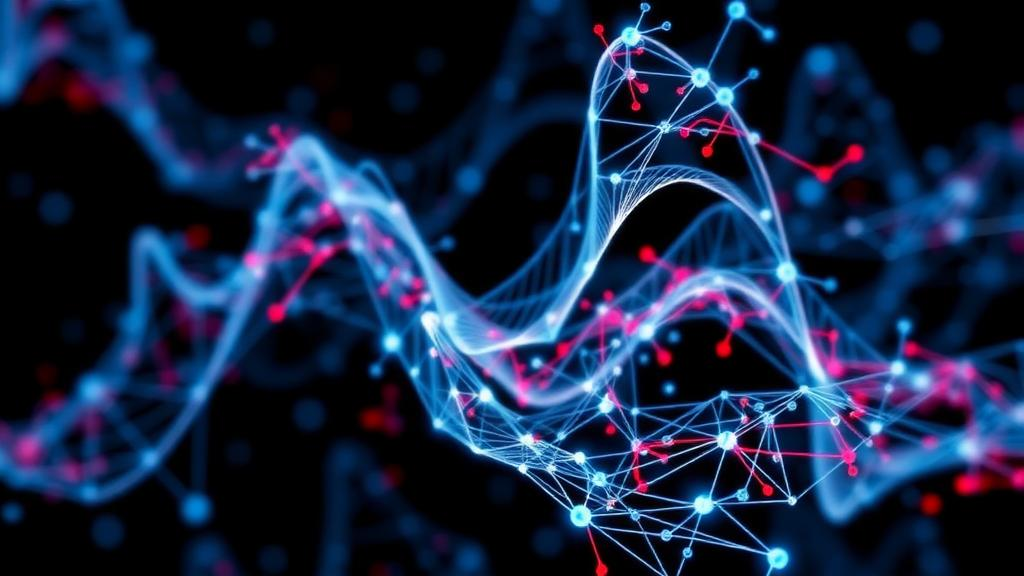
The architecture works in three stages. First, a temporal encoder built from two one-dimensional convolutional layers compresses each cell’s ten-sample waveform into a compact feature vector. These embeddings are concatenated with the cell’s position and normalized energy, and the combined node features are fed through multiple layers of a graph neural network, which propagates information between neighboring cells so that each cell’s classification is informed by its context. Finally, a small multilayer perceptron with a sigmoid output assigns each node a probability of being a genuine signal hit. The team compared four graph convolution backbones: a standard Graph Convolutional Network, a Graph Attention Network, Edge Convolution, and Dynamic Edge Convolution, all trained with a binary cross-entropy loss augmented by two physics-motivated regularization terms, one penalizing the spread of the relative energy error and another ensuring the seed cell at the shower’s center is always retained.
While all four architectures achieved nearly identical discrimination power on the signal-versus-noise task, they diverged in how well they reconstructed energy. The Graph Attention Network emerged as the clear winner, delivering the most accurate energy scale and the lowest, most uniform standard deviation of the relative energy error across the full range of photon energies from 5 to 30 gigaelectronvolts, evaluated at a pseudorapidity of 1.4, a high-pileup region of the CMS barrel chosen deliberately as a challenging scenario. The selected model contains roughly 11,300 trainable parameters, trained on a single NVIDIA Tesla V100 GPU over 1500 epochs in about eight hours, and reaches a verdict on each event in an average of just 4.38 milliseconds, fast enough to be contemplated for real reconstruction workflows.
The head-to-head comparison against the traditional method was striking. With the ML score threshold set at 0.5 and the baseline energy cut set at 150 megaelectronvolts, comparable to the simulated noise floor, the machine learning selection consistently produced better mean reconstructed photon energy, better energy resolution, and higher signal cell efficiency at every photon energy tested, a level of performance that no value of the energy cut could replicate. Visualizations of the 11 by 11 cell window around a 15 gigaelectronvolt photon show why: the simple threshold carves away the low-energy outskirts of the true shower, while the network, reading the pulse shapes and the collective pattern of deposits, keeps those cells and rejects the noise. The authors emphasize that the approach is dynamic rather than fixed, adapting to evolving detector conditions as radiation damage deepens, which makes it particularly suited to the long-term operation of calorimeters in radiation-intensive environments and could ultimately extend the physics reach of collider experiments as luminosity continues to climb.
Subject of Research: Machine learning-based noise discrimination for electromagnetic calorimeter signal reconstruction in high-radiation particle physics detectors
Article Title: Enhancing electromagnetic calorimeter signal reconstruction with machine learning-based noise discrimination
Article References: Das Gupta, S., Ghosh, S., Gazi, L., Dutta, S., Ledovskoy, A., Bhattacharya, S., & Jain, S. (2026). Enhancing electromagnetic calorimeter signal reconstruction with machine learning-based noise discrimination. The European Physical Journal C, 86(9), Article 1134. https://doi.org/10.1140/epjc/s10052-026-16346-z
Image Credits: AI Generated
DOI: 10.1140/epjc/s10052-026-16346-z
Keywords: graph neural networks, electromagnetic calorimeter, CMS experiment, Large Hadron Collider, noise discrimination, energy resolution, radiation damage, pileup, Geant4 simulation, lead-tungstate crystals, pulse-shape fitting, machine learning
Cite Scienmag News
Nicholas Scott. (September 30, 2026). Neural Networks Learn to Rescue Fading Particle Detector Signals from Noise. Scienmag. https://scienmag.com/neural-networks-learn-to-rescue-fading-particle-detector-signals-from-noise/
Nicholas Scott. "Neural Networks Learn to Rescue Fading Particle Detector Signals from Noise." Scienmag, 30 September 2026, https://scienmag.com/neural-networks-learn-to-rescue-fading-particle-detector-signals-from-noise/. Accessed 30 September 2026.
Nicholas Scott. "Neural Networks Learn to Rescue Fading Particle Detector Signals from Noise." Scienmag. September 30, 2026. https://scienmag.com/neural-networks-learn-to-rescue-fading-particle-detector-signals-from-noise/


