


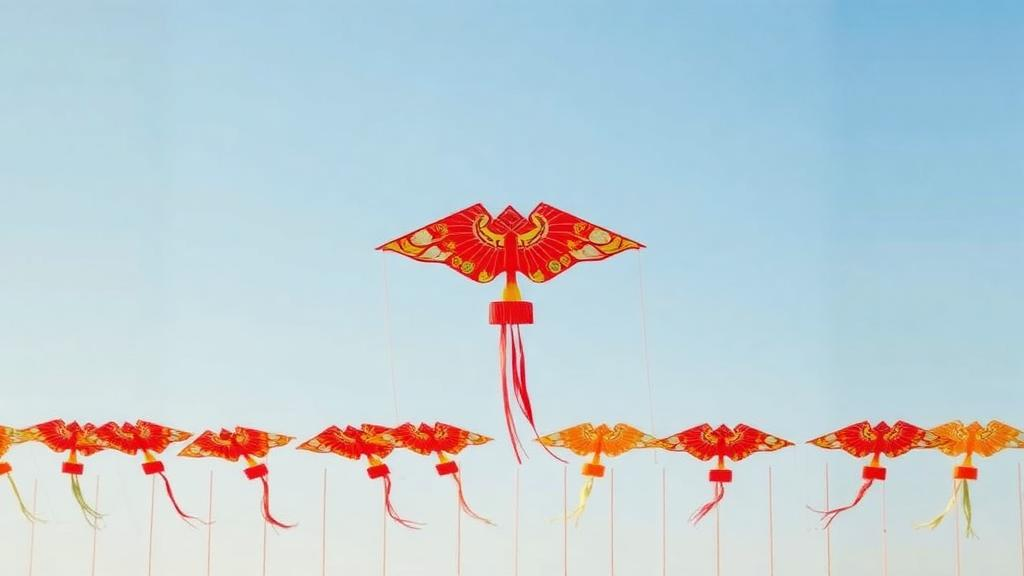
The skies over Weifang, a city in China’s Shandong province, have carried hand-painted kites for centuries, and those kites are widely regarded as some of the most refined examples of Chinese cultural craftsmanship. Their detailed motifs, carefully balanced geometric structures, and symbolic color schemes encode design knowledge that has traditionally lived only in the hands and memories of master artisans. A new study published in the Journal of Ambient Intelligence and Humanized Computing by Xuchang Li of Weifang University now attempts to translate that tacit knowledge into explicit, machine-readable form, using artificial intelligence to extract the structural, motif, and color rules that make a Weifang kite visually coherent.
The problem Li set out to address is a familiar one in digital heritage research. Although Weifang kites are celebrated cultural objects, there has been little systematic computational analysis of their design principles, particularly when it comes to quantifying how structural geometry, motif formation, and color relationships interact to produce a unified visual language. Without such quantification, it is difficult to build large-scale digital catalogs or to generate the kind of standardized documentation that preservationists call rule cards, concise descriptions of the design logic behind each artifact. The new work proposes an AI-based analytical model that combines image preprocessing, structural feature extraction, convolutional neural network based motif recognition, color pattern clustering, and automated rule generation into a single pipeline.
The first stage of the pipeline converts photographs of kites into precise structural descriptors. Using image processing techniques, the system measures wing angles, symmetry ratios, contour vertices, and aspect ratios, producing a numerical fingerprint of each kite’s geometry. These descriptors matter because Weifang kite design is famously dependent on balance: the aerodynamic behavior of a kite and its aesthetic harmony both emerge from the same underlying proportions. By capturing those proportions as measurable quantities, the framework makes it possible to compare kites across collections, workshops, and historical periods in a way that visual inspection alone cannot achieve.
Once the structure has been characterized, a convolutional neural network takes over the task of motif recognition. The CNN classifies the principal decorative subjects of each kite into six major categories: dragon, bird, butterfly, fish, tiger, and human figures. The network relies on hierarchical texture and contour data, learning to distinguish, for example, the flowing segmented body of a dragon from the layered wings of a butterfly even when both are rendered in similar palettes. This classification step is what allows the system to connect a kite’s geometry with its iconography, since different motif families in Chinese kite tradition carry different symbolic meanings and are typically paired with different structural conventions.
The reported performance figures suggest the approach is technically robust. Structural feature detection reached an accuracy of 97 percent, and the symmetry estimation proved stable, with a reported variation of 2.1 across the analyzed samples. Confidence levels exceeded 90 percent for the majority of the significant rule categories, meaning the system can reliably identify not just individual features but the recurring combinations of structure, motif, and color that constitute design rules. Those rules are then fed into an automated engine that generates digital rule cards, standardized documents that record the design logic of each kite in a form suitable for catalogs, databases, and educational use.
Color analysis forms the third analytical pillar. Weifang kite palettes are not arbitrary; particular hues and combinations carry specific cultural significance, and the interplay between color regions and motif boundaries is part of what gives the kites their visual coherence. By clustering color patterns across the image corpus, the system can detect which palettes recur with which motifs and structural types, effectively reverse engineering the conventions that artisans have refined over generations. The result is a set of quantitative rules where previously there was only expert intuition, a shift that researchers in computational aesthetics argue is essential if traditional design systems are to be preserved in actionable form.
The study situates itself within a rapidly growing body of work on AI for cultural heritage. Recent research has applied deep learning to pattern extraction in paintings and drawings, to the archiving of Indus script motifs, to the digitization and recognition of Jacquard cards used in textile weaving, and to the automated recognition of heritage building components. Computer vision has also been deployed to monitor damage in the Yungang cave paintings and to recognize materials in cultural relic images. In the specific domain of kites, earlier projects include KiteMR, an interactive mixed reality system for experiencing kite craftsmanship, and work that fine-tunes diffusion models to generate new kite designs for the revitalization of intangible cultural heritage. Li’s contribution is distinctive in focusing not on generating new designs or immersive experiences, but on extracting the explicit compositional rules of existing ones.
That focus has practical consequences for preservation. Digital catalogs built on the rule extraction pipeline could document thousands of kite designs systematically, capturing not just images but the underlying grammar of the craft. Rule cards generated automatically could support artisan training, allowing apprentices to study the proportional and chromatic conventions of historical masters alongside hands-on practice. The structured descriptors could also enable content-based retrieval, letting researchers search collections by symmetry ratio, motif family, or palette, and could provide a foundation for derivative design work in which new kites are composed within the traditional rule system rather than in imitation of individual examples. The research was supported by a Doctoral Research Fund Project on the innovation and application of Weifang kite art derivatives, reflecting an explicit interest in connecting preservation to contemporary creative practice.
The methodological choices also illustrate broader trends in how machine learning is being adapted for heritage applications. Rather than relying on a single end-to-end model, the framework decomposes the problem into stages, preprocessing, geometric measurement, motif classification, and color clustering, each of which produces interpretable intermediate outputs. That modularity matters for cultural data, where researchers need to verify that a system’s rules reflect genuine craft conventions rather than artifacts of the training data. The emphasis on symmetry measurement and contour analysis, techniques long used in pattern vision research, grounds the work in established image analysis methods while the CNN component brings the pattern recognition power of deep learning to the motif level.
There are, of course, limits to what any image-based system can capture. The feel of bamboo framing, the tension of the paper, and the tactile judgment of the kite maker all lie outside the photograph, and the study’s data availability statement notes that the underlying data are not publicly available, which will make independent replication harder. Yet the core achievement stands: a demonstration that the visual grammar of a living craft tradition can be measured, classified, and written down by machine. As intangible cultural heritage faces pressure from urbanization and generational change, tools of this kind offer a way to ensure that the knowledge encoded in objects like the Weifang kite survives not only as admired images but as explicit, teachable rules that future designers can understand, verify, and extend.
Subject of Research: AI-based computational analysis of traditional Chinese Weifang kite design for cultural heritage preservation
Article Title: AI-based structural and motif rule extraction for Weifang kite analysis and digital preservation
Article References: Li, X. (2026). AI-based structural and motif rule extraction for Weifang kite analysis and digital preservation. Journal of Ambient Intelligence and Humanized Computing. https://doi.org/10.1007/s12652-026-05126-y
Image Credits: AI Generated
DOI: 10.1007/s12652-026-05126-y
Keywords: Weifang kites, artificial intelligence, convolutional neural networks, cultural heritage preservation, motif recognition, pattern analysis, symmetry measurement, digital cataloging, intangible cultural heritage, image processing, color clustering, rule extraction
Cite Scienmag News
Blake Davidson. (September 30, 2026). AI Decodes the Hidden Design Rules of China’s Legendary Weifang Kites. Scienmag. https://scienmag.com/ai-decodes-the-hidden-design-rules-of-chinas-legendary-weifang-kites/
Blake Davidson. "AI Decodes the Hidden Design Rules of China’s Legendary Weifang Kites." Scienmag, 30 September 2026, https://scienmag.com/ai-decodes-the-hidden-design-rules-of-chinas-legendary-weifang-kites/. Accessed 30 September 2026.
Blake Davidson. "AI Decodes the Hidden Design Rules of China’s Legendary Weifang Kites." Scienmag. September 30, 2026. https://scienmag.com/ai-decodes-the-hidden-design-rules-of-chinas-legendary-weifang-kites/


