


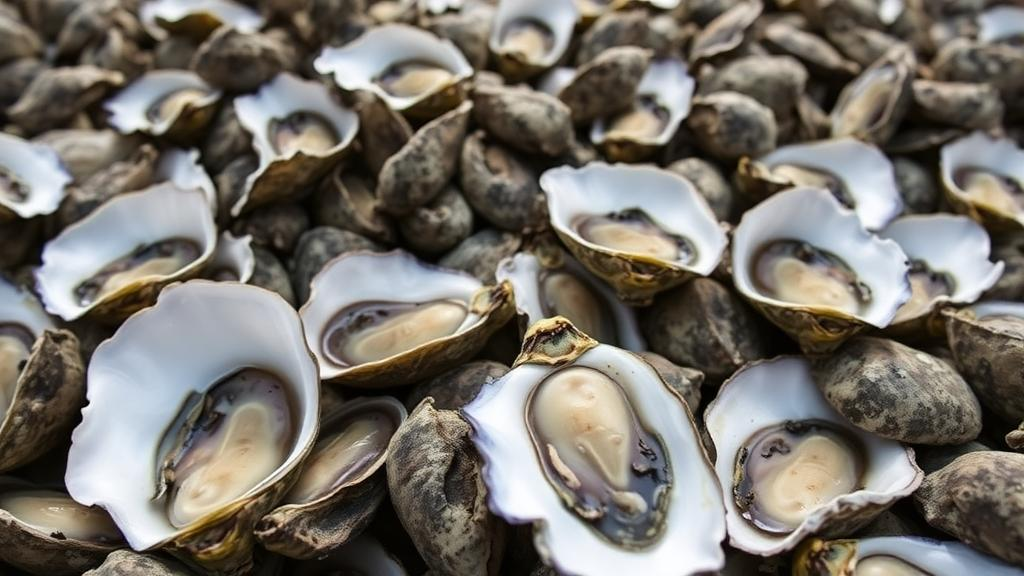
In the coastal waters of Quang Ninh province, where Vietnam’s largest coal mining region meets one of the country’s fastest-growing aquaculture industries, oysters are quietly keeping a chemical diary of everything that flows into the sea. A new study published in the Archives of Environmental Contamination and Toxicology has now read that diary in remarkable detail, measuring potentially toxic elements in two key organs of wild and farmed oysters and tracing the pollution back to its sources. The findings are a mix of reassurance and warning: most metal concentrations appear manageable, but cadmium in the oyster hepatopancreas crosses safety thresholds under worst-case consumption scenarios, a result with direct implications for the region’s booming shellfish trade.
The research team, led by Xuan-Quang Nguyen of Dong Nai Technology University and Trung-Tien Chu of Vietnam National University, Hanoi, together with colleagues in Vietnam and India, collected oysters of the genus Crassostrea from coastal sites across Quang Ninh and dissected them into two tissue types: the muscle, which is the part most people actually eat, and the hepatopancreas, the digestive gland where bivalves concentrate and process metals. This organ-by-organ approach matters because oysters do not distribute contaminants evenly through their bodies. The hepatopancreas acts as a metabolic hub, binding and detoxifying metals, which means it often accumulates elements that the muscle tissue largely excludes. Understanding that partitioning is essential for any realistic assessment of what seafood consumers are actually exposed to.
The measurements revealed a clear hierarchy among the elements. Zinc dominated the profile, reaching 65.4 milligrams per kilogram in muscle tissue and 56.8 milligrams per kilogram in the hepatopancreas. That is not surprising for oysters, which are famous among marine chemists as zinc hyperaccumulators; the element is physiologically essential and oysters regulate it in ways that allow extraordinary concentrations without obvious harm to the animal. At the opposite end of the scale sat mercury, the element with perhaps the most notorious public health reputation, which registered the lowest concentrations of any element measured: just 0.0064 milligrams per kilogram in muscle and 0.0034 milligrams per kilogram in the hepatopancreas. The gap between the most and least abundant elements spans four orders of magnitude, a reminder that ‘heavy metal pollution’ is not a single phenomenon but a family of chemically distinct problems.
One of the study’s most telling observations came not from the chemistry itself but from the oysters’ bodies. The researchers found a positive correlation between shell size and weight and the concentrations of potentially toxic elements in both organs. In other words, bigger, older oysters carried heavier metal burdens. This pattern is consistent with bioaccumulation, the slow buildup of contaminants over an organism’s lifetime. Oysters are filter feeders, pumping enormous volumes of seawater through their gills and trapping particles, dissolved metals and all. Every liter filtered is a small sampling event, and over months and years the exposures compound. For aquaculture managers, the implication is practical: harvest age and size influence contaminant loads, and longer grow-out periods in contaminated waters produce progressively more contaminated animals.
To untangle where the metals were coming from, the team turned to principal component analysis, a statistical technique that compresses many correlated variables into a few underlying axes, or components, that often correspond to real-world sources. The analysis resolved the contamination signal into three distinct components. The first, accounting for 33.0 percent of the variance, pointed squarely at anthropogenic inputs from industrial, agricultural and transportation activities. The second, explaining 22.9 percent, reflected a mixture of human and natural origins. The third, at 16.8 percent, combined natural geochemical background with the signature of coal mining, an industry that has shaped Quang Ninh’s landscape and economy for over a century. Together, the three components tell a coherent story of a coastline receiving metals from every direction: smokestacks and roads, farms and harbors, eroding rock and exposed coal seams.
That third component deserves particular attention. Quang Ninh is home to vast open-pit coal mines and the port infrastructure that ships their product across the region. Coal and its associated waste rock contain trace metals that leach into waterways and eventually reach the coastal zone. Previous studies of surface sediments in nearby Ha Long Bay have documented elevated metal contamination linked to mining and industrial activity, and the new oyster data provide a biological confirmation that these contaminants are moving through the food web, not just sitting in the mud. Because oysters integrate contamination over time, they function as living monitoring stations, smoothing out the daily and seasonal fluctuations that make water sampling alone an unreliable measure of long-term exposure.
The health risk assessment is where the study delivers its sharpest warning. The researchers calculated risk quotients, a standard metric that compares estimated contaminant intake from consumption against established safety reference values. A quotient above 1 signals a potential concern. For most elements and tissues, the values stayed below that line. But cadmium in the hepatopancreas produced risk quotients exceeding 1 under worst-case scenarios, making it the single most significant health concern identified in the study. Cadmium is an element worth taking seriously: it accumulates in human kidneys over decades of chronic exposure and is classified as a human carcinogen. While the worst-case framing assumes high consumption rates and the highest measured concentrations, the result flags a pathway of exposure that regulators cannot ignore in a province where oyster farming is expanding.
The authors argue that their findings provide a scientific basis for regional pollution monitoring and control, and they single out cadmium for continuous surveillance to support sustainable aquaculture development in Quang Ninh. That recommendation lands at a delicate moment. The province has been investing heavily in aquaculture as part of its economic diversification away from coal, and oyster farming in particular has been promoted as a livelihood for coastal communities. The new results do not suggest that local oysters are broadly unsafe, but they do suggest that the industry’s future depends on keeping industrial and mining discharges in check. Contaminated growing waters translate directly into contaminated product, and shellfish are especially vulnerable to reputational damage because they are consumed whole, digestive organs included.
Beyond the immediate regional implications, the study adds to a growing body of evidence that bivalves are among the most effective sentinels available for coastal pollution monitoring. Mussels and oysters have anchored ‘Mussel Watch’ style programs worldwide for decades precisely because they are sedentary, abundant, tolerant of contamination and chemically expressive of their environment. By pairing tissue-specific measurements with multivariate source apportionment, the Quang Ninh team demonstrated a template that other rapidly industrializing coastlines in Southeast Asia could adopt: use the oysters themselves to identify which elements are accumulating, which organs concentrate them, and which human activities are responsible. As coastal development accelerates across the region, the humble oyster may prove to be the cheapest and most honest pollution monitor anyone can deploy.
For now, the message from Quang Ninh’s coastal waters is one of cautious vigilance. Zinc and mercury levels pose no alarm, the natural and industrial sources of contamination are now statistically mapped, and the one element that demands attention, cadmium, has been identified with enough precision to target monitoring where it matters. Whether that translates into tighter control of mining runoff and industrial discharge will determine whether the region’s oysters remain a safe, sustainable food source, or whether the chemical diary they keep records a coastline drifting further out of balance.
Subject of Research: Bioaccumulation of potentially toxic elements in oysters from coastal Quang Ninh, Vietnam, and associated health risks and pollution sources
Article Title: Multivariate Analysis and Characteristics of Selected Potentially Toxic Elements in Muscle Tissue and Hepatopancreas of Oysters (Crassostrea spp.) from Coastal Areas of Quang Ninh: Bioaccumulation Features, Health Risk Assessments and Origin Sources
Article References: Nguyen, X.-Q., Duong, V.-H., Priyadharshini, M., Musthafa, M. S., Nguyen, K. M., Pham-Thi, T.-X., Hieu, N. D., Anh, H. B., Hoang Van, H., Ta, D.-K., & Chu, T.-T. (2026). Multivariate Analysis and Characteristics of Selected Potentially Toxic Elements in Muscle Tissue and Hepatopancreas of Oysters (Crassostrea spp.) from Coastal Areas of Quang Ninh: Bioaccumulation Features, Health Risk Assessments and Origin Sources. Archives of Environmental Contamination and Toxicology, 91(3), Article 22. https://doi.org/10.1007/s00244-026-01212-6
Image Credits: AI Generated
DOI: 10.1007/s00244-026-01212-6
Keywords: oysters, Crassostrea, heavy metals, cadmium, bioaccumulation, Quang Ninh, Vietnam, coal mining, hepatopancreas, health risk assessment, principal component analysis, aquaculture
Cite Scienmag News
Sloane Callahan. (September 30, 2026). Oysters in Vietnam’s Coal Country Reveal Cadmium Risk and Hidden Pollution Sources. Scienmag. https://scienmag.com/oysters-in-vietnams-coal-country-reveal-cadmium-risk-and-hidden-pollution-sources/
Sloane Callahan. "Oysters in Vietnam’s Coal Country Reveal Cadmium Risk and Hidden Pollution Sources." Scienmag, 30 September 2026, https://scienmag.com/oysters-in-vietnams-coal-country-reveal-cadmium-risk-and-hidden-pollution-sources/. Accessed 30 September 2026.
Sloane Callahan. "Oysters in Vietnam’s Coal Country Reveal Cadmium Risk and Hidden Pollution Sources." Scienmag. September 30, 2026. https://scienmag.com/oysters-in-vietnams-coal-country-reveal-cadmium-risk-and-hidden-pollution-sources/


