


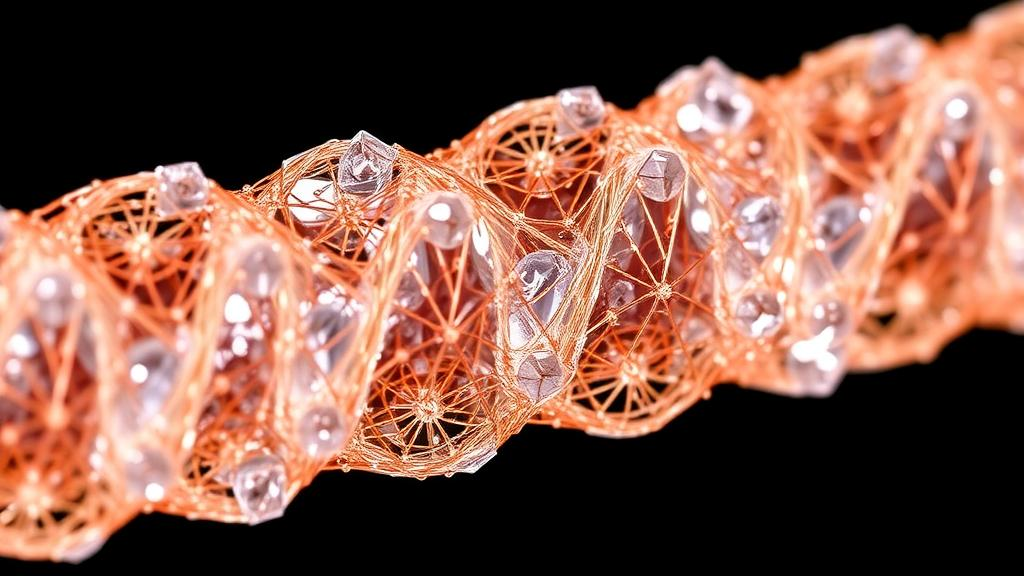
Crystals are supposed to be the very embodiment of order, yet some of the most striking examples of crystalline behavior are shapes that seem to defy it: ribbons that spiral like corkscrews, needles that bend into helices, and plates that twist as they grow. A team of researchers led by Wenhao Shao and Letian Dou, working across Purdue University, the University of Georgia, the University of Notre Dame, Emory University and ShanghaiTech University, has now shown that layered metal-halide perovskites, materials built entirely from achiral components, can spontaneously grow into twisted and helical nanoribbons. The driving force, they report in Nature Synthesis, is geometric frustration, the same mechanical principle that causes seed pods to twist open as they dry. The finding, published on 29 September 2026, offers a new route to chiral morphologies in two-dimensional materials without ever introducing a chiral molecule.
Chirality, the property of an object that cannot be superimposed on its mirror image, is usually associated with the handedness of molecules such as amino acids or DNA. Pasteur famously separated the left- and right-handed crystals of tartaric acid in 1848, and chemists have long known that achiral molecules can occasionally crystallize into chiral forms. But deliberate, controllable twisting in inorganic crystals remains rare, and in layered materials it is rarer still. Previous examples have relied on screw dislocations, which impose an Eshelby twist on growing whiskers, or on growth on curved, non-Euclidean surfaces that force layered crystals into supertwisted spirals. The new work demonstrates a different mechanism altogether, one rooted in the internal architecture of the crystal lattice itself.
The materials at the heart of the study are two-dimensional organic-inorganic hybrid perovskites of the general form (organic)2PbBr4, in which sheets of corner-sharing lead-bromide octahedra are separated by layers of organic cations. These cations are not passive spacers. In the compound (FCA3)2PbBr4, where FCA3 is a fluorinated aromatic cation, the organic layers form hydrogen-bonded networks that the authors describe as hydrogen-bonded organic frameworks embedded within the inorganic lattice. Using single-crystal X-ray diffraction, the team determined the structures at 150 K and 294 K, with crystallographic data deposited at the Cambridge Crystallographic Data Centre under deposition numbers 2485415, 2485416 and 2485417. The structures revealed that the hydrogen-bonded organic networks and the inorganic lead-bromide sheets want to deform in incompatible ways when the crystal grows.
That incompatibility is the essence of geometric frustration. As a ribbon grows from a supersaturated solution, mismatched strains accumulate between the organic and inorganic sublattices. When the strain is released, the ribbon relieves it by bending and twisting, exactly as a seed pod, made of two layers with different shrinkage directions, coils as it dries. The researchers combined brightfield and cross-polarized optical microscopy, scanning electron microscopy, transmission electron microscopy with selected-area electron diffraction, and molecular dynamics simulations to connect the atomic-scale mismatch to the macroscopic shape. The simulations, carried out by Zhichen Nian under the supervision of Brett M. Savoie, reproduced the spontaneous deformation of the ribbons and confirmed that incompatible elasticity within the lattice, rather than any external influence, drives the twisting.
The scale of the phenomenon is remarkable. The team documented ribbons roughly one micrometer wide and about a millimeter long carrying as many as 86 complete twists along their length, grown simply by cooling a supersaturated solution at 2.5 degrees Celsius per minute from 75 to 55 degrees Celsius. Crucially, microscopy under brightfield, photoluminescence and cross-polarized modes showed that the twisted microribbons are free of internal boundaries, meaning each ribbon is a single crystal that has deformed elastically rather than a composite of misoriented domains. Statistical and mechanical analyses of hundreds of ribbons showed that the shape is governed by intrinsic elastic strain and geometric constraints, and that tuning those parameters allows a continuous transition from twisted ribbons to fully helical ones.
Perhaps the most consequential discovery concerns handedness. Because the underlying molecules are achiral, one might expect equal numbers of left- and right-handed ribbons, yielding no net optical signature. Instead, the researchers found that the direction of twisting is controlled by crystal symmetry and by growth kinetics. By adjusting the cooling rate, for example to a slow 0.044 degrees Celsius per minute, they could bias nearly all ribbons in a bulk sample to twist in the same direction, producing centimeter-sized forests of ribbons with a single handedness. Ensemble-averaged circular dichroism measurements on these chirality-pure samples showed genuine chiroptical activity. The team took particular care to isolate the true signal: by rotating the sample about the light axis and flipping it, they removed artifacts arising from linear birefringence and linear dichroism, leaving the circular dichroism that arises from the coupling between electronic and magnetic transition dipoles.
The symmetry analysis explains why the effect appears in some compositions and not others. The inorganic [PbBr4]2- lattices contain specific symmetry elements, such as 21 screw axes or inversion centers, positioned at precise crystallographic sites, and the morphology of the growing crystal reflects these elements. When the team doped a second cation, BrCA3, into the (FCA3)2PbBr4 lattice, the doped crystals adopted the triclinic space group P-1 and their hydrogen-bonded organic networks aligned in a configuration resembling that of the pure (BrCA3)2PbBr4 compound. Partial occupancy refinement, made possible by the strong scattering contrast between fluorine and bromine, established a doping level of about 18 percent in one crystal, corresponding to the composition (FCA3)1.821(BrCA3)0.179PbBr4. The doped crystals showed markedly different twisting behavior, demonstrating that molecular doping offers a practical handle for tuning the frustration and hence the final morphology.
The work situates layered perovskites within a broader family of twisting crystals that includes benzamide, hippuric acid, aspirin and cholesterol monohydrate, all of which form helicoidal or twisted habits through growth-actuated bending. It also echoes recent advances in van der Waals materials, where chiral twisted nanowires and helical crystals with discretized Eshelby twist have been reported, and in nanoplatelet systems where ligand-induced curvature mismatches control polymorphism and chirality. What distinguishes the new result is the mechanism: rather than dislocations, external templates or curved substrates, the twist emerges from the interplay of two chemically distinct, hydrogen-bonded and ionic sublattices within a single crystal. The authors suggest this provides a general strategy for programming chiral shapes into layered two-dimensional materials through molecular design.
The practical implications could extend well beyond crystallography. Chiral perovskites are already of intense interest for spintronics, where chiral-induced spin selectivity has enabled room-temperature spin light-emitting diodes, and for photovoltaics, where chiral-structured heterointerfaces have been shown to improve the durability of solar cells. A material that can be grown in bulk with controlled handedness, using nothing more than cooling rate and molecular doping, would be an attractive platform for such technologies, as well as for circularly polarized light detection and chiral optoelectronics. Because the twisting is an elastic response baked into the lattice, it also raises the possibility of dynamic behavior, analogous to the reversible twisting motions observed in other molecular crystals and to light-powered flagella-like motion in photomechanical microwires.
For now, the study stands as an elegant demonstration that macroscopic chirality can be encoded in the geometry of interactions at the molecular scale. A crystal built from mirror-symmetric parts, given the right internal mismatch and the right growth conditions, will coil itself into a helix with a preferred hand, and that hand can be read out optically from an ensemble of thousands of ribbons. The researchers, whose work was supported by the US Department of Energy Office of Basic Energy Sciences and the US National Science Foundation, describe their results as a route to controlling chiral morphologies in layered two-dimensional materials. If the principle generalizes across the rich family of hybrid perovskites and related layered compounds, the humble twisted ribbon may become a standard building block in the designer materials of the coming decade.
Subject of Research: Geometric frustration driving spontaneous chiral twisting in layered halide perovskite nanoribbons
Article Title: Geometric frustration in morphologically chiral nanoribbons of layered perovskites
Article References: Shao, W., Nian, Z., Lu, Y., Yang, H., Yu, Y., Savoie, B. M., & Dou, L. (2026). Geometric frustration in morphologically chiral nanoribbons of layered perovskites. Nature Synthesis. https://doi.org/10.1038/s44160-026-01167-5
Image Credits: AI Generated
DOI: 10.1038/s44160-026-01167-5
Keywords: layered perovskites, geometric frustration, chirality, nanoribbons, two-dimensional materials, hydrogen-bonded organic frameworks, circular dichroism, molecular doping, crystal growth, elastic strain, chiroptical activity, metal-halide perovskites
Cite Scienmag News
Bethany Barker. (September 30, 2026). Twisted Crystals Emerge From Hidden Strain in Layered Perovskite Nanoribbons. Scienmag. https://scienmag.com/twisted-crystals-emerge-from-hidden-strain-in-layered-perovskite-nanoribbons/
Bethany Barker. "Twisted Crystals Emerge From Hidden Strain in Layered Perovskite Nanoribbons." Scienmag, 30 September 2026, https://scienmag.com/twisted-crystals-emerge-from-hidden-strain-in-layered-perovskite-nanoribbons/. Accessed 30 September 2026.
Bethany Barker. "Twisted Crystals Emerge From Hidden Strain in Layered Perovskite Nanoribbons." Scienmag. September 30, 2026. https://scienmag.com/twisted-crystals-emerge-from-hidden-strain-in-layered-perovskite-nanoribbons/


