


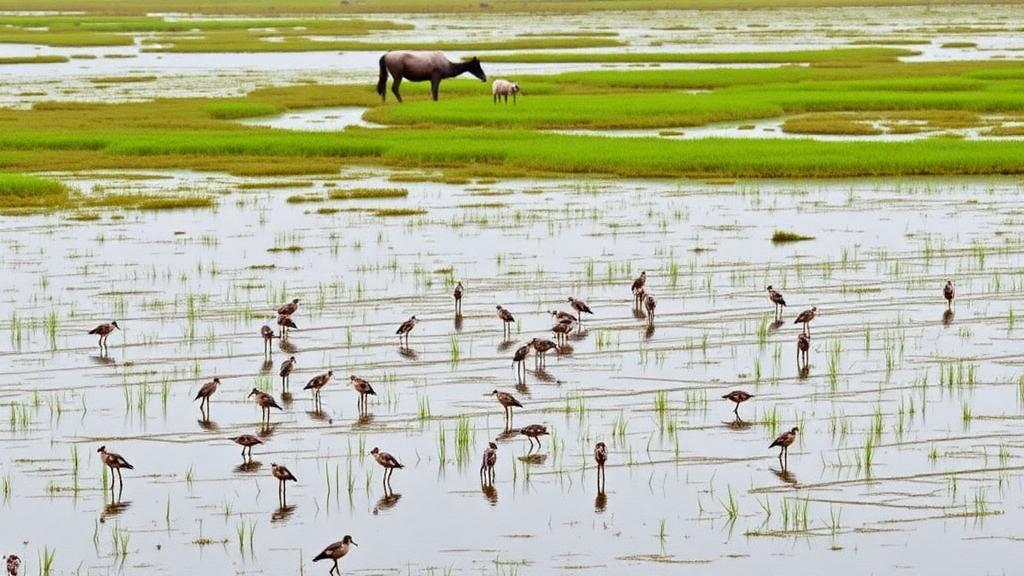
On the floating islands of Manipur’s Loktak Wetland, one of India’s most celebrated Ramsar sites, the decision to leave home is rarely a decision to leave forever. A new study published in the Journal of Population Research by geographers Ongtham Kipjen Singh and Avijit Mistri of Manipur University reveals that migration from this ecologically degraded wetland is overwhelmingly temporary and circular, with residents moving out for work and then returning, again and again, as their households juggle fishing, farming and wage labour in a landscape that no longer reliably feeds them. The research offers one of the most detailed portraits yet of how small-scale, wetland-dependent communities respond to environmental decline, a dimension of environmental migration that the authors argue has been largely overlooked in a literature dominated by droughts, floods and climate change at regional or national scales.
The study rests on an unusually rich empirical base. Singh and Mistri surveyed 600 households, split evenly between 300 migrant and 300 non-migrant households, across 12 villages in and around the Loktak Wetland, and supplemented the survey with 16 key informant interviews. They then subjected the data to a three-pronged analytical strategy: descriptive statistics to map who moves and how, Principal Component Analysis to construct composite indices of household assets and amenities, and Binary Logistic Regression to isolate the factors that significantly raise or lower the probability that a household sends a migrant out. This combination allowed the researchers to test, rather than merely assert, the predictions of three established migration theories applied together for the first time in this setting.
Those theories are the Push-Pull framework, the New Economics of Labour Migration, and the Sustainable Livelihoods Framework. The Push-Pull model, dating back to Everett Lee’s classic formulation, holds that people move when negative conditions at the origin outweigh attractions of the destination, moderated by intervening obstacles. The New Economics of Labour Migration, developed by Oded Stark and David Bloom in the 1980s, shifts the analytical unit from the individual to the household, treating migration as a collective strategy for diversifying income and managing risk rather than a purely individual wage calculation. The Sustainable Livelihoods Framework, institutionalised by the UK Department for International Development, examines how households combine five categories of assets, natural, physical, human, financial and social capital, to construct a living under given vulnerability contexts and institutional conditions.
The empirical findings map remarkably cleanly onto this integrated framework. Ecological degradation of the wetland, climatic variability and institutional constraints emerged as significant push factors, undermining the livelihood security of fishing and farming households. At the same time, urban employment opportunities acted as the principal pull factors drawing people toward towns and cities. In the regression analysis, the likelihood of migration was significantly associated with household size, landholding, household assets, perceived ecological and climatic risks, and what the researchers call policy uptake, the degree to which households had engaged with government schemes and support programmes. Larger households, with more labour to spare, were better positioned to send a member away; asset holdings shaped both the capacity to migrate and the need to do so.
Perhaps the most theoretically significant result concerns the function of migration itself. Consistent with the New Economics of Labour Migration, movement from the wetland operates primarily as a household-level strategy for income diversification. Rather than abandoning the wetland entirely, families diversify their labour portfolios: one member earns wages in town while others continue fishing or cultivating at home, and remittances or savings flow back to buffer the household against livelihood crises. This circular pattern, in which migrants retain strong ties to the origin and return repeatedly, echoes findings from other rural Indian settings, including the multilocational livelihood strategies documented in earlier work on circular migration, and it underscores why treating migration as a one-way, permanent relocation misses much of what is actually happening in ecologically fragile regions.
Yet the study resists a comfortable interpretation of migration as straightforward adaptation. The qualitative evidence from key informant interviews suggests that migration from Loktak is frequently undertaken under conditions of constrained choice, with households moving not because they have optimised a livelihood portfolio but because ecological and institutional pressures have left them few alternatives. Singh and Mistri conclude that migration in this setting exists along a continuum between adaptation and distress, shaped by differential access to livelihood assets and institutional support. Households with more assets may use migration strategically and benefit from it; households with fewer resources may be pushed into it as a last resort, absorbing the costs of separation and precarity without gaining much resilience in return.
The specific ecology of Loktak helps explain why distress runs so deep. The wetland, famous for its phumdis, the floating masses of vegetation and organic matter on which communities live and fish, has been profoundly altered by human intervention, most notably the Ithai Barrage, which has disrupted the natural hydrological regime and the drift of the floating islands. Declining fish catches, changing water levels and periodic clean-up campaigns that threaten access to fishing commons have combined to erode the natural capital on which Loktak’s fisherfolk depend. Earlier work by the same research team had already documented how ecological deterioration drives livelihood diversification among the lake’s fisherfolk; the new study extends that picture by quantifying the migration response and embedding it in formal theory.
The methodological choices deserve attention in their own right. By surveying migrant and non-migrant households separately and comparing them, the researchers could distinguish the characteristics that differentiate migrating households from otherwise similar stayers, a design that strengthens causal inference in the absence of experimental data. The use of Principal Component Analysis to build a Durable Household Asset Index and a Basic Amenities Index, alongside a Policy Uptake Index, converted messy multidimensional information about wealth, infrastructure and institutional engagement into measurable predictors. The Binary Logistic Regression then estimated the independent effect of each factor on migration probability, controlling for the others, so that the apparent influence of perceived ecological risk, for instance, is not merely a proxy for poverty or household size.
The policy implications are pointed. Because migration from Loktak is driven substantially by ecological degradation and institutional failure rather than by opportunity-seeking alone, the authors argue that wetland conservation must be integrated with livelihood enhancement if distress-driven movement is to be reduced. Restoring the ecological health of the wetland, securing fishing communities’ access to common resources, and strengthening the delivery of livelihood support and social protection would, on this evidence, do more to stabilise populations than any migration-focused intervention by itself. Conversely, conservation measures that ignore livelihoods, such as clean-up drives that displace fishers from their commons, risk intensifying exactly the pressure they aim to relieve.
More broadly, the study makes a case for mainstreaming the environment into migration theory, a call that has been growing in the demographic literature. Most environmental migration research has concentrated on dramatic, large-scale hazards, leaving a gap in understanding of how slow, cumulative degradation of a single ecosystem, a lake, a delta, a forest, reshapes mobility in the communities that depend on it. Loktak shows that such small-scale livelihood systems can generate substantial, theory-consistent migration flows that are simultaneously adaptive and distressing. As wetlands worldwide continue to shrink and degrade, the continuum between adaptation and distress traced in this Northeast Indian wetland may prove to be one of the defining mobility patterns of the coming decades, and a reminder that the people most affected by ecological decline are often those least equipped to choose whether to stay or go.
Subject of Research: Ecologically induced circular migration among fishing and farming households in the Ramsar-designated Loktak Wetland, Northeast India
Article Title: Circular migration under ecological stress in the Loktak Wetland, India: insights from migration theories
Article References: Singh, O. K., & Mistri, A. (2026). Circular migration under ecological stress in the Loktak Wetland, India: insights from migration theories. Journal of Population Research, 43(4), Article 30. https://doi.org/10.1007/s12546-026-09438-w
Image Credits: AI Generated
DOI: 10.1007/s12546-026-09438-w
Keywords: circular migration, environmental migration, Loktak Wetland, Ramsar site, Push-Pull Theory, New Economics of Labour Migration, Sustainable Livelihoods Framework, ecological degradation, livelihood diversification, Manipur, wetland conservation, household resilience
Cite Scienmag News
Courtney Benton. (September 30, 2026). Ecological Stress Drives Circular Migration in India’s Loktak Wetland, Study Finds. Scienmag. https://scienmag.com/ecological-stress-drives-circular-migration-in-indias-loktak-wetland-study-finds/
Courtney Benton. "Ecological Stress Drives Circular Migration in India’s Loktak Wetland, Study Finds." Scienmag, 30 September 2026, https://scienmag.com/ecological-stress-drives-circular-migration-in-indias-loktak-wetland-study-finds/. Accessed 30 September 2026.
Courtney Benton. "Ecological Stress Drives Circular Migration in India’s Loktak Wetland, Study Finds." Scienmag. September 30, 2026. https://scienmag.com/ecological-stress-drives-circular-migration-in-indias-loktak-wetland-study-finds/


