


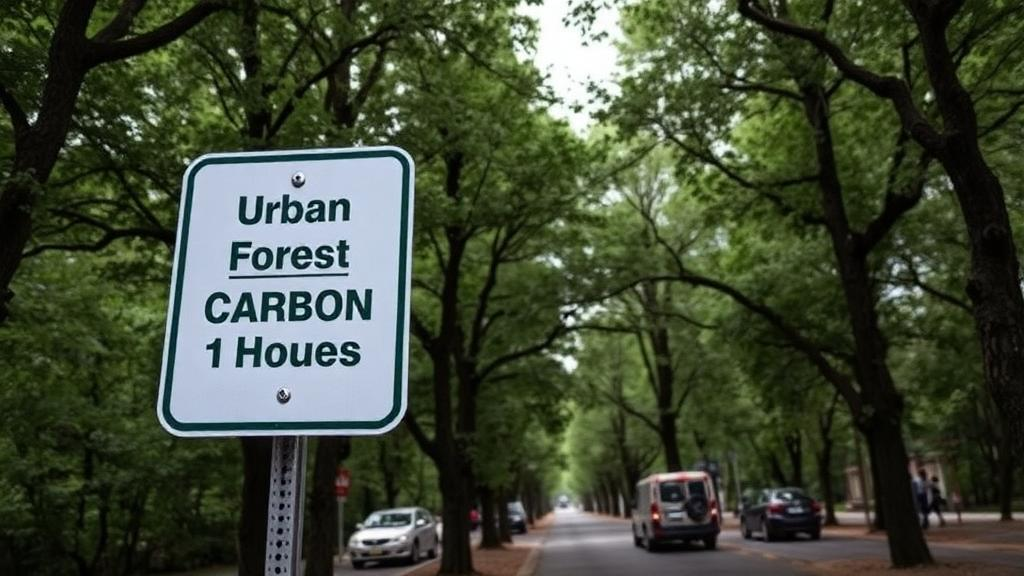
Urban forests are among the most celebrated tools in the climate playbook. Cities plant them to sequester carbon, cool overheated streets, buffer floods, and restore a measure of biodiversity to landscapes dominated by concrete. Yet a provocative new contribution to the Journal of Environmental Studies and Sciences argues that the information boards, signage systems, and interpretive panels that accompany these green spaces may be fundamentally incapable of doing what planners hope: making the invisible accumulation of carbon perceptible to the people walking past them. The piece, a Letter by Muchammad Bayu Tejo Sampurno of the Department of Performing Arts at Universiti Pendidikan Sultan Idris in Malaysia, published on 29 September 2026, turns the spotlight away from measurement and communication technology and toward something far less quantifiable — the aesthetic and memorial dimensions of how humans actually encounter urban nature.
The Letter’s central claim is distilled in its title: signage will not make carbon visible. Carbon dioxide, as Sampurno emphasizes by drawing on Timothy Morton’s influential concept of hyperobjects, is precisely the kind of phenomenon that resists direct perception. Hyperobjects are entities so massively distributed in time and space that they cannot be seen, touched, or heard as discrete things, even though their effects are everywhere. Climate-warming carbon is the paradigm case. A city dweller strolling through a planted grove cannot see the tonnes of carbon being drawn down by leaves and locked into trunk wood, and no placard listing sequestration figures will change that. Information, the argument goes, does not automatically become perception, and perception does not automatically become care.
This is where aesthetic mediation enters the analysis. Sampurno’s background is in the performing arts rather than forestry or atmospheric science, and that disciplinary position shapes the Letter’s distinctive approach. Rather than treating urban forests as engineering assets with a public-relations problem, the Letter treats them as social-ecological landscapes in which meaning is produced through embodied, sensory, and emotional engagement. In this framing, the value of an urban forest is not exhausted by its biophysical performance metrics. It also lies in how the forest is experienced — how light falls through a canopy, how a path invites repetition, how a place accrues personal and collective significance over years of visits.
To build this case, the Letter engages a body of anthropological and philosophical theory that has rarely been brought to bear on municipal climate infrastructure. Alfred Gell’s anthropology of art, which understands artworks as agents that act upon the world rather than as passive objects of contemplation, provides one pillar. Tim Ingold’s work on the temporality of landscape provides another: for Ingold, a landscape is not a static scene to be read but a record of ongoing dwelling, a palimpsest of tasks, memories, and histories written and rewritten by the people who move through it. From this perspective, an urban forest remembers. It carries environmental memory — the sedimented experiences of the communities who planted it, tended it, mourned trees lost to storms or development, and returned to it across seasons and generations.
Environmental memory, as the Letter frames it, is not a metaphorical flourish but a functional component of how green spaces sustain public commitment to them. When residents can trace the growth of a sapling they once helped plant, or navigate a park by remembered landmarks rather than posted signs, the forest becomes part of their autobiographical and communal narrative. This embeddedness is what allows a green space to matter morally, not merely instrumentally. Signage, by contrast, is an intrinsically thin form of mediation. It delivers declarative content — numbers, names, dates — but it does not participate in the slow accumulation of lived relationship. A sign can state that a stand of trees stores a certain quantity of carbon; it cannot make that fact felt.
The psychological literature on climate-related art, which the Letter surveys through work by researchers such as Lisette van Someren-adjacent scholars Roosen, Klöckner, and Swim, and subsequent studies of activist art at events like ArtCOP21 in Paris, offers empirical support for this distinction. That research suggests visual and performative art can communicate climate change in ways that exceed informational channels, engaging emotion, imagination, and identity in a single encounter. Related work by Julia Bentz and Karen O’Brien on art-for-change programs with young people points toward transformative learning: encounters with art can shift not just what people know about environmental change but how they position themselves within it. Sampurno’s wager is that urban forests themselves, when approached aesthetically rather than informationally, can operate in this same register — as living artworks whose agency works on their audiences.
The Letter also confronts the darker emotional side of this relationship. It invokes Glenn Albrecht’s concept of solastalgia, the distinctive distress experienced when a loved environment degrades while one remains in place. Urban forests are acutely exposed to this dynamic: they are cherished, proximate, and vulnerable, threatened by heat, drought, pests, and the relentless pressure of urban development. If environmental memory binds communities to these spaces, then their loss is not merely an ecological subtraction but a wound to collective identity. Any strategy for communicating the climate significance of urban forests must therefore reckon with grief and attachment, not just with data literacy.
Significantly, Sampurno’s argument is situated in dialogue with a companion study published in the same journal by Lukman and colleagues, which examines urban forests as social-ecological landscapes and traces pathways linking memory and well-being in Indonesia. That research context matters, because Southeast Asian cities are undergoing rapid transformation in which green space is simultaneously a climate asset, a heritage repository, and a contested development frontier. The Letter does not present new empirical data of its own — the author explicitly reports that no new data were generated or analysed, and the piece carries no funding declaration. Instead, it functions as a conceptual intervention, using the tools of environmental humanities to reframe what counts as evidence in debates about urban greening.
The practical implications are likely to discomfort municipal planners who lean on signage as a default engagement strategy. If the Letter is right, then a park saturated with interpretive boards but stripped of genuine participatory life will fail precisely where it matters most: in cultivating residents who notice, remember, and defend their urban canopy. Aesthetic mediation, by contrast, suggests investment in programming, performance, co-created public art, and design that deepens dwelling rather than annotating it. The goal would be to make the forest itself the medium — a place whose rhythms, growth, and vulnerability make planetary processes tangible through direct, repeated, embodied contact.
None of this diminishes the biophysical case for urban forests, which remains robust across the ecosystem-services literature. What it challenges is a communication model in which information is assumed to flow unidirectionally from label to mind to motivation. Sampurno’s Letter insists that between the chemistry of carbon and the consciousness of the city lies a vast aesthetic and memorial gap that no signboard can bridge. Closing that gap requires treating urban forests not as green infrastructure with an instruction manual, but as living, memory-bearing landscapes whose visibility to the human heart precedes any visibility on a placard. For a field increasingly convinced that the climate crisis is, at its core, a crisis of perception, the argument lands with uncomfortable force: we have been labeling our forests when we should have been learning to see them.
Subject of Research: Aesthetic mediation and environmental memory in the public perception of carbon in urban forests
Article Title: Signage will not make carbon visible: aesthetic mediation and environmental memory in urban forests
Article References: Sampurno, M. B. T. (2026). Signage will not make carbon visible: aesthetic mediation and environmental memory in urban forests. Journal of Environmental Studies and Sciences. https://doi.org/10.1007/s13412-026-01147-3
Image Credits: AI Generated
DOI: 10.1007/s13412-026-01147-3
Keywords: urban forests, carbon visibility, aesthetic mediation, environmental memory, climate communication, signage, hyperobjects, solastalgia, environmental humanities, social-ecological landscapes, urban greening, environmental psychology
Cite Scienmag News
Sloane Callahan. (September 30, 2026). Why Urban Forest Signs Cannot Make Carbon Visible to City Dwellers. Scienmag. https://scienmag.com/why-urban-forest-signs-cannot-make-carbon-visible-to-city-dwellers/
Sloane Callahan. "Why Urban Forest Signs Cannot Make Carbon Visible to City Dwellers." Scienmag, 30 September 2026, https://scienmag.com/why-urban-forest-signs-cannot-make-carbon-visible-to-city-dwellers/. Accessed 30 September 2026.
Sloane Callahan. "Why Urban Forest Signs Cannot Make Carbon Visible to City Dwellers." Scienmag. September 30, 2026. https://scienmag.com/why-urban-forest-signs-cannot-make-carbon-visible-to-city-dwellers/


