


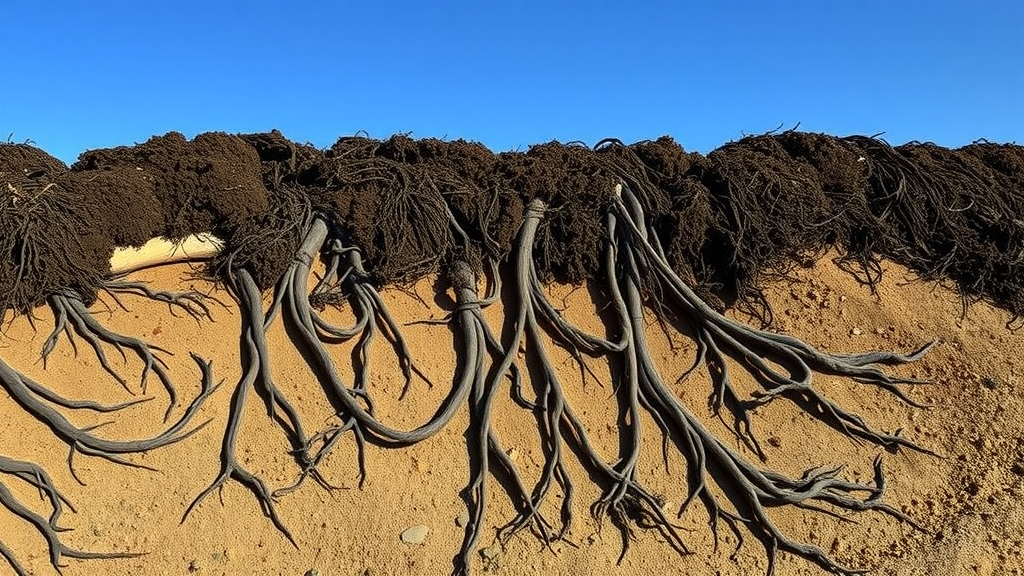
Beneath every plant, the narrow sleeve of soil hugging its roots—the rhizosphere—is one of the most chemically active zones on Earth. Roots leak sugars, organic acids and other compounds into this zone, feeding microbes and dissolving minerals, and in doing so they can dramatically accelerate or slow the breakdown of soil organic matter. A new study from the Mu Us Desert in northern China, published in Plant and Soil, shows that the identity of the plant matters enormously: across six dominant desert species, the rhizosphere effect on soil carbon mineralization ranged from minus 15 percent to 95 percent, while the effect on nitrogen mineralization spanned 10 percent to 95 percent. That enormous spread, the researchers report, is largely explained by measurable root traits—and by two very different sets of mechanisms, one biological and one mineralogical.
The research team, led by Xinyue Yuan and Yuqing Zhang of Beijing Forestry University together with colleagues, set out to answer a question that has been nagging soil scientists for years. Root traits are increasingly recognized as key drivers of belowground processes, but it has remained unclear how different traits influence rhizosphere effects on carbon and nitrogen mineralization, and whether those influences travel through living pathways—such as stimulating microbial enzymes—or through non-living ones, such as disrupting the mineral particles that lock organic matter away. Disentangling these biotic and abiotic controls is essential if models of soil carbon storage and nutrient supply are to be improved, particularly in drylands, which cover roughly 40 percent of the land surface and are highly sensitive to climate and land-use change.
To do this, the team sampled rhizosphere and bulk soil from six dominant plant species in the temperate desert and quantified how much faster carbon dioxide was released and nitrogen was mineralized in the root-adjacent soil compared with root-free soil. They then measured a suite of root functional traits, including root exudation rates, root tissue density and specific root length, alongside indicators of the rhizosphere’s biotic and abiotic environment: the activity of key extracellular enzymes, the size of the dissolved organic nitrogen pool, and the abundance of amorphous iron and aluminum oxides—reactive minerals famous for binding organic molecules and shielding them from decomposition.
The results reveal a striking asymmetry between the two elements. For carbon, the decisive root traits were those associated with intense rhizosphere carbon release: species with high root exudation rates and low root tissue density produced the strongest positive rhizosphere effects on carbon mineralization. Mechanistically, the study links this to two parallel routes. High exudation stimulated the activity of β-1,4-glucosidase, the microbial enzyme that cleaves cellobiose during cellulose breakdown, effectively revving up the microbial machinery of decomposition. At the same time, exudation-driven chemistry decreased amorphous iron and aluminum oxides in the rhizosphere, weakening the mineral protection that otherwise keeps organic carbon out of microbial reach.
This second route is the more surprising of the two, and it connects the desert findings to a rapidly growing body of work on mineral-associated organic matter. Soils hold much of their carbon not as loose detritus but as organic molecules stuck to the surfaces of reactive minerals. Root exudates, particularly organic acids, can pry these molecules loose—a process sometimes described with the ‘unbutton’ model, in which organic acids displace organic matter from metal-stabilized complexes. By showing that the depletion of amorphous iron and aluminum oxides in the rhizosphere tracks the strength of the carbon mineralization effect across species, the new study provides field-based evidence that mineral destabilization is not a laboratory curiosity but a real, trait-dependent control on carbon cycling in desert soils.
Nitrogen told a different story. Here, the rhizosphere effect was driven by the same carbon-release traits—high exudation and low tissue density—but in combination with specific root length, a morphological trait reflecting fine-root construction. Intriguingly, the pathway did not run through β-1,4-N-acetylglucosaminidase, the chitin-degrading enzyme often assumed to govern nitrogen mineralization. Instead, species with these trait combinations enhanced the rhizosphere effect on nitrogen mineralization primarily by enlarging the pool of dissolved organic nitrogen in the root zone. In other words, the plants appeared to be flooding the rhizosphere with readily available organic nitrogen substrates rather than simply activating the enzymes that mine nitrogen from recalcitrant organic matter.
Why would nitrogen follow a substrate-driven route while carbon follows both enzymatic and mineral routes? The authors suggest that the relative contribution of biotic and abiotic processes simply differs between carbon and nitrogen turnover. Carbon mineralization is ultimately about giving microbes both energy and physical access to protected organic matter, so both enzyme activation and mineral unbuttoning matter. Nitrogen mineralization, by contrast, may be more immediately limited by the supply of small, soluble organic compounds; when roots and their exudates deliver those compounds directly, microbes need not invest heavily in extracellular enzymes to meet their nitrogen demands. This interpretation is consistent with earlier work showing that root exudates can increase nitrogen availability by stimulating microbial turnover of fast-cycling nitrogen pools, and with the broader recognition that competition between roots and microbes for nitrogen shapes rhizosphere chemistry.
The study also carries a conceptual message for the root economics framework, the idea that plant roots array themselves along a spectrum from fast, acquisitive tissues to slow, conservative ones. Traits such as low tissue density and high exudation mark the fast end of that spectrum, and the findings confirm that plants at this end do not merely acquire resources more aggressively—they actively restructure the biogeochemistry of the soil around them. Meanwhile, the independent contribution of specific root length to the nitrogen effect underscores that root traits are multidimensional: morphology, tissue construction and exudation behavior each leave distinct fingerprints on the soil, and no single axis captures them all.
For a temperate desert ecosystem, these mechanisms have outsized significance. Desert soils are typically poor in organic matter and strongly limited by nitrogen, so the plants that dominate them—shrubs and grasses with very different root architectures—effectively engineer their own nutrient supply. Species that exude heavily can unlock mineral-protected carbon and enlarge dissolved organic nitrogen pools, sustaining microbial activity through hot, dry periods when substrate scarcity would otherwise shut decomposition down. As climate change alters precipitation regimes and vegetation composition in drylands, shifts in the abundance of fast-trait versus slow-trait species could therefore feed back into regional carbon balances in ways that current earth system models, which rarely resolve rhizosphere processes at all, do not capture.
The authors argue that their findings provide a mechanistic basis for predicting rhizosphere effects on soil carbon and nitrogen dynamics by integrating root functional traits with the biotic and abiotic processes they set in motion. In practical terms, that means a modeler could, in principle, estimate how much a given plant community accelerates decomposition from a handful of measurable root characteristics—exudation rate, tissue density, specific root length—plus the soil mineralogy that determines how much organic matter is mineral-protected in the first place. It is a compact recipe, but one built on a genuinely two-track understanding of the rhizosphere: microbes on one track, minerals on the other, and plant roots pulling the levers of both. For the barren-looking ground of the Mu Us Desert, the message is that the most important chemistry in the ecosystem happens in a few millimeters of soil, precisely where the roots decide it should.
Subject of Research: Rhizosphere effects of root traits on soil carbon and nitrogen mineralization in a temperate desert
Article Title: Root traits drive distinct biotic and abiotic controls of the rhizosphere effects on soil carbon and nitrogen mineralization in a temperate desert
Article References: Yuan, X., Guo, Y., She, W., Qin, S., & Zhang, Y. (2026). Root traits drive distinct biotic and abiotic controls of the rhizosphere effects on soil carbon and nitrogen mineralization in a temperate desert. Plant and Soil. https://doi.org/10.1007/s11104-026-09130-1
Image Credits: AI Generated
DOI: 10.1007/s11104-026-09130-1
Keywords: rhizosphere, root traits, soil carbon mineralization, nitrogen mineralization, root exudation, mineral protection, enzyme activity, temperate desert, soil organic matter, plant-soil interactions, dissolved organic nitrogen, Mu Us Desert
Cite Scienmag News
Alan Morgan. (September 27, 2026). Desert Roots Rewire Soil Carbon and Nitrogen Through Microbes and Minerals. Scienmag. https://scienmag.com/desert-roots-rewire-soil-carbon-and-nitrogen-through-microbes-and-minerals/
Alan Morgan. "Desert Roots Rewire Soil Carbon and Nitrogen Through Microbes and Minerals." Scienmag, 27 September 2026, https://scienmag.com/desert-roots-rewire-soil-carbon-and-nitrogen-through-microbes-and-minerals/. Accessed 27 September 2026.
Alan Morgan. "Desert Roots Rewire Soil Carbon and Nitrogen Through Microbes and Minerals." Scienmag. September 27, 2026. https://scienmag.com/desert-roots-rewire-soil-carbon-and-nitrogen-through-microbes-and-minerals/


