


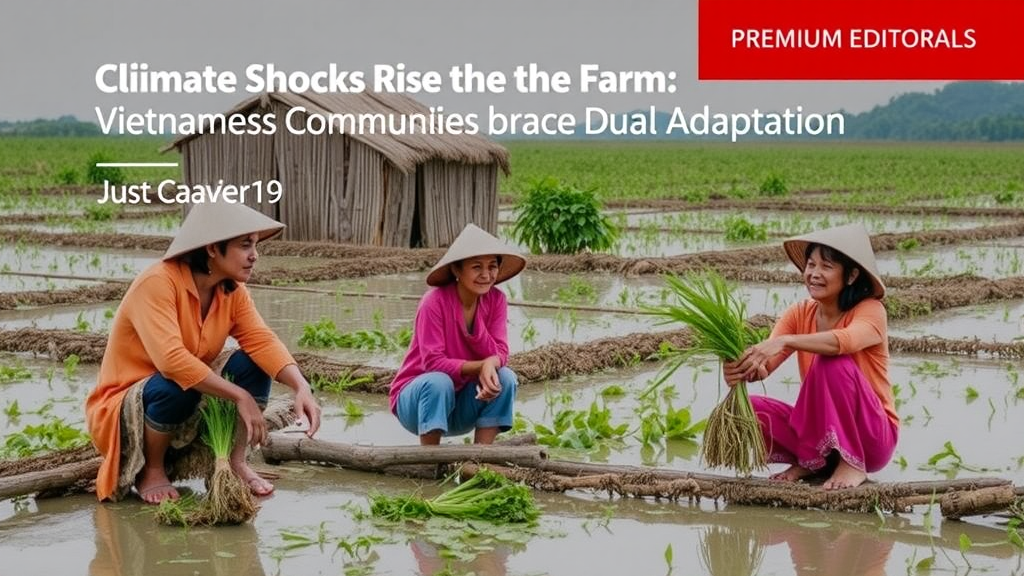
When a typhoon slams into Vietnam’s Central Coast, the damage is never confined to drowned rice paddies and snapped coconut palms. A new study of Hai Lang district in Quang Tri province reveals that climate extremes set off a cascade of consequences that ripple far beyond the fields, eroding household purchasing power, severing non-farm supply chains, and steadily draining the social and economic reserves that coastal families depend on to survive. The research, published in the journal Regional Environmental Change by Nhung Thi Hong Tran and Hoai Thi Thu Nguyen of Hanoi National University of Education, argues that these systemic spillovers demand a fundamentally different approach to adaptation than the agriculture-centric programs that have dominated climate policy in the region for decades.
The study draws on empirical data from a household survey of 60 families in Hai Lang, a low-lying coastal district that sits squarely in the path of the tropical storms and floods that batter central Vietnam each year. The region has long ranked among the country’s most hazard-prone corridors, exposed to typhoons, riverine flooding, coastal erosion, and salinity intrusion, and Vietnam as a whole has repeatedly appeared near the top of global climate risk indices. Rather than treating each disaster as an isolated shock, the researchers used a systemic vulnerability framework to trace how a single extreme event propagates through the entire local economy, touching households that never lose a single crop.
The central analytical insight is what the authors describe as a spillover effect. When floods or storms destroy harvests, farm incomes collapse, but that is only the first domino to fall. With less cash circulating in the local economy, demand for goods and services drops, squeezing shopkeepers, traders, transport operators, and other non-farm workers who might assume they are insulated from agricultural failure. Supply chains that move food, fuel, and materials through the district are disrupted, and the depletion cascades into what development economists call livelihood capitals: the stocks of natural, physical, financial, human, and social resources from which households build their living. Each successive shock strips away another layer of that foundation, leaving communities progressively less able to absorb the next event.
This systemic view aligns with a broader shift in climate science away from simple hazard-impact calculations toward complex risk assessment, in which vulnerability emerges from the interaction of exposure, sensitivity, and adaptive capacity across interconnected systems. Recent global assessments, including the Intergovernmental Panel on Climate Change’s Sixth Assessment Report, have emphasized that climate risks rarely arrive alone; compound and cascading events can overwhelm response systems in ways that single-hazard planning never anticipates. The Hai Lang findings give that abstract framework a granular, household-level texture, showing precisely how a flood upstream becomes a lost week of trading income, a child pulled from school, and a family that must sell livestock or borrow at punishing rates simply to eat.
Perhaps the most striking finding is the structural change in how communities are adapting. Traditional adaptation programs in Vietnam, as in much of the developing world, have centered on agricultural adjustments: switching crop varieties, altering planting calendars, building dikes around fields, or adopting so-called climate-smart farming practices. These measures remain important, but the survey data reveal that Hai Lang residents increasingly prioritize a dual adaptation strategy that pairs agricultural responses with a heavy emphasis on non-agricultural interventions. The first pillar is social capacity building, particularly climate education that equips residents to understand forecasts, interpret risk, and organize collective responses. The second is hard infrastructural defense, most concretely the construction of storm shelters that can protect lives and assets when the next typhoon makes landfall.
The logic behind this shift is pragmatic rather than ideological. For families whose livelihoods straddle farming, fishing, wage labor, and small commerce, no amount of crop adjustment can secure their future if the roads are washed out, the markets are closed, and their savings are gone. Storm shelters and climate literacy are, in the authors’ framing, fundamental requirements for sustaining any economic activity at all in a hazard-exposed landscape. In other words, the community has effectively redefined adaptation: instead of asking how to keep farming through disasters, it is asking how to keep living and trading through them, with agriculture as one component of a much broader portfolio.
Recognizing that even well-designed strategies collide with real-world resource constraints, the study proposes two targeted models to relieve current bottlenecks. The first is the development of multi-sectoral livelihood cooperatives, institutions that would pool labor, capital, and market access across farming and non-farming activities, diversifying income streams so that a single failed harvest no longer translates into household destitution. Cooperatives of this kind can also aggregate bargaining power, giving smallholders and informal traders a stronger position when supply chains are disrupted, and can serve as vehicles for channeling adaptation finance to the households least able to absorb losses.
The second proposed model is the integration of micro-information networks into dual-purpose educational facilities. Schools in hazard-prone districts, the study suggests, could do double duty: functioning as centers of learning by day and as community information hubs and shelters during emergencies, equipped to disseminate early warnings, weather updates, and practical guidance through local networks. This design exploits infrastructure that already exists, avoids the cost of building parallel systems, and embeds climate education in the daily life of the community rather than treating it as an occasional campaign. It is a quietly elegant example of what resilience scholars call transforming systems rather than merely reinforcing them.
The implications extend well beyond one district on the South China Sea. Coastal deltas and low-lying shorelines across South and Southeast Asia, Africa, and small island states face the same compound pressures: intensifying storms, uncertain rainfall, fragile supply chains, and households whose livelihoods are already stretched thin. Adaptation interventions in such settings have sometimes done harm or achieved little, a phenomenon researchers term maladaptation, when levees shift flood risk downstream or subsidized crops fail in saltier soils. The Hai Lang study adds weight to a growing argument that effective adaptation must be grounded in how communities actually earn their living, not in the sectoral silos of government ministries and donor programs.
What makes the research resonate is its insistence that the people most exposed to climate extremes have already diagnosed the problem better than many top-down frameworks have. Faced with storms that hollow out their entire local economy, Hai Lang residents are not choosing between rice and resilience; they are building shelters, educating their neighbors, organizing cooperatives, and wiring their schools into early-warning networks. The study’s authors frame their findings as a challenge to agriculture-centric adaptation orthodoxy and as a holistic, community-grounded model for sustainable risk governance in ecologically vulnerable coastal regions. If the spillover dynamics documented in Quang Tri province are as general as they appear, the lesson for policymakers is blunt: protecting a harvest is not the same as protecting a livelihood, and the communities closest to the rising water understood that first.
Subject of Research: Systemic climate vulnerability and community adaptation strategies in coastal central Vietnam
Article Title: Navigating climate extremes: systemic vulnerability and dual adaptation strategies in Vietnam’s Central Coast
Article References: Tran, N. T. H., & Nguyen, H. T. T. (2026). Navigating climate extremes: systemic vulnerability and dual adaptation strategies in Vietnam’s Central Coast. Regional Environmental Change, 26(4), Article 201. https://doi.org/10.1007/s10113-026-02695-8
Image Credits: AI Generated
DOI: 10.1007/s10113-026-02695-8
Keywords: climate extremes, systemic vulnerability, dual adaptation strategy, Vietnam, Central Coast, livelihood resilience, Quang Tri, storm shelters, climate education, coastal communities, adaptation policy, household survey
Cite Scienmag News
Sloane Callahan. (September 26, 2026). Climate Shocks Ripple Beyond the Farm: Vietnamese Communities Embrace Dual Adaptation. Scienmag. https://scienmag.com/climate-shocks-ripple-beyond-the-farm-vietnamese-communities-embrace-dual-adaptation/
Sloane Callahan. "Climate Shocks Ripple Beyond the Farm: Vietnamese Communities Embrace Dual Adaptation." Scienmag, 26 September 2026, https://scienmag.com/climate-shocks-ripple-beyond-the-farm-vietnamese-communities-embrace-dual-adaptation/. Accessed 26 September 2026.
Sloane Callahan. "Climate Shocks Ripple Beyond the Farm: Vietnamese Communities Embrace Dual Adaptation." Scienmag. September 26, 2026. https://scienmag.com/climate-shocks-ripple-beyond-the-farm-vietnamese-communities-embrace-dual-adaptation/

