


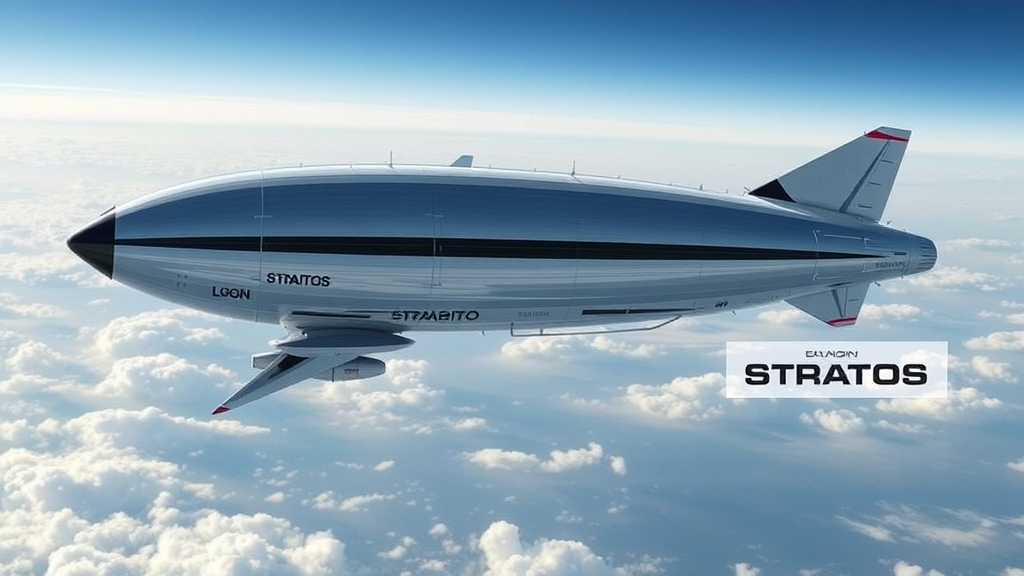
Airships are quietly staging a comeback. From stratospheric surveillance platforms to heavy-lift cargo carriers and months-long scientific balloon missions, lighter-than-air vehicles promise stable, low-noise flight with dramatically reduced energy consumption compared with conventional aircraft. Yet designing them has remained a stubbornly slow, fragmented process, involving a patchwork of expensive computer-aided design packages, computational fluid dynamics solvers and hand-built spreadsheets. A new open-source tool called STRATOS, described in the journal SoftwareX, aims to collapse that entire pipeline into a single, accessible program that can carry an engineer from a blank screen to a cut-ready fabric pattern in a fraction of the usual time.
Developed by Anantha Hari Arun Pedapudi, Sudarsan D. Naidu, Pranav Mittal and Manikandan Murugaiah, STRATOS is released under the MIT License and hosted on GitHub, with versions built in Python 3.10 or later and the SALOME geometry platform. The software is the first component of a broader suite intended to cover everything from initial sizing and geometry generation to computational fluid dynamics, finite element analysis and fabrication planning. Its central premise is that the conceptual design of lighter-than-air vehicles, which often feature bizarre multilobe hulls and intricate fin arrangements, should not require mastery of half a dozen specialized tools. Instead, STRATOS bundles geometric generation, physical evaluation and manufacturing output behind one graphical interface built with PySide6.
The engineering challenge the team set out to solve is deeper than mere convenience. Modern stratospheric airships frequently abandon the classic single cylindrical hull because a single massive envelope struggles to deliver the extreme lift required in the thin upper atmosphere while keeping structural loads manageable. The answer is to split the buoyancy across two or three lobes that merge into a single hull. Modelling such shapes by hand is notoriously tedious, and every design iteration forces engineers to recompute volumes, surface areas and projected areas from scratch. STRATOS automates this by letting users duplicate, translate and Boolean-fuse primary solids into bi-lobe and trilobe configurations, then computing all key metrics either through closed-form analytical expressions for axisymmetric shapes or numerically through the Shapely library for the more exotic geometries.
Under the hood, hull profiles are generated from three parametric families. The Gertler series represents an axisymmetric meridian as the square root of a sixth-order polynomial, with coefficients solved from five user-specified parameters including the position of maximum diameter, the prismatic coefficient, nose and tail radii, and the fineness ratio. The NACA series scales the classic four-digit symmetrical airfoil equation into a body of revolution, while the DragonDream series builds a three-dimensional ellipsoid and slices it with a Boolean cut to enforce a perfectly flat underside, reproducing the distinctive hull of the Dragon Dream cargo airship. Preset shapes ranging from spheres and ellipsoids to research airships such as LOTTE and ZHIYUAN-1 ship with the software, and a SciPy-driven solver can automatically find the hull length that achieves a target envelope volume for a required static lift.
Perhaps the most technically demanding feature is the computation of added mass, a quantity that is largely irrelevant to conventional aircraft but dominates the flight dynamics of balloons and airships. Because the atmosphere displaced by a lighter-than-air vehicle weighs as much as or more than the vehicle itself, accelerating the craft means accelerating the surrounding fluid, and the resulting virtual inertia must be captured in a full six-by-six added mass tensor for realistic six-degree-of-freedom simulation. Analytical solutions exist only for simple shapes like spheres, so STRATOS repairs the exported mesh with PyMeshLab and then runs a Boundary Element Method solver based on potential flow theory. By assuming inviscid, incompressible, irrotational flow, the solver evaluates the velocity potential solely on the vehicle’s surface, sidestepping the enormous volumetric fluid meshes that full CFD would demand. Validation against a sphere and an elongated spheroid shows errors falling to a few percent for the dominant coefficients as mesh density increases, with rotational terms accurate to many decimal places.
The software also tackles the thermal and structural physics that determine how high a tethered aerostat or stratospheric platform can safely fly. A dedicated aerostat analysis module models the atmosphere using the International Standard Atmosphere, evaluates lifting gas and ballonet air densities with allowances for gas purity, differential pressure and superheat, and then runs a steady-state three-node thermal model covering the lower surface, the lifting gas and the upper surface. That thermal approach inherits its pedigree from a transient model previously shown to agree with experimental data within about four percent. The energy balance accounts for convection, incident solar flux, infrared radiation from the sky, radiation from the Earth and infrared exchange between envelope surfaces, solving the coupled equations for steady-state temperatures at each node.
Those temperatures feed directly into a burst-altitude prediction that errs deliberately on the conservative side. STRATOS superimposes hoop stress from the internal pressure differential with thermal stress arising from the temperature gradient between the sunlit upper skin and the shaded lower skin, then applies a derating factor for material strength loss at elevated temperatures and a fatigue-and-UV degradation model that ages the fabric over years of service. The burst altitude is the height at which the total derated stress reaches the material limit set by the chosen factor of safety. Because the model assumes worst-case combined loading without empirical in-flight stress validation, the developers describe the result as a safe minimum theoretical ceiling rather than a precise prediction, a framing that suits the conceptual design stage where uncertainty is largest.
Beyond analysis, STRATOS reaches all the way into the workshop. Manufacturing an airship envelope requires flattening a doubly curved three-dimensional hull into two-dimensional fabric panels known as petals or gores, and the software performs this unrolling through an arc-length mapping that converts local circumferential arcs into planar coordinates. The resulting dense point plots are exported as .dat files that CNC fabric cutters and laser patterning systems can read directly, along with visual plots generated in Matplotlib. The developers are careful to note that fabric stretch, shrinkage, seam allowances, anisotropy and prestress depend on the chosen material and process, and are therefore outside the geometry module’s scope. A separate super-pressure balloon module, which bypasses the SALOME kernel entirely and works directly with point clouds and triangulated meshes, generates the lobed, pumpkin-like envelope geometries that distribute pressure loads efficiently during months-long stratospheric missions, supporting smooth sinusoidal, flat-facet or no gore patterns.
Aerodynamic appendages receive equally careful treatment. Wings are built in two stages, beginning with two-dimensional airfoil parametrization using the NACA four-digit series or imported coordinate data cleaned up through Class Shape Transformation or PARSEC curve fitting, with the software automatically choosing whichever method yields the lowest root-mean-square error. The wing engine then discretizes the semi-span into multiple stations, each with its own chord length, geometric twist about the quarter-chord point, sweep and dihedral, before lofting the sections into a single volumetric wing. Fins follow a simpler root-and-tip lofting routine, and the algorithm automatically rotates each fin about its root-chord leading edge until it conforms to the curvature of the hull, supporting arbitrary angular placements such as X-tail configurations at forty-five degree intervals.
The wider significance of STRATOS lies in what it removes from the design loop: the dependency on fragmented commercial CAD packages and computationally punishing CFD runs during the earliest, most iterative phase of development. By computing the added mass tensor locally, solving for buoyancy-driven hull dimensions automatically, predicting burst altitude and handing the designer a ready-to-cut fabric pattern, the platform compresses a workflow that once took weeks of specialist effort into an interactive session. Its developers position it as a scalable foundation for future Multidisciplinary Design Analysis and Optimization pipelines, with planned integration of CFD, finite element and cost-analysis modules still under development. For a field whose renaissance depends on making exotic vehicles like trilobed stratospheric airships and super-pressure balloons cheaper to conceive and build, an open-source tool that speaks the language of both the aerodynamicist and the fabric cutter may prove to be exactly the catalyst lighter-than-air flight has been waiting for.
Subject of Research: Open-source software for the conceptual design and fabrication of lighter-than-air vehicles such as airships and super-pressure balloons
Article Title: STRATOS: Software-based tool for rapid airship transformation & optimized shaping
Article References: Pedapudi, A. H. A., Naidu, S. D., Mittal, P., & Murugaiah, M. (2026). STRATOS: Software-based tool for rapid airship transformation & optimized shaping. SoftwareX, 36, Article 103036. https://doi.org/10.1016/j.softx.2026.103036
Image Credits: AI Generated
DOI: 10.1016/j.softx.2026.103036
Keywords: airships, lighter-than-air, STRATOS, super-pressure balloons, added mass, boundary element method, aerostats, open-source software, stratospheric platforms, CNC fabric cutting, computational design, SALOME
Cite Scienmag News
Denise Maddox. (September 26, 2026). STRATOS: Open-Source Software Speeds Airship Design From Hull to Fabric. Scienmag. https://scienmag.com/stratos-open-source-software-speeds-airship-design-from-hull-to-fabric/
Denise Maddox. "STRATOS: Open-Source Software Speeds Airship Design From Hull to Fabric." Scienmag, 26 September 2026, https://scienmag.com/stratos-open-source-software-speeds-airship-design-from-hull-to-fabric/. Accessed 26 September 2026.
Denise Maddox. "STRATOS: Open-Source Software Speeds Airship Design From Hull to Fabric." Scienmag. September 26, 2026. https://scienmag.com/stratos-open-source-software-speeds-airship-design-from-hull-to-fabric/


