


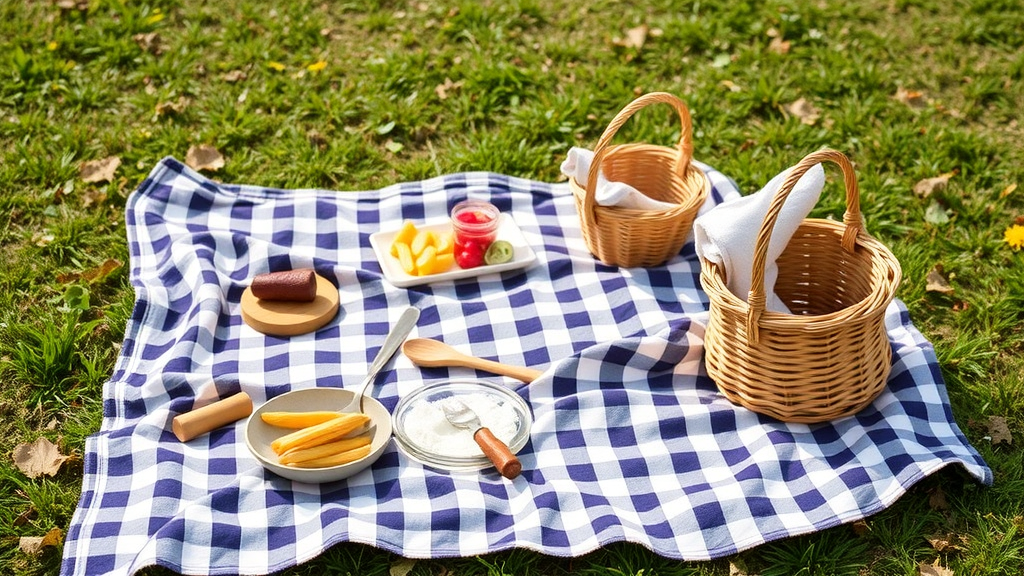
On a warm afternoon in a park somewhere, a checkered blanket is spread with deliberate care. A wicker basket opens to reveal food arranged not for convenience but for the camera that will almost certainly appear before the first bite. What looks like an ordinary day of outdoor leisure is, according to new research, something far more psychologically structured: a modern ritual, complete with symbolic display, emotional payoff and a digital afterlife on social media. A study published in Current Psychology argues that picnicking has quietly become one of the clearest examples of ritualized everyday leisure, a practice through which people generate emotional energy, craft identities and extend their experiences far beyond the grass beneath the blanket.
The research, led by Yunxi Yang of Guizhou University of Finance and Economics together with Pan Chen and Peng Lei of Sichuan Tourism University and Jie Cao of Guizhou Normal University, draws on a well-established sociological framework known as Interaction Ritual Theory. Developed by the sociologist Randall Collins, building on the earlier work of Emile Durkheim, the theory holds that face-to-face gatherings function as emotional engines. When people coalesce around a shared focus of attention, a shared mood and clearly marked boundaries of participation, the encounter produces what Collins calls emotional energy: a durable feeling of confidence, enthusiasm and belonging that participants carry away with them. Rituals, in this view, are not confined to churches, stadiums or coronation ceremonies. They operate wherever bodies gather, attention synchronizes and feelings become mutually reinforcing.
What makes the new study distinctive is its insistence that a humble picnic satisfies these conditions. Picnicking has long been treated in the leisure literature as casual, low-stakes recreation, the sort of activity that requires little planning and carries little symbolic weight. The researchers reconceptualize it instead as a ritualized practice in which the setting, the props and the choreography of the meal work together to create a bounded, sacred-feeling enclave of ordinary life. The blanket functions as a ritual boundary, marking where the everyday world ends and the picnic world begins. The shared meal synchronizes attention and emotion. The staging of food and objects lends the gathering a performative dimension that reaches outward toward imagined audiences.
To unpack that performative dimension, the team used an exploratory sequential mixed-methods design, a two-phase strategy in which qualitative findings shape the structure of subsequent quantitative measurement. In the first phase, semi-structured interviews allowed participants to describe their picnic experiences in their own words. From this material, the researchers identified three core dimensions of picnic ritualization. The first is conspicuousness, the deliberate visibility of the picnic as a display, echoing the classic concept of conspicuous consumption in which goods and settings signal status and taste to observers. The second is avoidance of similarity, a drive to distinguish one’s picnic from the generic versions others produce, reflecting the consumer’s need for uniqueness. The third is self-presentation, the management of how the self appears to others, a concept inherited from Erving Goffman’s analysis of everyday performance.
These three dimensions are theoretically distinct but psychologically entangled. Conspicuousness asks the picnic to be seen; avoidance of similarity asks that it not be seen as ordinary; self-presentation asks that what is seen reflect favorably on the person staging it. Together they transform a meal outdoors into a curated production. The interview evidence suggests that participants are not merely eating outside; they are composing scenes, selecting backdrops, arranging tableware and calibrating the aesthetic register of the entire event. In the vocabulary of consumer culture theory, the picnic becomes a site of hedonic consumption in which the experience itself, and not only the food, is the product being crafted.
The second phase of the study translated these qualitative insights into a survey that modeled the relationships among ritualized practice, experiential states and the intention to share on social networking sites. The researchers focused on two experiential states with long histories in psychology. The first is perceived playfulness, the sense that an activity is intrinsically fun, absorbing and worth doing for its own sake, a construct rooted in the study of hedonic consumption. The second is perceived flow, the state of deep absorption described by psychologist Mihaly Csikszentmihalyi, in which action and awareness merge, time distorts and the activity becomes self-rewarding. Both constructs have been widely applied to online environments and tourism experiences, where they reliably predict engagement and satisfaction.
The survey findings point to a clear structural conclusion: picnic ritualization influences social sharing intention primarily through experiential engagement. In other words, the ritualized staging of a picnic does not simply push people toward posting photos as a calculated marketing exercise. Rather, the ritual produces heightened playfulness and flow, and it is these immersive experiential states that in turn fuel the desire to share. Sharing, on this account, is the downstream consequence of a successful ritual, not its primary motive. The findings suggest that people share picnic content because the ritual has already done its emotional work, generating a surplus of feeling that seeks expression and extension through digital channels.
This reframing has significant implications for how researchers understand the relationship between offline leisure and online behavior. A common assumption in both public discourse and some academic work is that social media sharing corrupts authentic experience, reducing lived moments to content production. The new study complicates that narrative. If sharing functions as an extension of the ritual process, then the photograph of the picnic is not a betrayal of the experience but a continuation of it, a way of prolonging the emotional energy and consolidating the shared meanings the ritual created. The digital audience becomes an imagined extension of the ritual assembly, receiving the emotional residue of a gathering it never physically attended. This aligns with interaction ritual scholarship on technology, which argues that mediated encounters can carry ritual force even when bodies are absent.
The study also situates picnicking within a broader research program on ritualized tourism and leisure. Recent work has applied Interaction Ritual Theory to glamping, hotel service encounters, traditional festivals and intangible cultural heritage tourism, consistently finding that ritual dynamics predict memorable experiences, emotional energy and behavioral intentions. The picnic literature specifically has grown rapidly, with prior studies by overlapping research teams examining the proactive tourist gaze at picnics, narcissism-based frameworks of picnic behavior in Eastern cultural contexts and conspicuous consumption in picnics analyzed through social comparison. The new study synthesizes these strands by specifying the internal architecture of picnic ritualization and demonstrating statistically how that architecture translates into digital sharing behavior.
Methodologically, the research illustrates the value of sequential mixed-methods designs in leisure and consumer psychology. Qualitative interviews provided the conceptual vocabulary of conspicuousness, avoidance of similarity and self-presentation, constructs that might have been missed or mis-specified if the survey had been designed purely from existing scales. The quantitative phase then tested the mediated pathway from ritualization through playfulness and flow to sharing intention using structural equation modeling, an approach whose modern implementations require careful attention to measurement validity, discriminant validity and model fit. The two phases are complementary: the interviews generate ecological validity and theoretical richness, while the survey delivers generalizable structure and tests competing explanatory pathways.
For practitioners in tourism, hospitality and destination marketing, the findings carry practical weight. If experiential engagement is the conduit through which ritualized leisure drives sharing, then designing picnic environments that amplify playfulness and absorption, through scenic settings, curated amenities and opportunities for creative staging, may do more to stimulate organic social media promotion than any direct incentive to post. For the rest of us, the study offers a quietly subversive thought: the elaborate blanket, the matching plates and the carefully composed photograph are not symptoms of vanity or performative superficiality. They are the visible machinery of a genuine ritual, an ancient emotional technology dressed in gingham, doing exactly what rituals have always done, which is to gather people, concentrate their attention, multiply their feelings and send that energy out into the world, one shared image at a time.
Subject of Research: Ritualization of picnics as everyday leisure and its effects on experiential states and social media sharing intention
Article Title: Ritualizing everyday leisure: a mixed-methods study of picnic experiences and social sharing
Article References: Yang, Y., Chen, P., Cao, J., & Lei, P. (2026). Ritualizing everyday leisure: a mixed-methods study of picnic experiences and social sharing. Current Psychology, 45(18), Article 1543. https://doi.org/10.1007/s12144-026-10085-w
Image Credits: AI Generated
DOI: 10.1007/s12144-026-10085-w
Keywords: picnicking, interaction ritual theory, emotional energy, conspicuous consumption, self-presentation, playfulness, flow experience, social media sharing, mixed methods, leisure studies, consumer culture, Current Psychology
Cite Scienmag News
Glenn Wilkins. (September 25, 2026). Why Your Picnic Is Really a Ritual: The Science of Blankets, Baskets and the Urge to Share. Scienmag. https://scienmag.com/why-your-picnic-is-really-a-ritual-the-science-of-blankets-baskets-and-the-urge-to-share/
Glenn Wilkins. "Why Your Picnic Is Really a Ritual: The Science of Blankets, Baskets and the Urge to Share." Scienmag, 25 September 2026, https://scienmag.com/why-your-picnic-is-really-a-ritual-the-science-of-blankets-baskets-and-the-urge-to-share/. Accessed 25 September 2026.
Glenn Wilkins. "Why Your Picnic Is Really a Ritual: The Science of Blankets, Baskets and the Urge to Share." Scienmag. September 25, 2026. https://scienmag.com/why-your-picnic-is-really-a-ritual-the-science-of-blankets-baskets-and-the-urge-to-share/


