


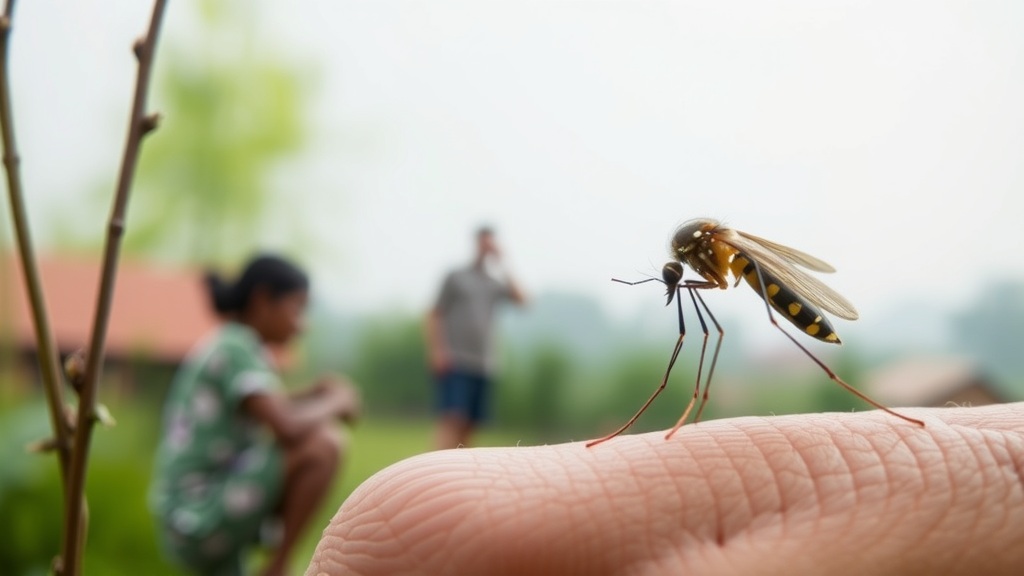
Every time an Anopheles mosquito bites a person, it injects a cocktail of salivary proteins into the skin. The human immune system notices, and it responds by producing antibodies against those proteins. For years, malaria researchers have wondered whether these antibodies could serve as a biological record of mosquito exposure — a measurable fingerprint of how often someone is being bitten. A new study from Southeast Myanmar, published in Parasites & Vectors, puts that idea to one of its most demanding tests yet: using an anti-mosquito-saliva antibody as the primary outcome measure in a large, cluster-randomised trial of a topical repellent.
The work was led by Ellen A. Kearney of the University of Melbourne and the Burnet Institute, together with colleagues in Australia and Myanmar, including senior author Freya J. I. Fowkes. Their target was gSG6-P1, a peptide derived from the Anopheles gambiae Salivary Gland 6 protein. Antibodies against gSG6-P1 have been widely proposed as biomarkers of Anopheles biting exposure, but the authors note that most studies to date have been descriptive. What has been missing is a direct quantification of how an intervention changes antibody levels — both immediately and cumulatively over time — in a controlled trial setting.
The setting was the Greater Mekong Subregion, a hotspot of malaria transmission where elimination efforts face a stubborn problem: many infections occur among mobile and hard-to-reach populations, such as migrants and forest workers, who sleep outdoors or far from formal health services. In this context, personal protection tools like topical repellents are attractive because they do not depend on people being inside a bed net or a sprayed house. But measuring whether such tools actually reduce biting exposure across whole communities has been difficult, since mosquito counts and human landing catches are labour-intensive and imprecise.
To answer the question, the team drew on a stepped-wedge cluster randomised controlled trial in which personal repellent was distributed to 114 villages in Southeast Myanmar. In a stepped-wedge design, all clusters eventually receive the intervention, but the timing of the rollout is randomised, with villages crossing over from control to intervention in monthly blocks. This structure allows researchers to compare periods before and after intervention delivery within the same communities, while controlling for secular trends in transmission. The trial is registered in the Australian New Zealand Clinical Trials Registry and was approved by ethics committees in Myanmar and Australia, with informed consent collected from all participants or their guardians.
The serological engine of the study was a high-throughput enzyme-linked immunosorbent assay, or ELISA, run on an extraordinary 14,128 samples. Many of these were dried blood spots, a sampling format well suited to remote field settings because it requires only a finger-prick of blood that can be stored and transported without a cold chain. The assay quantified IgG antibodies specific to the gSG6-P1 peptide, expressed as optical density values, and classified participants as seropositive or seronegative depending on whether their signal exceeded a defined threshold.
The baseline picture was striking. Across the study population, antibody levels were generally high, with a median optical density of 2.1, and 59.9 percent of participants were seropositive for anti-gSG6-P1 IgG. In other words, roughly six in ten people carried measurable evidence of recent Anopheles biting. That prevalence alone confirms that the biomarker registers meaningful exposure in this setting, but the crucial question was whether the numbers would move when the repellent arrived.
Using generalised linear mixed-effects modelling, the researchers estimated both the instantaneous effect of repellent distribution — the change in antibody levels at the moment villages transitioned to the intervention — and a series of lagged effects designed to capture cumulative impact. The logic behind the lagged models is important: antibodies do not vanish overnight. If a repellent reduces biting, existing antibodies should decay gradually as the immune response wanes, so the effect of sustained repellent use should only emerge over subsequent months. The modelling therefore tested whether antibody levels fell in the months following distribution, treating the antibody response as a slowly turning dial rather than a switch.
The headline result was nuanced. Overall, there was no instantaneous effect of repellent on anti-gSG6-P1 IgG levels, with a mean difference of just 0.01 optical density units and a confidence interval spanning zero (95 percent CI −0.02 to 0.04; p = 0.583). When the team modelled delayed effects, the estimates pointed in the expected direction but remained statistically inconclusive: repellent distribution six months prior was associated with a 0.02-unit decrease in antibody levels (95 percent CI −0.07 to 0.03; p = 0.381). The picture sharpened, however, when the analysis was stratified by risk group. Migrants showed a statistically significant reduction in antibody levels at the six-month lag, with a mean difference of −0.10 (95 percent CI −0.20 to −0.001; p = 0.048), while forest dwellers showed a borderline reduction of −0.05 (95 percent CI −0.10 to 0.005; p = 0.075). Village residents, by contrast, showed no reduction at all (mean difference 0.02; 95 percent CI −0.04 to 0.08; p = 0.489).
That pattern makes biological sense. Migrants and forest dwellers are precisely the groups whose exposure is hardest to control with bed nets and indoor residual spraying, and who spend the most time in transmission hotspots. If a topical repellent works anywhere, it should work for people who apply it while exposed to intense outdoor biting. Yet the authors are careful to temper the interpretation: the magnitudes of the observed effects were small, and the confidence intervals were often wide, meaning the data cannot rule out effects ranging from negligible to modest. The study also did not find convincing changes in the odds of seropositivity, suggesting that the continuous antibody level may be a more sensitive metric than a binary seropositive classification in trials of this kind.
Even so, the study delivers something the field has lacked: empirical parameters on antibody kinetics in a real intervention trial. Knowing how quickly anti-gSG6-P1 IgG responds — and how slowly it decays — tells future trial designers how long they must wait after an intervention begins before antibody outcomes can be expected to move, and how large a sample they need to detect the change. The authors conclude that antibodies to Anopheles salivary proteins could serve as an informative outcome measure in vector-control trials, particularly in settings where conventional entomological monitoring is impractical. As malaria elimination programs in the Greater Mekong Subregion push into their endgame, tools that can quietly read a community’s biting exposure from a drop of dried blood may prove indispensable for knowing whether the last miles of the campaign are actually being won.
Subject of Research: Using anti-gSG6-P1 salivary antibodies as biomarkers of Anopheles biting exposure in a topical repellent trial
Article Title: Anopheles salivary antibody biomarker outcomes to assess the effectiveness of topical repellent in Southeast Myanmar
Article References: Kearney, E. A., Agius, P. A., O’Flaherty, K., Oo, W. H., Cutts, J. C., Htike, W., Da Silva Gonçalves, D., Thi, A., Aung, K. Z., Thu, H. K., Thein, M. M., Zaw, N. N., Htay, W. Y. M., Soe, A. P., Simpson, J. A., & Fowkes, F. J. I. (2026). Anopheles salivary antibody biomarker outcomes to assess the effectiveness of topical repellent in Southeast Myanmar. Parasites & Vectors. https://doi.org/10.1186/s13071-026-07694-6
Image Credits: AI Generated
DOI: 10.1186/s13071-026-07694-6
Keywords: malaria, Anopheles, salivary biomarkers, gSG6-P1, vector control, topical repellent, serology, ELISA, Myanmar, Greater Mekong Subregion, stepped-wedge trial, IgG antibodies
Cite Scienmag News
Drew Townsend. (September 25, 2026). Mosquito Spit Antibodies Put a New Repellent Trial in Myanmar to the Test. Scienmag. https://scienmag.com/mosquito-spit-antibodies-put-a-new-repellent-trial-in-myanmar-to-the-test/
Drew Townsend. "Mosquito Spit Antibodies Put a New Repellent Trial in Myanmar to the Test." Scienmag, 25 September 2026, https://scienmag.com/mosquito-spit-antibodies-put-a-new-repellent-trial-in-myanmar-to-the-test/. Accessed 25 September 2026.
Drew Townsend. "Mosquito Spit Antibodies Put a New Repellent Trial in Myanmar to the Test." Scienmag. September 25, 2026. https://scienmag.com/mosquito-spit-antibodies-put-a-new-repellent-trial-in-myanmar-to-the-test/


