


Deep beneath the surface of the Lakshadweep Sea, on the flanks of underwater mountains that few research vessels have ever sampled, a small crab has quietly rewritten its own distribution map. Scientists surveying seamount habitats off India’s west coast have reported the first-ever record of the trapeziid crab Sphenomerides trapezioides from this corner of the northern Indian Ocean, extending the known range of an elusive species that was first described in 1891 from the Andaman Sea. The discovery, published in the journal Discover Oceans, also carries a bonus: the solitary coral found living alongside the crab represents the first documented occurrence of the genus Paracyathus from the seamounts of the Lakshadweep Sea.
The specimens came to light during deep-sea exploratory surveys conducted by the fisheries oceanographic research vessel FORV Sagar Sampada, operating under India’s Deep Ocean Mission through the Centre for Marine Living Resources and Ecology (CMLRE) of the Ministry of Earth Sciences. Using a Challenger dredge towed at roughly 2.5 knots across seamount summits and slopes, the team retrieved crabs from two separate locations. One female was collected at Sandhayak seamount off Alappuzha, Kerala, at a depth of 283 metres, while a male and a second female were recovered from Investigator Bank near Minicoy Island at 220 metres. The two sites lie hundreds of kilometres apart, suggesting the species may be more widely established on these submerged elevations than the sparse record implies.
Sphenomerides trapezioides is no ordinary crab. It belongs to the Trapeziidae, a family of small, obligate symbiotic brachyurans that spend their entire lives in intimate association with corals and other cnidarians. Most trapeziids, such as the familiar guard crabs of the genus Trapezia, shelter among the branches of reef corals, feeding on coral mucus and repaying their hosts by aggressively deterring predators, including the notorious crown-of-thorns starfish Acanthaster planci. This defensive partnership is ancient: the tropical to subtropical distribution of modern trapeziids, together with their fossils preserved in coral-bearing rocks, indicates that the symbiosis had already been established by the Eocene epoch, tens of millions of years ago.
What sets Sphenomerides apart from its reef-dwelling relatives is both its taxonomy and its choice of partner. The genus is monotypic, meaning it contains just this single species, and it is placed in its own subfamily, Sphenomeridinae. Unlike most trapeziids, which associate with hermatypic, zooxanthellate corals of shallow sunlit reefs, S. trapezioides is usually found with siliceous sponges and azooxanthellate corals in deeper water. In the Lakshadweep material, the crabs were found associated with a solitary coral identified as Paracyathus sp., an ahermatypic coral that builds no reefs and hosts no symbiotic algae. The finding doubles as a biogeographic milestone, marking the first record of this coral genus from the seamounts of the Lakshadweep Sea.
The species has a fragmented and intriguing distribution history. It was originally described from a male specimen measuring 8.5 by 11 millimetres, collected off the west coast of the Andaman Islands at depths of 403 to 439 metres during the pioneering deep-sea dredging expeditions of the survey steamer Investigator in the late nineteenth century. Subsequent records came from the Nicobar Islands at 271 metres, with additional Andaman Sea material extending the depth range to between 238 and 531 metres. Beyond Indian waters, the crab has been reported from Haruku Island in Indonesia at 138 to 152 metres and from off Madagascar at 220 to 362 metres, and more recently it was documented off Visakhapatnam on India’s southeast coast in the northwestern Bay of Bengal. The new Lakshadweep records now bridge the gap between these scattered Indo-West Pacific populations.
Morphological details recorded from the fresh specimens add valuable diagnostic information. The carapace is hexagonal, convex, smooth and glabrous, with a carapace width to length ratio of about 1.4 and poorly defined regions. The frontal margin is moderately wide and deflexed, divided into two truncated, rounded lobes by a shallow median notch, while the anterolateral margins carry three small teeth, the first sitting at the external orbital angle. The orbits are incomplete, each supraorbital margin bearing a single suture, and the inner suborbital angle carries a small spine. The ocular peduncles are short and thick with lightly pigmented terminal corneas, and the antennules fold transversely within transverse fossae. The female from Sandhayak seamount measured 5.3 millimetres in carapace length and 7.1 millimetres in width; the male from Investigator Bank measured 5.8 by 7.6 millimetres.
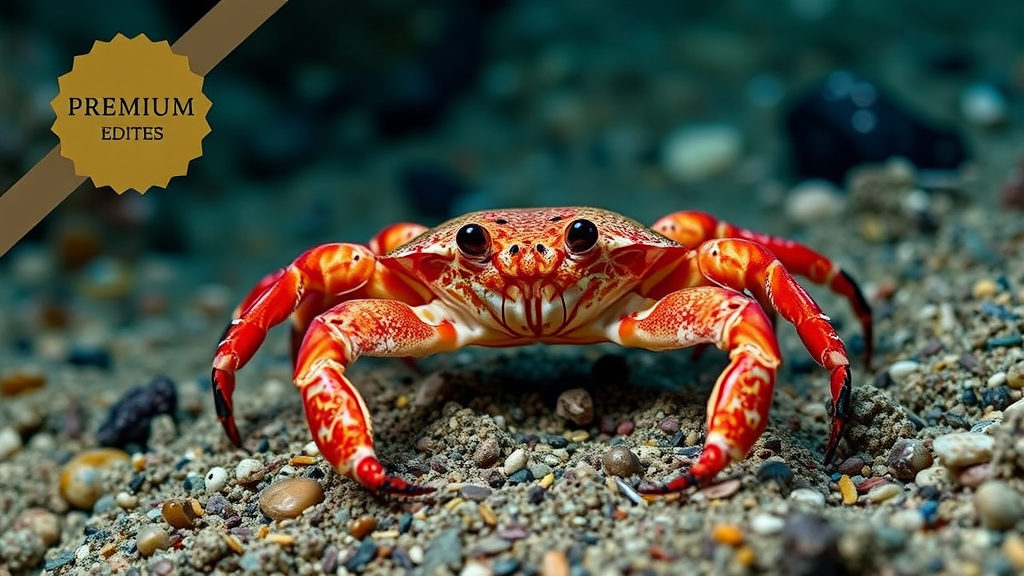
Perhaps the most striking contribution of the new study is the documentation of live coloration, which is rarely captured for deep-water crabs. Freshly collected animals were narcotised with menthol pellets, photographed alive, and then preserved in 90 percent ethanol, following the standardised survey protocols developed by the CMLRE team. In life, the carapace is uniformly pale pinkish-orange with slightly deeper orange margins. The chelipeds match the carapace in colour, with translucent proximal segments and slightly lighter distal segments, while the tips of the fingers are distinctly white, creating a sharp contrast against the surrounding orange-pink. The walking legs are semi-translucent orange-pink with faint darker orange tinges at the joints, and the ocular peduncles are pale orange with darker corneal regions. Photographs were captured with a Fujifilm GFX 100S mirrorless camera fitted with a 120 millimetre macro lens, producing archival-quality images of a species few living researchers had seen intact.
All voucher specimens have been deposited in the reference collections of CMLRE in Kochi, Kerala, ensuring that future researchers can verify the identification and apply modern techniques such as DNA barcoding. The authors, Raveendhiran Ravinesh, Nosad Sahu and Narayanane Saravanae, note that establishing reliable taxonomic records from bathyal and seamount habitats is essential for long-term biodiversity monitoring, particularly as climate change and mounting anthropogenic pressures bear down on deep-sea ecosystems. Seamounts are increasingly recognised as biodiversity hotspots and potential stepping stones for larval dispersal, yet the fauna of Indian seamounts remains only patchily catalogued, making every verified record a building block for conservation planning.
The biogeographic implications reach well beyond a single crab. The Lakshadweep Sea occupies a strategic position between the Arabian Sea and the broader Indo-West Pacific region, and the authors suggest it may function as a dispersal corridor, a transition zone, or even a partially isolated biogeographic unit. Comparative analyses with adjacent basins and seamount systems can help scientists evaluate species distribution patterns, larval dispersal pathways, habitat-driven morphological variation, and the influence of deep-water circulation on regional biodiversity. In other words, a crab measuring barely six millimetres across its carapace may hold clues to how marine life moves across one of the planet’s largest ocean basins.
The work also aligns directly with the objectives of India’s Deep Ocean Mission, a flagship national programme aimed at building baseline knowledge of the country’s vast exclusive economic zone, including its little-explored seamount ecosystems. Cruises 402 and 404 of FORV Sagar Sampada, during which the crabs were collected, form part of a systematic effort to sample deep-sea benthic habitats using standardised collection, preservation and documentation methods. As dredges continue to bring up unfamiliar organisms from these submerged mountains, records like this one underscore how much of the deep Indian Ocean remains unmapped at the species level, and how a single dredge haul can connect the present-day fauna to specimens collected aboard a nineteenth-century steamship more than 135 years ago.
Subject of Research: New distribution record of the symbiotic trapeziid crab Sphenomerides trapezioides from Lakshadweep Sea seamounts
Article Title: A new record of the trapeziid crab Sphenomerides trapezioides (Wood-Mason in Wood-Mason & Alcock, 1891) (Decapoda: Brachyura: Trapezioidea) from the seamounts of the Lakshadweep Sea, Northern Indian Ocean
Article References: Ravinesh, R., Sahu, N., & Saravanae, N. (2026). A new record of the trapeziid crab Sphenomerides trapezioides (Wood-Mason in Wood-Mason & Alcock, 1891) (Decapoda: Brachyura: Trapezioidea) from the seamounts of the Lakshadweep Sea, Northern Indian Ocean. Discover Oceans, 3(1), Article 42. https://doi.org/10.1007/s44289-026-00149-x
Image Credits: AI Generated
DOI: 10.1007/s44289-026-00149-x
Keywords: Sphenomerides trapezioides, Trapeziidae, seamounts, Lakshadweep Sea, deep-sea biodiversity, Indian Ocean, coral symbiosis, Paracyathus, Deep Ocean Mission, FORV Sagar Sampada, brachyuran crabs, biogeography
Cite Scienmag News
Violet Maxwell. (September 25, 2026). Rare Coral Crab Resurfaces After 135 Years on Indian Ocean Seamounts. Scienmag. https://scienmag.com/rare-coral-crab-resurfaces-after-135-years-on-indian-ocean-seamounts/
Violet Maxwell. "Rare Coral Crab Resurfaces After 135 Years on Indian Ocean Seamounts." Scienmag, 25 September 2026, https://scienmag.com/rare-coral-crab-resurfaces-after-135-years-on-indian-ocean-seamounts/. Accessed 25 September 2026.
Violet Maxwell. "Rare Coral Crab Resurfaces After 135 Years on Indian Ocean Seamounts." Scienmag. September 25, 2026. https://scienmag.com/rare-coral-crab-resurfaces-after-135-years-on-indian-ocean-seamounts/


