


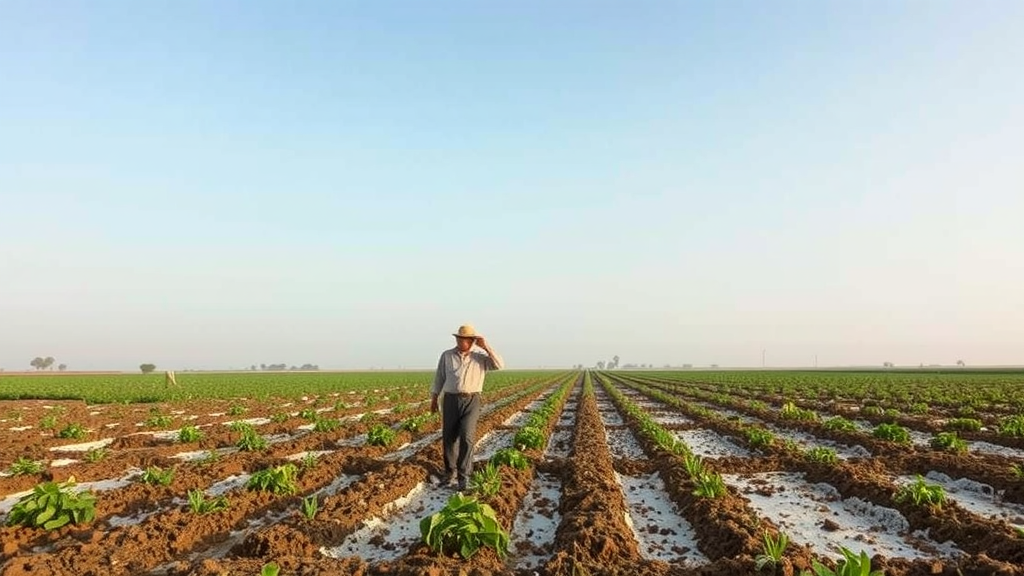
Beneath the vegetable fields and mango orchards of Sinaloa, one of Mexico’s most productive agricultural regions, an invisible crisis is unfolding one dissolved ion at a time. A new ten-year study of the Mocorito River Aquifer reveals that the water feeding farms and towns across this tropical corner of northwestern Mexico is becoming steadily saltier and harder, and that intensive agriculture is accelerating a natural process that would otherwise unfold far more slowly. The research, published in Environmental Earth Sciences, offers one of the most detailed long-term portraits yet of how farming reshapes the chemistry of a vulnerable coastal aquifer, and its findings carry warnings for irrigated landscapes around the world.
The research team, led by Yaneth A. Bustos-Terrones of the Instituto Tecnológico de Culiacán, analyzed a decade of groundwater quality data, from 2012 to 2022, collected at seven monitoring wells operated through Mexico’s National Water Quality Monitoring Network, RENAMECA, run by the National Water Commission. The wells were deliberately placed in the most environmentally relevant sectors of the aquifer: downstream of a dam surrounded by farmland, near villages and ranches, in zones of intensive cultivation, and in the center of the city of Angostura. Because the aquifer is coastal and its water table sits just 2 to 12 meters below the surface, the shallow groundwater it holds is exceptionally exposed to whatever happens on the land above it.
The headline numbers are striking. Average total dissolved solids in the aquifer measured 1,008 milligrams per liter, and electrical conductivity averaged 1,606 microsiemens per centimeter, both exceeding World Health Organization guideline values for drinking water. Total hardness averaged 488 milligrams per liter, a level dominated by calcium and magnesium salts, and in some individual samples dissolved solids climbed as high as 3,000 milligrams per liter, with hardness approaching 1,500. Sodium, at 181 milligrams per liter, hovered uncomfortably close to its 200 milligram guideline limit, a concern both for drinking water and for the long-term health of irrigated soils. By contrast, nutrients told a more moderate story: nitrate averaged 9.63 milligrams per liter, below the permissible limit, though individual outliers reached 30 milligrams per liter in areas of concentrated fertilizer use.
What makes the study scientifically compelling is its dissection of where all that salt comes from. Using ionic ratio diagrams, Piper plots, and a battery of multivariate statistical tools, the researchers showed that the aquifer’s fundamental chemistry is set by natural geogenic processes: the dissolution of silicate minerals and carbonate rocks, together with ion exchange as water moves through the alluvial sands, gravels, silts, and clays that fill the basin to depths of over 200 meters. Samples plotted squarely in the silicate weathering field on magnesium-to-sodium versus calcium-to-sodium diagrams, while bicarbonate ratios pointed to a strong carbonate contribution from dissolving calcite and dolomite. In other words, the water was always destined to be mineral-rich. But agriculture, the study concludes, is amplifying these natural processes dramatically.
The mechanism is a feedback loop familiar to hydrogeologists but rarely documented with such temporal depth. Intensive irrigation pushes water through the soil profile, leaching dissolved salts and fertilizer-derived ions downward into the shallow aquifer. During the dry season, evaporation concentrates what remains, while return flows from over-irrigated fields redistribute ions across the landscape. The result is a salinity pattern that does not simply track drought, as it would in an untouched system, but responds in complex, non-linear ways to the interplay of recharge, evapoconcentration, and human water use. During the drought years of 2021 and 2022, the researchers recorded dissolved solids between 408 and 456 milligrams per liter and conductivity between 1,413 and 1,514 microsiemens per centimeter, evidence of seasonal mineralization even as external inputs declined.
Seasonality adds another layer of drama. During the rainy months from June to October, nutrients and fecal coliforms spike as runoff carries fertilizers, organic matter, and wastewater into the shallow groundwater. In 2014, a wet year, nitrate peaked at 14.26 milligrams per liter and total phosphorus at 0.285 milligrams per liter, a signature of agricultural leaching in full swing. During the dry season, microbial contamination recedes but salts concentrate. The aquifer, in effect, breathes with the climate, inhaling contaminants with each wet season and exhaling mineralized water through every drought.
The spatial contrasts are equally revealing. The well near the Eustaquio Buelna reservoir, in the heart of farm country, recorded the worst chemistry of all: total hardness of 1,090 milligrams per liter and electrical conductivity of 3,625 microsiemens per centimeter, alongside the highest organic carbon and nutrient loads. A well in an intensive farming zone showed fecal coliform counts of 211 per 100 milliliters, while the most alarming microbial reading came from a site surrounded by ranches and cropland, which in 2020 registered a staggering 24,196 coliforms per 100 milliliters, an episodic contamination event the authors attribute to livestock or domestic wastewater. Urban wells, by contrast, showed lower salinity but persistent, if localized, microbiological contamination, a fingerprint of untreated domestic discharges.
For irrigation, the picture is mixed but increasingly precarious. Applying the classification scheme of the United States Salinity Laboratory, the team found that 67 percent of the water remains suitable for irrigation, with moderate salinity and low sodium adsorption risk. But roughly 17 percent of samples fell into the poor category, restricting use for salt-sensitive crops, and 16 percent, all from the well near the reservoir, rated very poor, with salinity and sodium hazards high enough to degrade soil structure and suppress crop yields over time. The Water Quality Index, which synthesizes ten parameters weighted by their health significance, confirmed that most of the aquifer still rates good to moderate, but with a deteriorating core where dissolved solids climb and quality collapses.
The broader lesson extends far beyond Sinaloa. Mexico officially recognizes 653 aquifers, and a considerable number suffer overexploitation or quality decline; the Mocorito River Aquifer, where extraction already exceeds recharge, is a case study in what happens when agricultural intensification, drought, and shallow coastal geology converge. The authors argue that protecting such systems demands sustained long-term monitoring, optimized fertilizer application, sustainable irrigation practices, and protection of recharge zones, supplemented by isotopic tracing techniques such as nitrogen-15 and oxygen-18 to distinguish fertilizer-derived nitrate from wastewater sources. As climate change tightens its grip on northwestern Mexico, bringing longer dry seasons and less reliable recharge, the study’s central warning resonates: groundwater quality is not just a function of what we dump into aquifers, but of how hard we make them work, and the salt accumulating beneath Mexico’s breadbasket is the receipt for a decade of that pressure.
Subject of Research: Hydrogeochemical processes controlling groundwater quality in the Mocorito River Aquifer, a tropical agricultural region of northwestern Mexico
Article Title: Analysis of hydrogeochemical processes regulating groundwater quality in a tropical agricultural landscape of northwestern Mexico
Article References: Bustos-Terrones, Y. A., Mendoza-Aguilar, O. A., Loaiza, J. G., Rangel-Peraza, J. G., Ramirez-Pereda, B., Kurniawan, T. A., Estrada-Manjarrez, J., & Rojas-Valencia, M. N. (2026). Analysis of hydrogeochemical processes regulating groundwater quality in a tropical agricultural landscape of northwestern Mexico. Environmental Earth Sciences, 85(15), Article 387. https://doi.org/10.1007/s12665-026-13104-y
Image Credits: AI Generated
DOI: 10.1007/s12665-026-13104-y
Keywords: groundwater, hydrogeochemistry, salinization, agriculture, aquifer, water quality index, Mexico, Sinaloa, irrigation, drought, multivariate statistics, coastal aquifer
Cite Scienmag News
Violet Maxwell. (September 25, 2026). Farming Is Quietly Salting the Groundwater Beneath Mexico’s Breadbasket. Scienmag. https://scienmag.com/farming-is-quietly-salting-the-groundwater-beneath-mexicos-breadbasket/
Violet Maxwell. "Farming Is Quietly Salting the Groundwater Beneath Mexico’s Breadbasket." Scienmag, 25 September 2026, https://scienmag.com/farming-is-quietly-salting-the-groundwater-beneath-mexicos-breadbasket/. Accessed 25 September 2026.
Violet Maxwell. "Farming Is Quietly Salting the Groundwater Beneath Mexico’s Breadbasket." Scienmag. September 25, 2026. https://scienmag.com/farming-is-quietly-salting-the-groundwater-beneath-mexicos-breadbasket/


