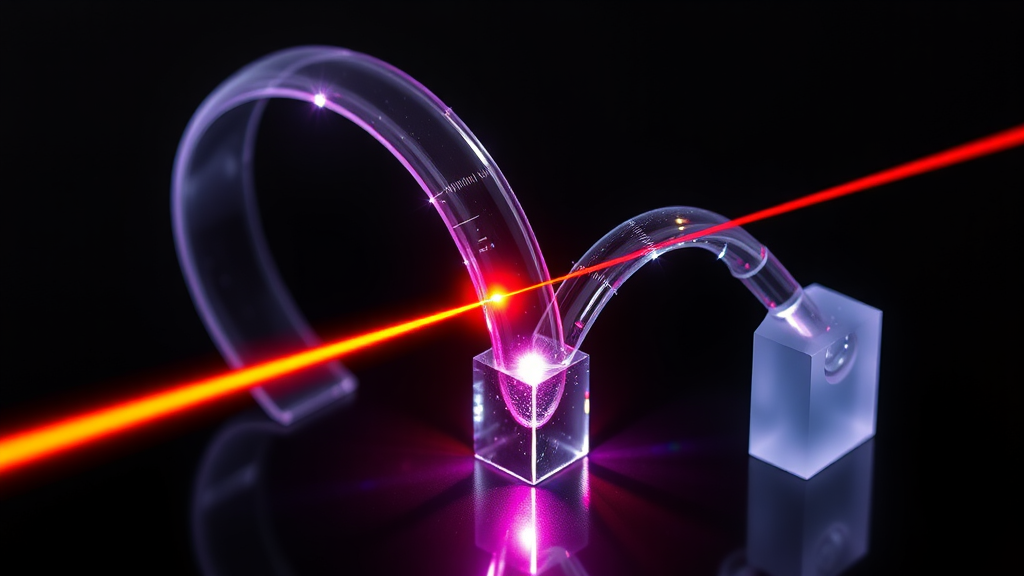
Researchers in Brazil have taken a significant step toward compact, three-dimensional photonic circuits that can amplify light on a chip. In a study published in Results in Optics, a team led by Thiago Vecchi Fernandes and Luciana Reyes Pires Kassab fabricated active S-bend and Y-branch waveguides directly inside a neodymium-doped lead-germanate glass containing silver nanoparticles, using femtosecond laser inscription. The work demonstrates, for the first time in this material system, that curved and branched waveguide architectures can not only guide light but also deliver measurable optical gain, opening the door to more complex integrated devices such as interferometers, ring resonators, and waveguide lasers.
The material at the heart of the study is a heavy-metal-oxide glass composed of 40 percent germanium dioxide and 60 percent lead oxide, doped with 1.0 weight percent neodymium oxide and containing silver nanoparticles introduced through 2.0 weight percent silver nitrate. Lead-germanate glasses have long attracted attention because they offer a compelling combination of properties: compared with silicates, they melt and form the glassy state at lower temperatures and readily accommodate rare-earth ions, which act as the amplifying centers for light. Unlike fluoride glasses, which demand carefully controlled atmospheres, they can be processed in ambient air without a glove box. The addition of metallic nanoparticles is known to enhance optical performance through localized surface plasmon effects, and these glasses also exhibit strong third-order nonlinear responses with ultrafast characteristics, making them attractive for advanced photonic applications.
The fabrication technique, femtosecond laser direct writing, has been a mainstay of integrated photonics since the mid-1990s, when researchers first showed that ultrashort pulses focused inside fused silica could write buried optical waveguides. When femtosecond pulses are tightly focused inside a transparent material, multiphoton absorption and tunneling ionization generate a localized electron plasma in the focal volume, producing irreversible structural modifications that alter the local refractive index. Because the modification is confined to the focal point, the technique offers spatial selectivity and true three-dimensional accessibility, enabling circuit layouts that conventional planar lithography struggles to produce. Extending the method to rare-earth-doped hosts has opened the prospect of active waveguides that amplify as well as guide light.
In this work, each waveguide consisted of a double-line structure formed by two parallel damage tracks separated by 10 micrometers, written by retracing the same path four times. This multiscan approach was chosen deliberately: sub-micrometer sidewall roughness has been reported as the dominant source of optical loss in femtosecond-laser-written waveguides, accounting for more than 90 percent of total attenuation through scattering, and repeated exposure under high pulse overlap progressively averages out periodic irregularities, producing smoother interfaces than single-pass writing. The double-line geometry corresponds to a Type II inscription regime, in which the laser creates damage tracks with a reduced refractive index at their center while the surrounding stressed regions experience an increased index. Because the guiding core lies outside the most heavily modified zones, the neodymium ions retain their optical activity, avoiding defect-induced quenching while still benefiting from stable index contrast for light confinement.
Three architectures were inscribed: a straight reference waveguide, an S-bend with a curvature radius of 40 millimeters, and a Y-branch with an opening angle of 5 degrees and an arm separation of 480 micrometers. These design choices were informed by the group’s earlier passive studies, which showed that optical performance improved gradually with increasing bend radius and that arm separations above 600 micrometers reduced the uniformity of light distribution between branches. The intermediate separation of 480 micrometers was selected to balance structural quality against a longer optical path, maximizing the potential gain. The refractive-index modification produced by the writing process was of the order of 10 to the minus 3, consistent with previous characterization of the same glass composition under identical irradiation conditions.
Characterizing the devices required some ingenuity. The standard cutback method, which measures loss by physically shortening a sample, cannot be applied to bent or branched guides, so the team evaluated relative propagation losses at 632 nanometers by comparing each device’s output power with that of a straight reference waveguide. Beam quality was assessed through the M-squared parameter at both 632 and 1064 nanometers following the ISO 11146 methodology, and the guided mode diameter of the straight waveguide was measured at approximately 11.4 and 11.3 micrometers in the horizontal and vertical directions using a calibrated imaging system with a 20.6-fold magnification. Optical microscopy with polarized contrast revealed the faint laser-modified structures, and guided mode profiles at 1064 nanometers were captured with a CCD camera, confirming light propagation through all three geometries, including simultaneous output from both Y-branch arms.
The active measurements revealed the most striking results. Pumping the waveguides at 808 nanometers with a continuous-wave laser diode while injecting a weak 1064-nanometer signal, the researchers recorded amplified spontaneous emission and stimulated emission spectra, from which they calculated relative gain. Extrapolation of the experimental data using a one-phase exponential decay function revealed saturation values of 7.5 decibels per centimeter for the straight waveguide, 6.5 decibels per centimeter for the S-bend, and 6.6 and 7.3 decibels per centimeter for the two Y-branch arms. After subtracting propagation losses, the internal gains stood at 5.61 decibels per centimeter for the straight guide, 3.86 for the S-bend, and 4.63 and 5.32 for the Y-branch arms. The straight waveguide, with its shortest propagation path, showed the lowest loss and the highest internal gain, while the S-bend, despite higher relative losses of 0.75 decibels per centimeter, still delivered clearly positive gain.
The Y-branch devices proved particularly interesting. The two arms exhibited very low relative losses of 0.08 and 0.09 decibels per centimeter and gains approaching those of the straight reference. A measured power-splitting ratio of 54 to 46 between the arms indicated a small asymmetry in the optical power delivered to each branch, which the authors attribute to fabrication tolerances and local geometric variations at the Y-junction. Notably, the slight differences in beam quality between the two arms, with M-squared values of 4.8 and 4.0 horizontally and vertically for one arm and 4.6 and 3.0 for the other at 632 nanometers, were consistent with the observed splitting asymmetry, suggesting that beam-quality measurements can serve as a sensitive diagnostic of junction uniformity in branched amplifying structures.
What makes these results remarkable is the interplay between gain and loss in non-linear geometries. Bending a waveguide normally introduces additional radiation losses, and splitting light into two branches reduces the power in each path. Yet in this material system, the internal gain provided by the neodymium ions, potentially enhanced by the plasmonic contribution of the silver nanoparticles, was sufficient to counterbalance the optical bending losses, confirming that both the glass chemistry and the double-line architecture are suitable for active, curved, and branched photonic circuits. The authors note that silver nanoparticles typically form during the annealing stage of glass preparation, though they cannot exclude additional nanoparticle growth or concentration changes during the femtosecond laser irradiation itself, a phenomenon previously reported in other glasses.
The broader implications extend across integrated photonics. Femtosecond laser writing has already produced ring resonators, high-gain amplifiers, beam splitters, fan-in and fan-out devices, mode multiplexers, and laser cavities in a variety of doped crystals and glasses. By demonstrating active S-bend and Y-branch structures in a silver-nanoparticle-enhanced neodymium-doped lead-germanate glass, the Brazilian team has added a versatile new platform to this landscape, one that combines the amplification needed for signal regeneration with the three-dimensional design freedom of laser direct writing. The findings suggest a path toward Mach-Zehnder interferometers, waveguide lasers, and resonant rings fabricated in a single monolithic substrate, bringing the vision of compact, self-amplifying photonic circuits a step closer to reality.
Subject of Research: Femtosecond laser-written active waveguides with optical gain in Nd3+-doped GeO2-PbO glass
Article Title: Integrated photonic platforms based on femtosecond laser-inscribed S-bend and Y-branch waveguides in Nd 3+ -doped GeO₂–PbO glass
Article References: Fernandes, T. V., Kumada, D. K., Wetter, N. U., de Rossi, W., & Kassab, L. R. P. (2026). Integrated photonic platforms based on femtosecond laser-inscribed S-bend and Y-branch waveguides in Nd3+-doped GeO₂–PbO glass. Results in Optics, Article 101174. https://doi.org/10.1016/j.rio.2026.101174
Image Credits: AI Generated
DOI: 10.1016/j.rio.2026.101174
Keywords: femtosecond laser, waveguide, neodymium doping, lead-germanate glass, silver nanoparticles, optical gain, integrated photonics, Y-branch, S-bend, photonic circuits, rare-earth ions, Integrated
Cite Scienmag News
Denise Maddox. (September 24, 2026). Femtosecond Laser Carves Light-Amplifying S-Bend and Y-Branch Waveguides in Silver-Enhanced Neodymium Glass. Scienmag. https://scienmag.com/femtosecond-laser-carves-light-amplifying-s-bend-and-y-branch-waveguides-in-silver-enhanced-neodymium-glass/
Denise Maddox. "Femtosecond Laser Carves Light-Amplifying S-Bend and Y-Branch Waveguides in Silver-Enhanced Neodymium Glass." Scienmag, 24 September 2026, https://scienmag.com/femtosecond-laser-carves-light-amplifying-s-bend-and-y-branch-waveguides-in-silver-enhanced-neodymium-glass/. Accessed 25 September 2026.
Denise Maddox. "Femtosecond Laser Carves Light-Amplifying S-Bend and Y-Branch Waveguides in Silver-Enhanced Neodymium Glass." Scienmag. September 24, 2026. https://scienmag.com/femtosecond-laser-carves-light-amplifying-s-bend-and-y-branch-waveguides-in-silver-enhanced-neodymium-glass/