


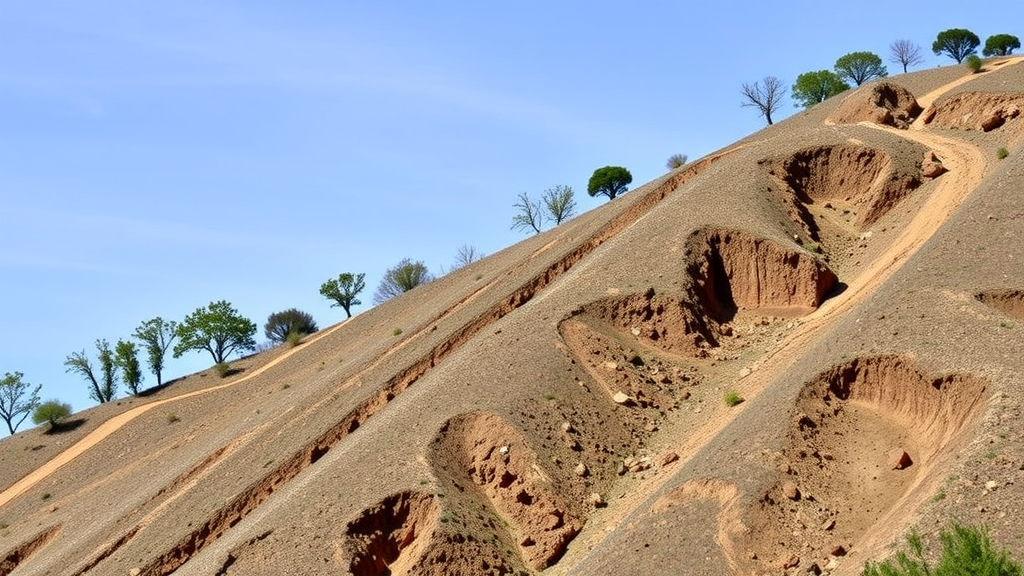
Landslides are among the most destructive geohazards facing the world’s rapidly growing cities, and a new study published in Environmental Challenges suggests that a hybrid reinforcement system combining geogrids with steel pin anchors could make steep slope protection both cheaper and more reliable. The research, led by Eriko Dewangga and Alfrendo Satyanaga together with colleagues from Universitas Indonesia and partner institutions, tackles a stubborn engineering problem: how to stabilize slopes built on weak, clay-rich soils without using excessive amounts of reinforcement material. By attaching J-shaped steel pins to the ends of shortened geogrid layers, the team demonstrated that a carefully calibrated anchorage system can compensate for reduced reinforcement length, but only up to a critical threshold beyond which no amount of pinning can save the design.
The urgency of this work is rooted in global urbanization trends. According to United Nations projections cited in the study, roughly 45 percent of the world’s population currently lives in urban areas, a figure expected to climb to about 60 percent by 2050. As cities expand vertically and laterally into topographically complex terrain, engineers must build on geologically difficult ground where slope failure threatens not only infrastructure but also environmental goals. Landslides degrade land, strip away vegetated cover, disrupt drainage systems, and expose urban communities to escalating geohazard risk, directly undermining the United Nations Sustainable Development Goals on sustainable cities and life on land.
The study’s setting is the Almaty Basin in Kazakhstan, a region flanked by the Zaili Alatau Mountains and blanketed in thick Quaternary sedimentary deposits. These soils, formed from the weathering of deeply buried Paleozoic bedrock, consist of heterogeneous mixtures of pebbles, sands, sandy loams, and clay-rich loams. Laboratory testing on soil sampled from Almaty at a depth of four meters classified the material as low-plasticity silty clay under the Unified Soil Classification System, with an effective friction angle of just 19 degrees and moderate cohesion of 33 kilonewtons per square meter. These weak shear parameters mean that failure surfaces tend to develop as shallow mechanisms within the weathered soil layer rather than in the intact rock below, particularly when rising pore water pressure accompanies rainfall infiltration.
To confront these conditions, the researchers turned to the Geobarrier System, or GBS, an integrated slope protection technology that evolved from the capillary barrier concept. A capillary barrier exploits the hydraulic contrast between an overlying fine-grained soil layer and an underlying coarse-grained layer: water infiltrating the fine layer is retained and diverted laterally by capillary forces rather than percolating downward into the slope. While effective, conventional capillary barriers are limited to slope inclinations of up to 45 degrees. The Geobarrier System overcomes this by adding retaining elements, drainage provisions, and geosynthetic reinforcement, allowing stable designs on slopes as steep as 70 degrees. Its facing is built from geobags filled with an Approved Soil Mixture that supports vegetation, turning the structure into a green, nature-based solution rather than a bare concrete wall.
In standard GBS practice, biaxial geogrids are connected to the geobags and extend into the soil mass behind the structure, mobilizing tensile resistance through frictional interaction with the compacted backfill. The customary minimum embedment length is 0.7 times the height of the structure, a figure consistent with guidance from the Federal Highway Administration and AASHTO for geosynthetic reinforced soil systems. Shortening the geogrid saves material and cost, but it risks insufficient anchorage: if the reinforcement does not extend beyond the potential failure surface, tensile stresses cannot be transferred into the stable region of the slope, and deformation escalates. The central question of the new study was whether steel J-pin anchors attached to the free ends of shortened geogrids could restore the lost stability.
Answering that question required a numerical model capable of simulating three distinct interactions simultaneously: soil against geogrid, geogrid against J-pin, and soil against J-pin. The team selected the general-purpose finite element software ABAQUS over the geotechnical package PLAXIS because ABAQUS offers the flexibility to model structure-to-structure contacts directly, something PLAXIS handles only through predefined interface elements. The researchers used ABAQUS/Explicit with central difference time integration to handle the severe geometric nonlinearity and complex contact conditions, while carefully monitoring the ratio of kinetic to internal energy, which stayed below 0.8 percent throughout the analyses, well under the 5 percent limit accepted for quasi-static behavior. Factor of safety values were computed with the strength reduction method, progressively scaling down the soil’s cohesion and friction angle until failure occurred, automated through a Python-based scripting framework.
The model represented a 12-meter-high, 25-meter-wide block of Almaty soil supporting a 4-meter-high GBS with eight reinforcement layers, a 70-degree face inclination, and a 10 kilonewton per square meter surcharge on the crest. The geogrid properties matched those of the Miragrid GX-80/30 product, providing 80 kilonewtons per meter of longitudinal strength, while the J-pins were modeled as 12-millimeter-diameter S275 steel rods, 0.5 meters long, with bilinear elastoplastic behavior. Before adding pins, the team validated their ABAQUS setup against PLAXIS 2D for the baseline 0.7H configuration and shortened variants of 0.6H, 0.5H, and 0.4H. Deformation differences between the two platforms ranged from 0.3 to 6.63 percent and factor of safety differences from 0.97 to 3.2 percent, comfortably within the 10 percent tolerance considered acceptable when comparing different computational platforms.
The validation runs alone revealed a stark pattern. Cutting the geogrid from 0.7H to 0.6H raised maximum deformation only modestly, from 6.98 to 7.37 millimeters, but shortening to 0.5H pushed deformation up by roughly 52 percent to 10.58 millimeters, and 0.4H produced a 140 percent increase to 16.74 millimeters. The factor of safety fell in parallel, from 1.34 at 0.7H to 1.24, 1.15, and finally 1.09 at 0.4H. When J-pins were then added one layer at a time, starting from the lowest geogrid, the results split cleanly. For the 0.6H model, deformation decreased steadily up to five pins before a slight rebound, and the factor of safety peaked at the same five-pin configuration. The 0.5H model improved up to six pins. The 0.4H model, however, showed only marginal gains, with its factor of safety hovering near unity regardless of how many pins were attached.
Force distribution data explained why. With eight pins installed, the J-pins carried 17.2 percent of the total reinforcement force in the 0.6H model and 19.3 percent in the 0.5H model, evidence of effective composite load transfer between geogrid and anchors. Individual pin contributions were non-uniform: middle layers, which experience the greatest driving forces, mobilized the most tensile resistance, while the topmost and bottommost pins contributed the least. In the 0.4H model, by contrast, the pins carried only 13.3 percent of the force and their contributions were evenly spread, a signature of a geometry-controlled failure mechanism in which the shortened geogrid simply cannot mobilize meaningful tensile resistance beyond the slip surface. The conclusion is unambiguous: anchorage density can compensate for moderate geogrid shortening, but below roughly 0.5H no number of pins can rescue the design in weak colluvial soil.
The team put their findings to the test in a pilot-scale field construction on a 3.5-meter slope, using the 0.5H design with five J-pins attached to the lowest five geogrid layers. Recycled concrete aggregates served as both the fine and coarse capillary barrier layers, underscoring the sustainability credentials of the approach, and young plants were established in vegetation pockets on the structure’s face. Numerical analysis of the as-built design predicted a maximum deformation of 6.5 millimeters and a factor of safety of 1.424, exceeding the long-term stability minimum required by British Standard BS 6031. One month after planting, the vegetation had grown into a substantial green cover, and the structure has shown no significant cracking or movement since completion. The authors caution that their model assumes idealized pin anchorage without progressive soil yielding around the shaft, so field-scale monitoring remains important, but the demonstrated threshold of 0.5H with five pins offers designers a practical, material-efficient rule for deploying geobarrier systems on the landslide-prone clay slopes found not only in Almaty but across comparable mountainous terrain worldwide.
Subject of Research: Hybrid geogrid and J-pin reinforced geobarrier systems for landslide prevention on clay-rich colluvial slopes
Article Title: Landslide preventive approach incorporating hybrid geogrid-J-pin reinforced geobarrier system
Article References: Landslide preventive approach incorporating hybrid geogrid-J-pin reinforced geobarrier system. (n.d.). Original publication
Image Credits: AI Generated
DOI: Not provided
Keywords: landslide prevention, geobarrier system, geogrid reinforcement, J-pin anchorage, slope stability, capillary barrier, finite element analysis, Almaty Kazakhstan, colluvial soils, strength reduction method, geosynthetics, nature-based solution
Cite Scienmag News
Sloane Callahan. (September 24, 2026). Steel Pins and Shorter Geogrids Offer a New Way to Stop Landslides on Unstable Slopes. Scienmag. https://scienmag.com/steel-pins-and-shorter-geogrids-offer-a-new-way-to-stop-landslides-on-unstable-slopes/
Sloane Callahan. "Steel Pins and Shorter Geogrids Offer a New Way to Stop Landslides on Unstable Slopes." Scienmag, 24 September 2026, https://scienmag.com/steel-pins-and-shorter-geogrids-offer-a-new-way-to-stop-landslides-on-unstable-slopes/. Accessed 24 September 2026.
Sloane Callahan. "Steel Pins and Shorter Geogrids Offer a New Way to Stop Landslides on Unstable Slopes." Scienmag. September 24, 2026. https://scienmag.com/steel-pins-and-shorter-geogrids-offer-a-new-way-to-stop-landslides-on-unstable-slopes/


