


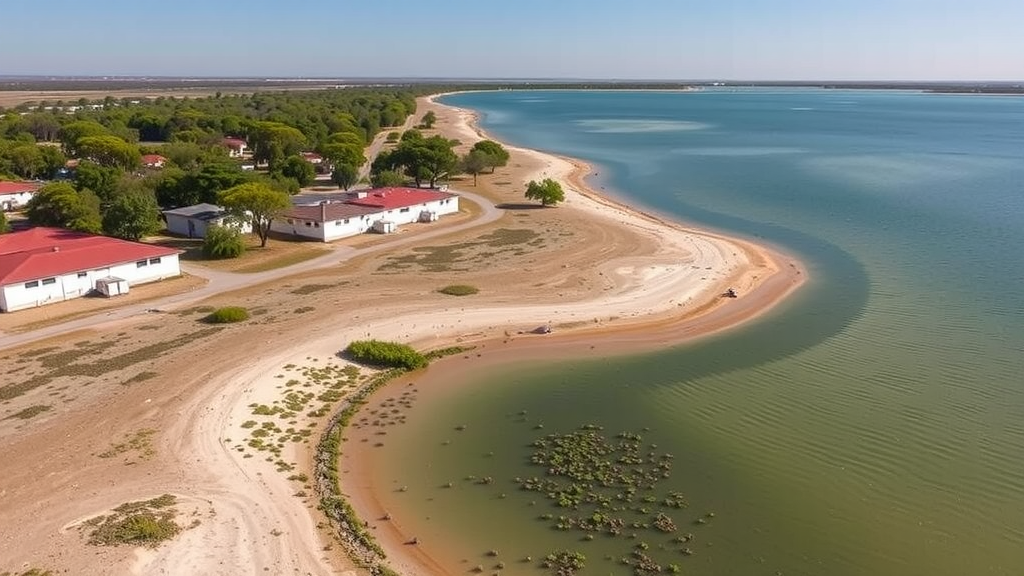
In the shallow, wind-scoured waters of Garzón lagoon on Uruguay’s Atlantic coast, scientists have documented one of the most complete ecological transformations a coastal ecosystem can undergo without losing its basic identity. Over a seven-year monitoring program running from 2018 to 2024, a research team led by Leandro Bergamino of the Universidad de la República tracked the animals living in and on the lagoon’s sediments, the chemistry of its water, and the rise and fall of its underwater plants. What they found was a lagoon operating in two fundamentally different modes, separated by a sharp transition that coincided with an explosion of submerged vegetation and a shift in the regional climate. The study, published in Environmental Monitoring and Assessment, offers a rare, finely resolved look at how quickly the foundations of a coastal food web can be rebuilt when the physical environment flips.
Coastal lagoons are among the most dynamic ecosystems on Earth. Stranded between rivers and the sea, often connected to the ocean only by a narrow, intermittently open inlet, they experience swings in salinity, water level, and temperature that would kill most marine or freshwater communities outright. The animals that thrive there, collectively known as macrozoobenthos, the worms, snails, insect larvae, and crustaceans large enough to see with the naked eye, are therefore extreme specialists in tolerating instability. For decades, ecologists have used these bottom-dwelling assemblages as biological barometers: because they live in the sediment and cannot easily flee deteriorating conditions, their species composition integrates environmental stress over weeks, months, and years. In Garzón, that barometer registered a dramatic change of weather, metaphorically and literally.
The research team assembled an unusually comprehensive dataset, combining regular benthic sampling with measurements of salinity, water depth, temperature, nutrient concentrations, and the biomass of submerged macrophytes, the rooted aquatic plants that grow entirely underwater. They also examined regional climatic trends to place the lagoon’s behavior in a broader context. The statistical analysis, which included methods for detecting shifts in multivariate community structure and partitioning the contributions of individual environmental drivers, revealed two clearly demarcated phases. The first, spanning 2018 to 2022, was a period of high environmental variability in which the lagoon had no submerged vegetation at all and the entire benthic community was dominated by a single estuarine gastropod, a small snail identified as Heleobia aff. australis.
That first phase tells a story of ecological simplification under stress. When salinity and temperature fluctuate widely, as they did in Garzón during those years, most bottom-dwelling species are pushed beyond their physiological limits. What survives is often a handful of generalists, and in this case one snail genus proved supremely well adapted to the lagoon’s erratic conditions. Heleobia snails are classic inhabitants of South American brackish waters, tolerant of both marine influence and freshwater pulses, and capable of reaching enormous densities on soft sediments. A community reduced essentially to one dominant species is not necessarily a dead community, but it is a fragile one, with simplified food webs and diminished functional redundancy, the insurance policy that biodiversity provides when conditions change.
The second phase, from 2023 to 2024, could hardly have been more different. Salinity dropped to stable low levels, and into that newly freshened water came an exuberant growth of Myriophyllum quitense, a submerged macrophyte also known as Andean water milfoil. The plant spread through the lagoon with such vigor that the researchers describe it as excessive growth, blanketing sediments that had been bare sand and mud for years. Where plants go, animals follow. The benthic assemblage reorganized around a new cast of characters: Heleobia parchappii, a freshwater-tolerant relative of the earlier dominant snail, and chironomids, the larval stage of non-biting midges, which are classic opportunists in nutrient-rich, vegetated freshwaters. Both are considered opportunistic taxa, species that capitalize rapidly on newly available habitat and resources.
The mechanistic chain the researchers traced is a textbook example of how climate variability can cascade through an ecosystem. Regional climatic anomalies during the study period altered the hydrological balance of the lagoon, changing the mix of freshwater inflow and marine exchange that determines its salinity regime. Between 2018 and 2022, the statistical models showed that species responses were governed primarily by salinity and temperature, the abiotic master variables of any estuarine system. Once those variables stabilized at low salinity in 2023 and 2024, the picture changed. Salinity relief opened the door for macrophyte colonization, and once the plants established, the dominant factors structuring the benthic community became a broader set that included macrophyte biomass itself. In other words, the ecosystem shifted from being controlled purely by physical stress to being co-organized by its own living structure.
This transition from physical to biological control has deep roots in ecological theory. Submerged macrophytes are ecosystem engineers: they slow water movement, trap fine sediments, release oxygen through their tissues into the sediment, and provide a three-dimensional habitat that shelters small invertebrates from predators. Their presence can lock a shallow lagoon into a clear-water, vegetated state, while their absence leaves the system vulnerable to wind-resuspended sediments and phytoplankton dominance. Theorists have long described such systems as having alternative stable states, with abrupt transitions between them. Garzón’s seven-year record provides a real-time illustration of one side of that switch: a bare, salinity-stressed, single-species benthos giving way to a vegetated, freshened, multi-taxon community within roughly two years.
The findings carry practical weight for environmental management well beyond Uruguay. Coastal lagoons worldwide face a pincer movement from climate change and eutrophication, with warming, altered rainfall, sea-level rise, and nutrient runoff all pushing on the same sensitive levers of salinity and nutrient balance. Monitoring programs, which many countries maintain at considerable expense, are sometimes criticized as slow to reveal anything actionable. This study demonstrates the opposite: a well-designed monitoring series, combining physicochemical measurements with benthic sampling, can detect structural reorganization in an ecosystem as it happens, and can attribute that reorganization to identifiable drivers. The physicochemical data underlying the work are publicly available through Uruguay’s National Environmental Observatory, and the monitoring itself was conducted under a formal collaboration between Uruguay’s Ministry of Environment and the Universidad de la República, a model of how government science agencies and universities can pool resources.
There is also a cautionary note embedded in the data. The arrival of lush submerged vegetation and a more diverse benthic community might look like recovery, and in some respects it is: more species, more habitat structure, more pathways for energy flow. But the new assemblage is dominated by freshwater-tolerant opportunists, and the underlying driver was climatic anomaly, not pollution control or restoration. If regional rainfall and hydrology swing back, the lagoon could flip again, and each flip resets the benthic community to whichever species can colonize fastest. Ecologists have increasingly recognized that biodiversity change in dynamic ecosystems is often about turnover rather than simple loss, with species replacing one another as conditions cycle. Garzón’s record captures that turnover in unusually sharp relief, showing that the identity of a lagoon’s inhabitants can be rewritten almost entirely within the span of a monitoring career.
For the researchers, the broader lesson is about speed. Rapid submerged plant growth, triggered by a window of stable low salinity, restructured an entire benthic assemblage faster than most ecological studies are designed to detect. As climate variability intensifies, the windows are opening and closing more abruptly in transitional ecosystems everywhere, from Mediterranean lagoons to Baltic coastal bays. The Garzón study suggests that the communities living in these systems are not slowly adjusting to a changing world but are instead being periodically dismantled and reassembled, with each reassembly contingent on the particular sequence of salinity, temperature, and vegetation that precedes it. Seven years of patient sampling on a windswept Uruguayan lagoon has made that hidden choreography visible, and it is a choreography that coastal managers, and the ecosystems they steward, will need to learn to anticipate.
Subject of Research: Temporal changes in macrobenthic diversity during rapid submerged macrophyte growth in a subtropical coastal lagoon
Article Title: Temporal changes of macrobenthic diversity during rapid submerged plant growth in a subtropical coastal lagoon
Article References: Temporal changes of macrobenthic diversity during rapid submerged plant growth in a subtropical coastal lagoon. (n.d.). https://doi.org/10.1007/s10661-026-15968-w
Image Credits: AI Generated
DOI: 10.1007/s10661-026-15968-w
Keywords: coastal lagoon, macrobenthos, biodiversity, submerged macrophytes, Myriophyllum quitense, salinity, climate variability, Uruguay, environmental monitoring, benthic communities, ecosystem regime shift, Heleobia
Cite Scienmag News
Violet Maxwell. (September 24, 2026). A Uruguayan Lagoon Flipped Its Entire Bottom-Dwelling Community in Just Two Years. Scienmag. https://scienmag.com/a-uruguayan-lagoon-flipped-its-entire-bottom-dwelling-community-in-just-two-years/
Violet Maxwell. "A Uruguayan Lagoon Flipped Its Entire Bottom-Dwelling Community in Just Two Years." Scienmag, 24 September 2026, https://scienmag.com/a-uruguayan-lagoon-flipped-its-entire-bottom-dwelling-community-in-just-two-years/. Accessed 24 September 2026.
Violet Maxwell. "A Uruguayan Lagoon Flipped Its Entire Bottom-Dwelling Community in Just Two Years." Scienmag. September 24, 2026. https://scienmag.com/a-uruguayan-lagoon-flipped-its-entire-bottom-dwelling-community-in-just-two-years/


