


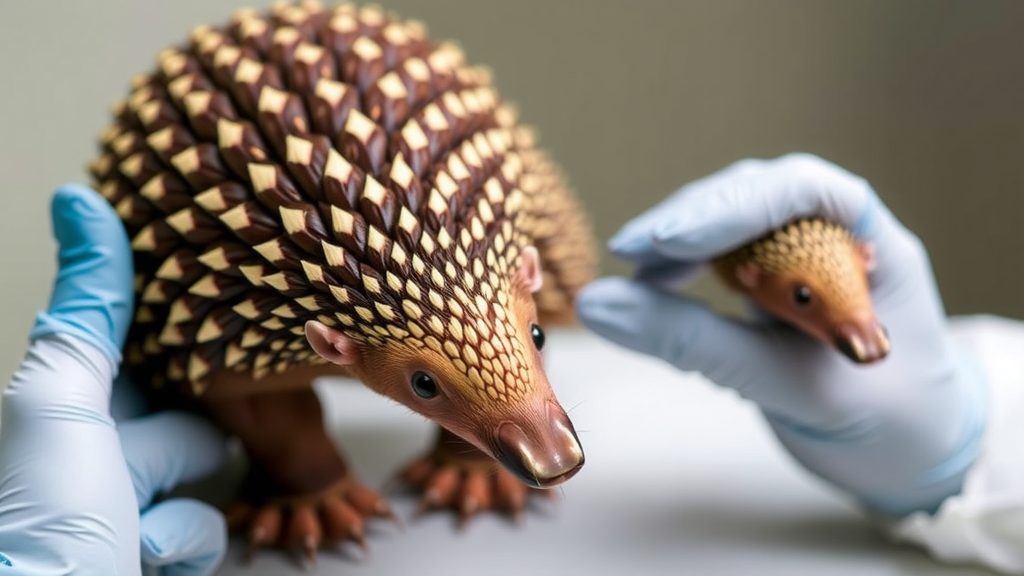
For the first time, scientists have validated a non-invasive hormone test for one of the world’s most trafficked and most stress-sensitive mammals, the Temminck’s pangolin, using nothing more than faecal samples collected from rescued animals. The study, published in Discover Conservation, marks a milestone for a species so fragile that handling it for research has long been considered impossible. By biologically validating enzyme immunoassays (EIAs) against real stressors experienced by confiscated pangolins undergoing rehabilitation, a South African research team has given conservationists a practical tool to measure physiological stress without ever touching the animals they are trying to save.
The research was born of necessity. Temminck’s pangolin (Smutsia temminckii) is classified as Vulnerable by the International Union for Conservation of Nature, and its populations have declined drastically across its range due to poaching for illegal wildlife and traditional medicine trades, habitat loss, electric fences, and overexploitation. Individuals rescued from traffickers often arrive at rehabilitation facilities in poor condition and require extended care before they can be released. Yet the species is notoriously stress-prone, and ethical, logistical, and conservation constraints make it impossible to capture, hold, or conduct experimental manipulations on pangolins purely for research purposes. Traditional physiological validation, which involves administering a compound such as adrenocorticotropic hormone to artificially activate the stress axis, was therefore off the table.
To understand why this matters, it helps to look at how stress hormones work. The physiological stress response involves two main systems: the sympathetic nervous system, which triggers the familiar ‘fight or flight’ release of catecholamines, and the hypothalamic–pituitary–adrenal (HPA) axis, which drives the secretion of glucocorticoid steroid hormones. An acute rise in glucocorticoids is adaptive, mobilising energy, enhancing cardiovascular activity, and shifting behaviour to restore homeostasis. But chronic elevation carries serious costs, including immune and reproductive suppression and a general decline in fitness. Researchers therefore track glucocorticoid concentrations as a proxy for the stress an individual experiences and its likely consequences for survival and reproduction.
Blood sampling, the traditional route for hormone monitoring, is particularly problematic for pangolins. Capturing and restraining an animal to draw blood activates the very stress response researchers want to measure, with blood glucocorticoids rising significantly within three to five minutes of capture. Repeated collections are impractical for small-bodied species with limited blood volumes, and serum or plasma hormone levels fluctuate with pulsatile secretion patterns, circadian rhythms, and feeding state. For threatened species, invasive endocrine monitoring has fallen out of favour across much of the research community.
Non-invasive monitoring sidesteps these problems. Once steroid hormones are secreted into the bloodstream by the HPA axis, the liver metabolises them and excretes them in bile and faeces. Because metabolites pool in the gut, faecal glucocorticoid metabolite (fGCM) concentrations provide a smoother, longer-term signal spanning several hours, rather than a snapshot distorted by episodic hormone pulses. Collecting faeces requires no direct human–animal interaction, eliminates stress-related feedback from handling, and allows repeated longitudinal sampling from small-bodied species. But there is a catch: hormone metabolism and excretion are sex- and species-specific, so any EIA must be validated in each species before its results can be trusted.
The team, led by Juan Scheun of the BioPulse Research Group at Tshwane University of Technology, together with colleagues from the South African National Biodiversity Institute, Tshwane University of Technology, and the Mammal Research Institute at the University of Pretoria, turned to biological validation. They opportunistically collected 28 faecal samples from five Temminck’s pangolins—three females and two males—confiscated from the illegal wildlife trade and admitted to the Johannesburg Wildlife Veterinary Hospital during 2020 and 2021. Samples were gathered before and after known stressors such as confiscation, veterinary handling, and transport, with samples collected during periods of no handling serving as baselines. For security reasons, the animals were housed at an undisclosed off-site location, and the hospital’s welfare policies meant no strict sampling regime could be imposed; staff simply collected fresh faeces whenever animals defecated, sometimes days apart.
In the laboratory, frozen samples were lyophilised, pulverised, and sieved, then extracted with 80% ethanol and analysed at the Endocrine Research Laboratory of the University of Pretoria using five different EIAs: a cortisol assay, a corticosterone assay, two 11-oxoaetiocholanolone assays (designated 72a and 72T), and a 5α-pregnane-3ß,11ß,21-triol-20-one assay (37e). Serial dilutions produced displacement curves parallel to the standard curves in all assays, confirming analytical validity. The researchers then applied a stringent criterion: an assay was considered reliable only if it detected peak fGCM increases exceeding 150% above baseline, a tougher threshold than the 100% often used in comparable studies, to reduce the risk of false positives.
The results were striking. In female 1, the 72a assay recorded a 982% increase in fGCM concentrations following a stressful event, with 72T close behind at 763%, followed by the cortisol assay at 481% and 37e at 317%. Female 2 showed increases above the 150% threshold for 37e (325%), 72T (221%), and 72a (201%), and her secondary fGCM rise coincided with a move to a holding facility ahead of release. Female 3 exceeded the threshold on both 72a (339%) and 72T (251%). Among the males, only 72a detected increases above 150% in both individuals, reaching 168% in male 1 and 695% in male 2, where the cortisol assay also responded strongly at 437%. Notably, in female 2, fGCM levels rose considerably before a decline in health that led to her readmission to the rehabilitation centre, hinting that hormone monitoring might one day flag deteriorating welfare before clinical signs appear.
The standout performer was the 72a assay, the only one to exceed the 150% threshold in every study animal of both sexes, making it the recommended tool for monitoring fGCM levels in Temminck’s pangolin. The 72T assay proved a strong alternative for females, while 37e, which exceeded 100% increases in all females, can serve as a back-up when the primary assays are unavailable. The cortisol assay should be treated as equivocal pending further validation. Interestingly, the finding that cortisol metabolites dominated the faecal profile contrasts with work on the Taiwanese pangolin, where mass spectrometry revealed higher faecal corticosterone concentrations, though that study measured actual hormones rather than immunoreactive metabolites, and the authors suggest mass spectrometry could further clarify active circulating glucocorticoids in Temminck’s pangolin.
Beyond the assay validation itself, the study delivers an uncomfortable but important message: direct human interaction, even in the context of care and rehabilitation, elicits pronounced physiological stress responses in pangolins, with increases exceeding 100% across all study animals. Similar patterns have been documented in rehabilitated African penguins and koalas. The findings argue for refining rehabilitation protocols to minimise human contact and for assessing individuals physiologically before release to improve survival odds. The authors caution that the small sample size limits generalisability, that excretion time lags could not be determined for the species—gut passage times in other pangolins range from roughly 20 to 60 hours—and that individual variation in stress perception likely shapes adrenal responses. Even so, the validated 72a EIA now offers researchers, conservationists, and rehabilitation managers a way to track stress in captive settings and, crucially, in free-ranging populations, where pressures such as climate change are expected to intensify. For an animal that rolls into an armour-plated ball when threatened, the ability to read its stress from a dropping may prove one of the most powerful conservation tools yet devised.
Subject of Research: Biological validation of non-invasive faecal glucocorticoid metabolite enzyme immunoassays for measuring physiological stress in rehabilitated Temminck's pangolins
Article Title: Biological validation of enzyme immunoassays for measuring physiological stress in rehabilitated Temminck’s pangolins
Article References: Scheun, J., Labuschagne, K., Jansen, R., Ganswindt, A., & Long, C. (2026). Biological validation of enzyme immunoassays for measuring physiological stress in rehabilitated Temminck’s pangolins. Discover Conservation, 3(1), Article 20. https://doi.org/10.1007/s44353-026-00090-2
Image Credits: AI Generated
DOI: 10.1007/s44353-026-00090-2
Keywords: Temminck's pangolin, faecal glucocorticoid metabolites, enzyme immunoassay, stress physiology, wildlife rehabilitation, non-invasive hormone monitoring, conservation, HPA axis, animal welfare, illegal wildlife trade, biological validation, South Africa
Cite Scienmag News
Margaret Porter. (September 24, 2026). Scientists Crack Stress Testing for Rescued Pangolins Using Just Their Droppings. Scienmag. https://scienmag.com/scientists-crack-stress-testing-for-rescued-pangolins-using-just-their-droppings/
Margaret Porter. "Scientists Crack Stress Testing for Rescued Pangolins Using Just Their Droppings." Scienmag, 24 September 2026, https://scienmag.com/scientists-crack-stress-testing-for-rescued-pangolins-using-just-their-droppings/. Accessed 24 September 2026.
Margaret Porter. "Scientists Crack Stress Testing for Rescued Pangolins Using Just Their Droppings." Scienmag. September 24, 2026. https://scienmag.com/scientists-crack-stress-testing-for-rescued-pangolins-using-just-their-droppings/


