


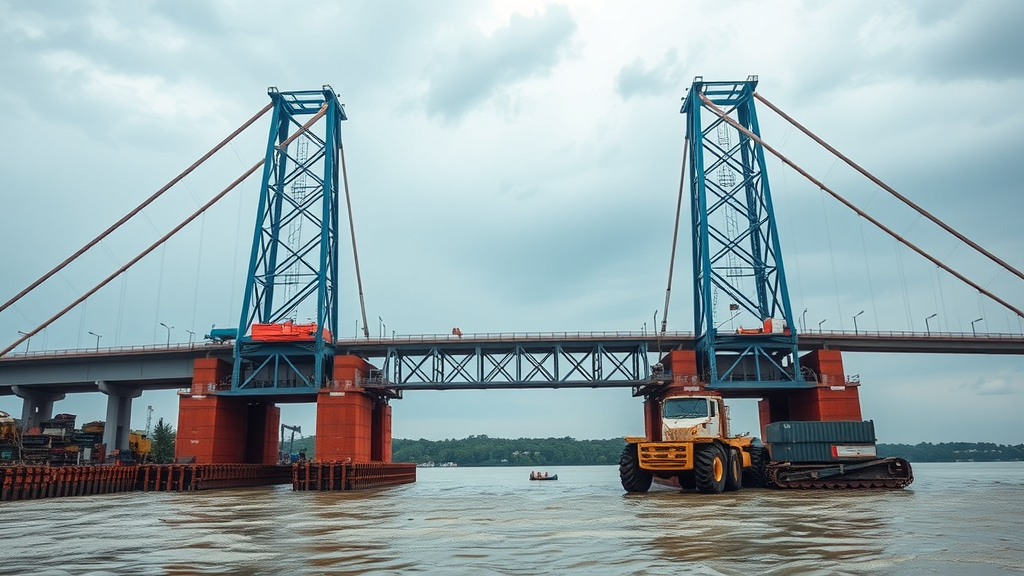
When rivers flood, they do more than rise. The fast-moving water scours away the sediment that surrounds the foundations of bridges, leaving piles and pile caps more exposed than their designers ever intended. If an earthquake then strikes a bridge in this weakened state, a dangerous and poorly understood failure mode can emerge: the entire pile-group foundation can rock, rotate, and even begin to lift out of the ground. A new study published in the Bulletin of Earthquake Engineering by Jingcheng Wang, Hao Luo, Xiaowei Wang, and Yin Gu, researchers at Fuzhou University and Tongji University in China, has for the first time put hard probabilities on that uplift risk, producing fragility curves that tell engineers just how likely pile uplift becomes at any given level of ground shaking.
The concept at the heart of the paper is seismic uplift fragility, defined as the conditional probability that pile uplift will occur given a particular ground motion intensity measure. Fragility analysis is a cornerstone of modern earthquake engineering because it converts the messy, uncertain physics of soil-structure interaction into probabilistic statements that can feed directly into risk assessment and design codes. Previous research had established that scour removes overburden soil around the pile cap, amplifies pile-cap rotations during shaking, and can trigger uplift of the piles themselves. But the authors note that the seismic uplift behavior of scoured pile-group foundations had never been probabilistically quantified, leaving a significant gap in multi-hazard bridge assessment.
To close that gap, the team built an extensive numerical modeling campaign. They established 49 archetype bridge configurations by varying twelve structural and geotechnical parameters, including pile length, pile spacing, axial load ratio, and the longitudinal reinforcement ratio of the piles. The bridges were founded in cohesionless soils, meaning sandy, non-clayey sediments of exactly the kind that scour attacks most aggressively and that are common beneath river and coastal crossings. Each archetype was subjected to suites of ground motions, and the resulting simulations were mined for the quantities that best track uplift behavior.
A central technical contribution of the study is the careful selection of the response metrics used in the probabilistic demand models. The researchers systematically compared candidate engineering demand parameters and intensity measures, and concluded that the peak rotation of the pile cap is the optimal engineering demand parameter for quantifying uplift, while the Housner intensity, a measure based on the energy content of the ground motion, is the optimal intensity measure. Crucially, they found that pile-cap rotation is more efficient and more practical than the pile cap’s lateral displacement for characterizing uplift demand. Rotation, it turns out, directly captures the rocking mechanism that precedes uplift, whereas lateral displacement conflates rocking with sliding and bending responses, diluting the statistical relationship.
With demand quantified, the team then turned to capacity. Uplift capacity models were derived from the pile-cap rotations at the onset of uplift, effectively defining the rotation threshold beyond which part of the pile group begins to pull free of the surrounding soil. When a rocking foundation reaches this point, load redistributes to the remaining compressed piles, soil resistance on the uplifted side vanishes, and the energy dissipation and recentering behavior of the foundation change fundamentally. Combining the probabilistic demand models with these capacity models yielded the study’s headline output: seismic uplift fragility curves for scoured pile-group foundations in cohesionless soils.
The numbers are sobering. For the base bridge model, the probability of uplift reaches 82 percent under a seismic hazard level associated with a 475-year return period, the design-level event around which many modern seismic codes are organized. In other words, a bridge whose foundations have been scoured has a very high likelihood of experiencing pile uplift when struck by an earthquake of the magnitude engineers already plan for. Because uplift initiates the transition from a ductile rocking response toward potentially uncontrolled foundation movement, an 82 percent probability at the design event represents a serious vulnerability, particularly for the aging river and coastal bridges that dominate many transportation networks.
The parametric analysis that followed is where the study becomes most directly useful to practitioners. The fragility decreases as pile length increases, as pile spacing increases, and as the axial load ratio rises, while it increases as the longitudinal reinforcement ratio of the piles decreases. Among all the parameters examined, pile length was identified as the single most influential factor. Each of these trends has an intuitive physical basis. Longer piles provide deeper embedment and greater resistance to pullout. Wider spacing reduces the overlapping stress zones between adjacent piles, letting each pile mobilize more of the surrounding soil. Higher axial load on the foundation provides a stabilizing, self-weight-driven resistance to rocking and uplift. Conversely, less longitudinal reinforcement weakens the capacity of individual piles to sustain the tension that develops during rocking, making uplift and its consequences more damaging.
These findings resonate with a broader body of experimental work on rocking foundations. Quasi-static tests and shaking table studies by the same research group and by others in recent years have shown that scoured pile-group foundations exhibit distinctive uplift behavior and energy dissipation mechanisms, and that rocking can sometimes even be harnessed as a deliberate design strategy when the foundation is detailed to recenter after shaking. The new study adds the probabilistic layer that such experimental work lacks, translating deterministic observations into fragility statements that can be integrated into regional risk models, resilience assessments, and retrofit prioritization for bridge stocks exposed to both flood scour and seismic hazard.
Recognizing that running full nonlinear finite element simulations of 49 archetype bridges is impractical for routine design offices, the authors also distilled their results into practical tools. They established and validated multivariate linear regression models that allow rapid estimation of uplift fragility from the key design parameters, without the need for expensive simulation. This surrogate modeling approach mirrors a wider trend in earthquake engineering, in which machine-learned and regression-based approximations of physics-based analyses are used to bring probabilistic assessment within reach of everyday engineering workflows. For a bridge engineer wondering whether a scour-critical crossing needs longer piles, wider spacing, or enhanced reinforcement, the regression models offer a first-order answer in seconds.
The broader significance of the work lies in its treatment of concurrent hazards. Flood-induced scour and earthquakes are usually assessed separately, yet they are physically coupled in ways that can dramatically worsen outcomes. Scour weakens exactly the soil-foundation system that must resist seismic demands, and climate-driven changes in flood frequency suggest that more bridges will spend more of their service lives with compromised foundations. By delivering the first probabilistic quantification of seismic uplift fragility for scoured pile-group foundations in cohesionless soils, the Fuzhou University and Tongji University team has given the engineering community both a warning and a toolkit: multi-hazard assessment is not optional for river and coastal bridges, and the levers that most reduce uplift risk, above all pile length, are already in the hands of designers.
Subject of Research: Seismic uplift fragility analysis of scour-affected bridge pile-group foundations in cohesionless soils
Article Title: Seismic uplift fragility of scoured bridge pile-group foundations in cohesionless soils
Article References: Wang, J., Luo, H., Wang, X., & Gu, Y. (2026). Seismic uplift fragility of scoured bridge pile-group foundations in cohesionless soils. Bulletin of Earthquake Engineering. https://doi.org/10.1007/s10518-026-02686-4
Image Credits: AI Generated
DOI: 10.1007/s10518-026-02686-4
Keywords: bridge scour, pile-group foundation, seismic fragility, pile uplift, cohesionless soils, Housner intensity, pile-cap rotation, probabilistic seismic demand, multi-hazard assessment, sensitivity analysis, regression surrogate model, earthquake engineering
Cite Scienmag News
Violet Maxwell. (September 24, 2026). Scouring Floods and Earthquakes Combine to Lift Bridge Foundations, Study Warns. Scienmag. https://scienmag.com/scouring-floods-and-earthquakes-combine-to-lift-bridge-foundations-study-warns/
Violet Maxwell. "Scouring Floods and Earthquakes Combine to Lift Bridge Foundations, Study Warns." Scienmag, 24 September 2026, https://scienmag.com/scouring-floods-and-earthquakes-combine-to-lift-bridge-foundations-study-warns/. Accessed 24 September 2026.
Violet Maxwell. "Scouring Floods and Earthquakes Combine to Lift Bridge Foundations, Study Warns." Scienmag. September 24, 2026. https://scienmag.com/scouring-floods-and-earthquakes-combine-to-lift-bridge-foundations-study-warns/


