


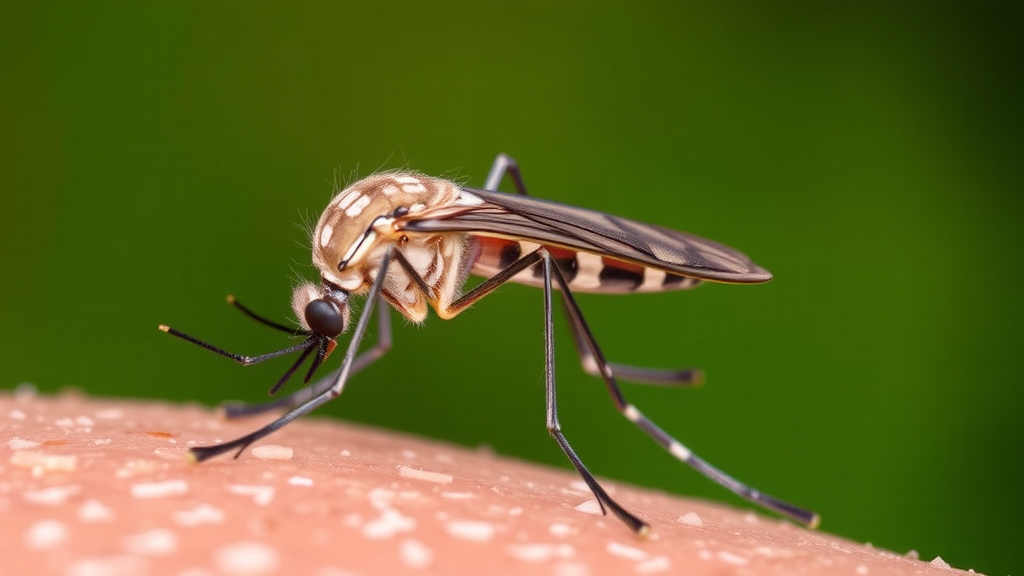
West Nile virus remains the most widely distributed mosquito-borne disease in North America, and the factors that determine when and where transmission flares up are more complicated than a simple matter of mosquitoes and virus. A new laboratory study published in Parasites & Vectors suggests that two environmental pressures increasingly common in urban and agricultural landscapes — residual insecticide pollution in breeding waters and rising ambient temperatures — do not act independently on the mosquito vector. Instead, they interact in ways that can either suppress or amplify the potential for Culex pipiens, the primary enzootic vector of West Nile virus in much of the United States, to transmit the virus to new hosts. The findings carry implications for how mosquito control programs and public health agencies think about the unintended consequences of pesticide use in a warming world.
The research, led by Kylee R. Noel and colleagues at the University of Illinois Urbana-Champaign and the Illinois Natural History Survey, set out to answer a question that has received surprisingly little rigorous experimental attention. Insecticides applied to agricultural fields, suburban lawns, and mosquito control zones inevitably find their way into surface waters, where concentrations rarely reach levels that kill mosquito larvae outright. Yet these sublethal concentrations can still perturb larval physiology, development, and behavior. Because many of the traits that determine how efficiently a mosquito transmits a virus — adult survival, fecundity, and vector competence — are shaped during the aquatic juvenile stages, the researchers hypothesized that early-life insecticide exposure could leave a lasting imprint on transmission potential.
To test this, the team reared Culex pipiens larvae under standard insectary conditions, with temperatures maintained at approximately 27.6 degrees Celsius, relative humidity around 70 percent, and a photoperiod of 16 hours of light and 8 hours of darkness. One group of larvae was exposed to a sublethal concentration of permethrin, a widely used synthetic pyrethroid insecticide, at 0.01 milligrams per liter — a dose low enough not to cause mortality but high enough to exert physiological stress. Upon eclosion, adult mosquitoes from both the exposed and unexposed control groups were transferred into environmental chambers held at either 25 or 29 degrees Celsius, two temperatures within the range that Culex pipiens routinely experiences during the summer transmission season in the American Midwest.
The experimental design is notable because it separates the larval and adult environments, allowing the investigators to disentangle effects that occur during development from those imposed on the adult stage. Mosquitoes infected with West Nile virus were then monitored across the key parameters that together constitute vectorial capacity, the epidemiological framework used to estimate how effectively a vector population can transmit a pathogen. These parameters include adult survival, which determines how long a female lives and therefore how many blood meals she can take; fecundity, which influences population growth; and vector competence, a composite measure encompassing infection rate, dissemination rate from the midgut to other tissues, and the ability to transmit virus in saliva during a subsequent bite.
The life-history results revealed that permethrin exposure during the larval stage slowed development: exposed larvae took longer to mature into adults than untreated controls. More strikingly, the adult females that emerged from treated larvae survived longer than their control counterparts. Extended adult longevity is a critical variable in vectorial capacity, because the extrinsic incubation period of West Nile virus — the time it takes for an infected mosquito to become infectious — must be shorter than the mosquito’s lifespan for transmission to occur. Females that live longer have a greater probability of surviving that incubation window and biting another host while infectious, effectively multiplying their contribution to the transmission cycle.
Temperature exerted its own powerful influence on the virological side of the equation. At 29 degrees Celsius, mosquitoes showed higher infection and dissemination rates, and viral RNA was detected at greater levels within mosquito tissues, compared with the cooler 25 degree environment. This pattern is consistent with a broader literature showing that warmer temperatures accelerate viral replication within mosquito vectors, shortening the extrinsic incubation period and pushing mosquitoes to infectious status sooner after an infective blood meal. However, the study’s most consequential finding emerged when the two stressors were analyzed together rather than in isolation.
At 29 degrees Celsius, the control mosquitoes — those with no larval insecticide exposure — exhibited the lowest transmission potential of any group in the experiment. By contrast, mosquitoes that had been exposed to permethrin as larvae displayed markedly higher transmission potential under the same warm conditions. This interaction indicates that sublethal pesticide exposure and elevated temperature do not simply add their effects; they combine in a non-additive manner that reshapes the overall transmission equation. A warmer world, in other words, may not uniformly increase West Nile virus risk — the outcome depends on what the vector population experienced during its aquatic development, and urban or agricultural waters contaminated with pyrethroid residues could tip the balance toward greater transmission.
Why would larval chemical stress enhance transmission potential at high temperatures while control mosquitoes fared worse? The authors’ data suggest that the combination of extended adult survival in permethrin-exposed females and temperature-driven gains in infection and dissemination rates produced a population of longer-lived, more competent vectors precisely under the conditions where unexposed mosquitoes performed least well. The physiological mechanisms linking larval permethrin exposure to adult longevity and vector competence were not fully resolved in this experiment, but stress-induced changes in larval metabolism, immune priming, or resource allocation could plausibly alter adult physiology in ways that interact with viral kinetics at elevated temperatures. Further mechanistic work will be needed to pin down these pathways, and the authors note that their experiment used a single permethrin concentration and two adult temperatures, leaving open questions about dose-response relationships and the full thermal range experienced in the field.
The public health and environmental implications are substantial. Mosquito abatement districts routinely apply pyrethroids as larvicides and adulticides, and agricultural runoff delivers additional residues into stormwater ponds, drainage ditches, and other habitats where Culex pipiens breeds. If those residues leave surviving larvae physiologically primed for greater transmission as adults — particularly during heat waves, when West Nile virus epidemics historically peak — then conventional insecticide use could carry an unrecognized trade-off: suppressing mosquito abundance in the short term while inadvertently enhancing the transmission efficiency of the mosquitoes that survive. The study therefore argues for integrated surveillance that monitors not just mosquito numbers but the chemical and thermal conditions of larval habitats, especially in environments exposed to rising temperatures driven by climate change.
As with all laboratory studies, translating these results to real-world epidemics will require field validation, since wild mosquito populations encounter fluctuating temperatures, heterogeneous insecticide mixtures, and competing larval stresses that a controlled chamber experiment cannot fully replicate. Nevertheless, the work provides a clear experimental demonstration that the developmental environment of a disease vector can rewrite the rules of transmission established by adult conditions alone. For a virus like West Nile, whose seasonal dynamics depend on a delicate interplay between vectors, hosts, and climate, understanding these cross-generational and cross-stressor interactions may prove essential for predicting and preventing the outbreaks of the future. The research was supported by the State of Illinois Used Tire Management and Emergency Public Health funds and by a grant from the University of Illinois Center for Advanced Climate Solutions.
Subject of Research: Interaction of sublethal insecticide exposure and temperature on West Nile virus transmission by Culex pipiens mosquitoes
Article Title: Sublethal insecticide exposure and temperature interact to shape West Nile virus transmission potential of Culex pipiens
Article References: Sublethal insecticide exposure and temperature interact to shape West Nile virus transmission potential of Culex pipiens. (n.d.). https://doi.org/10.1186/s13071-026-07700-x
Image Credits: AI Generated
DOI: 10.1186/s13071-026-07700-x
Keywords: West Nile virus, Culex pipiens, permethrin, sublethal exposure, vector competence, vectorial capacity, temperature, insecticide pollution, mosquito-borne disease, Parasites & Vectors, life history traits, climate change
Cite Scienmag News
Kristina Jarvis. (September 24, 2026). Larval Insecticide Exposure and Warmer Temperatures Reshape West Nile Virus Risk from Culex Mosquitoes. Scienmag. https://scienmag.com/larval-insecticide-exposure-and-warmer-temperatures-reshape-west-nile-virus-risk-from-culex-mosquitoes/
Kristina Jarvis. "Larval Insecticide Exposure and Warmer Temperatures Reshape West Nile Virus Risk from Culex Mosquitoes." Scienmag, 24 September 2026, https://scienmag.com/larval-insecticide-exposure-and-warmer-temperatures-reshape-west-nile-virus-risk-from-culex-mosquitoes/. Accessed 24 September 2026.
Kristina Jarvis. "Larval Insecticide Exposure and Warmer Temperatures Reshape West Nile Virus Risk from Culex Mosquitoes." Scienmag. September 24, 2026. https://scienmag.com/larval-insecticide-exposure-and-warmer-temperatures-reshape-west-nile-virus-risk-from-culex-mosquitoes/


