


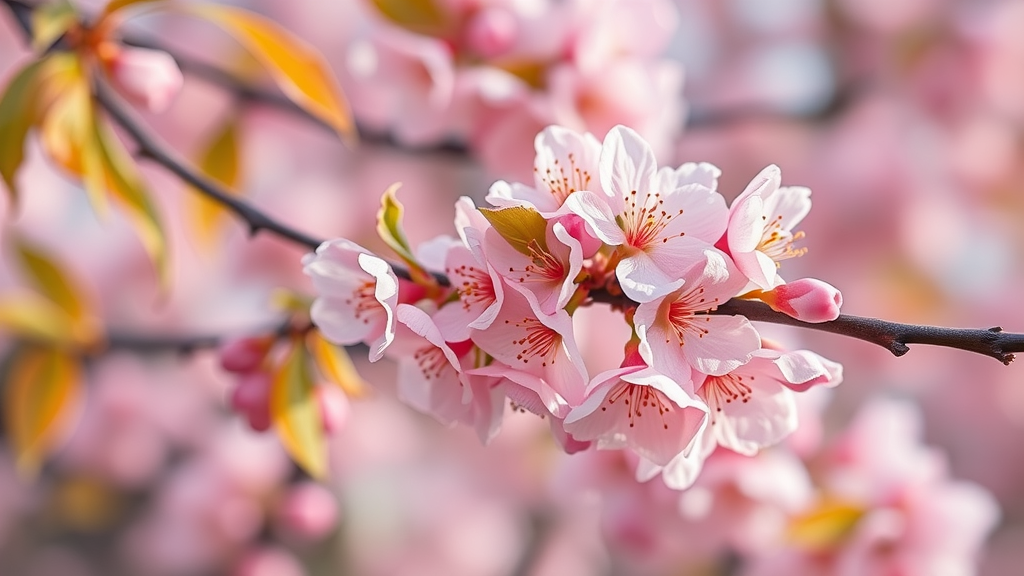
As winters warm across Europe, one of the most delicate moments in fruit farming is drifting into ever greater danger. Many temperate fruit trees now break dormancy and flower earlier in spring than they did decades ago, and that earlier bloom increasingly collides with late frost events that can wipe out an entire crop in a single cold night. A new experimental study from a research team led by the University of Göttingen suggests that a well-known plant growth regulator, ethephon, may offer growers a way to push the flowering clock back — at least in some sweet cherry varieties. The findings, published in BMC Plant Biology, show that autumn applications of ethephon substantially delayed bloom in the commercially important sweet cherry cultivar Kordia, while leaving flowering largely untouched in a second cherry variety and two apple varieties.
The logic behind the approach rests on the biology of bud dormancy. Fruit trees in temperate zones must accumulate a certain amount of winter chilling to release their buds from dormancy, and then a period of warmth to drive them toward flowering. When winters become milder and springs warmer, buds often reach the flowering stage weeks before the historical last frost date. A bloom that opens early is exposed to sub-zero temperatures at its most vulnerable stage: open flowers can be killed at temperatures only a few degrees below freezing, and even developing fruitlets that survive an initial frost may abort later, thinning the crop. Growers currently defend against frost with sprinklers, wind machines, helicopters and heaters, all of which are expensive, energy-intensive and sometimes insufficient. Delaying bloom itself, so that flowers open after the frost window has largely passed, would be a cheaper and more elegant form of protection.
Ethephon is a synthetic compound that growers have used for decades for other purposes, from promoting uniform ripening to loosening fruit for harvest. Its active ingredient is ethylene, the plant hormone that regulates many aspects of growth and development, and which is known to influence dormancy and bud break. When sprayed in autumn, ethephon can interfere with the dormancy cycle of the buds, slowing their progress toward flowering the following spring. Whether this effect is strong enough, and reliable enough, to serve as a practical anti-frost tool has remained an open question — one that the Göttingen team set out to answer under real orchard conditions rather than in the greenhouse.
The experiment took place in commercial sweet cherry and apple orchards in Lower Saxony in Germany. The researchers worked with 20 trees each of two sweet cherry varieties, Bellise and Kordia, and two apple varieties, Elstar and Kanzi. They tested two concentrations of ethephon, applied either in early autumn or in late autumn, and then monitored flowering and fruit development through the spring of 2024. To capture the timing of bloom precisely, the team recorded the flowering stage repeatedly on four marked branches per tree, counting around 30 cherry flower buds and 15 apple flower buds on each branch. This fine-grained, branch-level monitoring allowed them to compare the distribution of flowering stages between treated and untreated trees as the season unfolded.
The results in Kordia were striking. On 9 April, 88 percent of flower buds on untreated trees were in bloom, compared with only 56 percent on trees that had received a high-dose ethephon treatment in early autumn, and 63 percent after a low-dose treatment applied in late autumn. In practical terms, the treated trees were roughly a third less advanced in their bloom than their untreated neighbours at a point in spring when frost risk is still very real. That gap translates directly into a smaller proportion of flowers sitting at the frost-sensitive open-bloom stage during any given cold night, and it could mean the difference between a full crop and a devastated one in a frost year.
“Our results show that applying ethephon in autumn can postpone flowering in some sweet cherry cultivars,” says Dr Wiebke Kämper at Göttingen University’s Agroecology and Functional Agrobiodiversity Group. “This could provide fruit growers with an additional tool for reducing the risk of frost damage.” For cherry growers, whose crops are notoriously vulnerable because sweet cherries flower early and their blossoms are easily damaged, even a few days of delay can be commercially meaningful. The finding is particularly notable because Kordia is a widely grown, high-value variety, meaning that a validated treatment could reach a large share of the European cherry acreage.
Yet the study is equally instructive in what it did not find. The treatment did not significantly delay flowering in Bellise, the second sweet cherry variety, nor in either of the two apple varieties, Elstar and Kanzi. “Effects depend strongly on the crop, and the variety, as well as the timing and concentration,” Kämper explains. “We expected stronger effects in stone fruit than in apples, and the unusually early, warm spring of 2024 may have further limited our ability to detect differences. Further trials across varieties, regions and years are needed before recommendations for practical use can be made.” This cultivar specificity is a recurring theme in dormancy research: varieties differ in their chilling requirements, their sensitivity to ethylene and the internal timing of their dormancy release, so a treatment that works in one genetic background may fail entirely in another.
The weather in the study year itself illustrates how variable the challenge is. The spring of 2024 in Germany was unusually early and warm, which compressed the flowering period and may have masked differences between treated and untreated trees. In a warm spring, all buds race toward bloom together, and a treatment that delays bud development by a fixed amount may appear less effective when measured against a rapidly advancing baseline. Conversely, in a cooler, slower spring the same delay might produce a larger visible gap. This is why the authors caution that multi-year, multi-region trials are essential before ethephon can be recommended as a standard practice: a single season cannot capture the range of conditions under which growers will need the treatment to work.
The technical details of the treatment also matter for any future application. The fact that both a high-dose early-autumn spray and a low-dose late-autumn spray delayed bloom in Kordia suggests some flexibility in how the treatment could be scheduled, which is valuable for growers who must fit spraying into busy autumn workloads. At the same time, ethephon is a biologically active compound, and any practical protocol would need to balance efficacy against possible side effects on tree health, fruit set and yield in the following season — questions that this first orchard-scale study was not designed to resolve fully. Dose, timing, weather at the time of application and the physiological state of the trees all interact, and each of these variables will need systematic testing.
For now, the study stands as a proof of concept that bloom delay through autumn ethephon is achievable in at least one major sweet cherry cultivar under field conditions. It adds a promising candidate to the toolbox that fruit growers will need as climate change continues to tighten the collision between earlier flowering and stubborn late frosts. The research was funded by the European Union’s Horizon Europe programme through a Marie Skłodowska-Curie grant and supported by the Open Access Publication Funds of Göttingen University. If follow-up trials confirm the effect across more varieties, regions and seasons, autumn ethephon sprays could become a simple, targeted line of defence — one that protects the blossom not by fighting the frost, but by quietly moving the flowers out of its way.
Subject of Research: Using ethephon to delay flowering in sweet cherry to reduce frost damage
Article Title: Delaying cherry blossom to reduce frost damage
Article References: Delaying cherry blossom to reduce frost damage. (n.d.). Original publication
Image Credits: AI Generated
DOI: Not provided
Keywords: ethephon, sweet cherry, frost damage, flowering delay, climate change, bud dormancy, plant growth regulator, apple, orchards, BMC Plant Biology, University of Göttingen, cultivar specificity
Cite Scienmag News
Alan Morgan. (September 24, 2026). Autumn Ethephon Treatment Delays Sweet Cherry Blossom to Cut Frost Risk. Scienmag. https://scienmag.com/autumn-ethephon-treatment-delays-sweet-cherry-blossom-to-cut-frost-risk/
Alan Morgan. "Autumn Ethephon Treatment Delays Sweet Cherry Blossom to Cut Frost Risk." Scienmag, 24 September 2026, https://scienmag.com/autumn-ethephon-treatment-delays-sweet-cherry-blossom-to-cut-frost-risk/. Accessed 24 September 2026.
Alan Morgan. "Autumn Ethephon Treatment Delays Sweet Cherry Blossom to Cut Frost Risk." Scienmag. September 24, 2026. https://scienmag.com/autumn-ethephon-treatment-delays-sweet-cherry-blossom-to-cut-frost-risk/


