


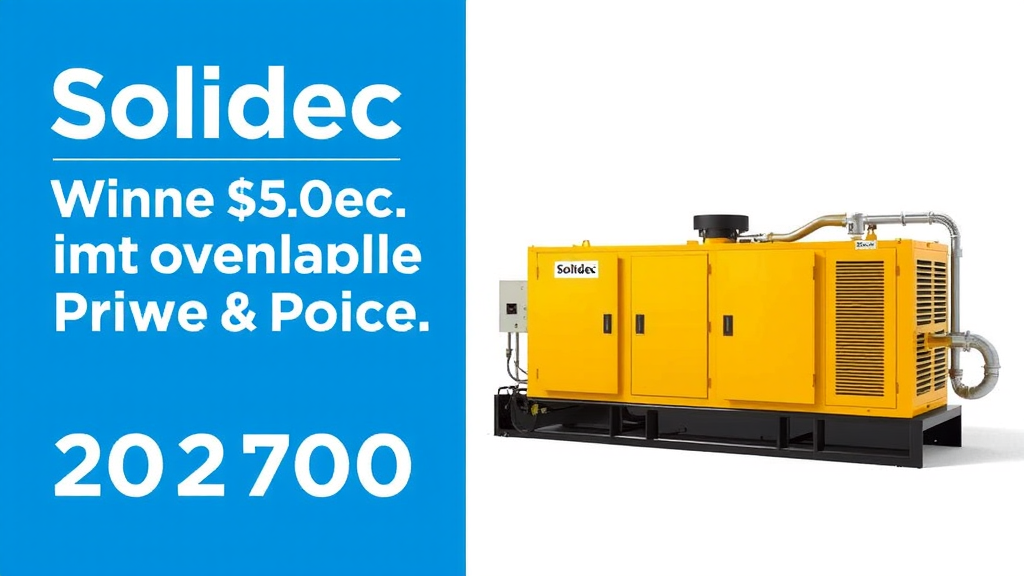
A Houston-based startup that wants to reinvent how the world’s most essential chemicals are made and delivered has taken home one of the most closely watched prizes in the climate technology calendar. The Wilkes Center for Climate Science & Policy at the University of Utah announced on September 23, 2026, that Solidec is the winner of the $250,000 Wilkes Climate Innovation Prize for 2026, selected from a field of nine finalists drawn from 504 total submissions. The company develops autonomous, on-site chemical generators that produce essential industrial chemicals using nothing more than air, water and electricity, a proposition that could fundamentally reshape supply chains that today depend on massive centralized plants and fleets of tanker trucks.
The core idea behind Solidec is deceptively simple but technically demanding. Rather than manufacturing chemicals in enormous facilities and shipping them across continents, the company builds generators that can sit directly at the point of use, converting readily available feedstocks into the molecules a business needs, when it needs them. The technology gives businesses greater control over their chemical supply chains while reducing the storage, transportation, waste and carbon emissions that come with conventional distribution. According to the company, its initial commercial focus is hydrogen peroxide, one of the most widely used oxidizers in the world, with a platform capable of producing additional chemicals including formic acid, acetic acid and syngas.
Hydrogen peroxide is a revealing choice for a first product. The compound is indispensable to pulp and paper bleaching, textile processing, wastewater treatment, mining and semiconductor manufacturing, yet nearly all of it is produced in a centralized, energy-intensive anthraquinone process that involves hydrogenation and oxidation steps followed by extraction and concentration. The resulting solution, often shipped at relatively dilute concentrations for safety reasons, carries an enormous logistical burden: vast quantities of water are transported alongside the active chemical, and the product can decompose during storage, generating waste and hazard. An electrochemical route that synthesizes hydrogen peroxide directly from air, water and electricity at the customer’s site eliminates much of that burden, producing the chemical only in the quantities required and only at the moment it is needed.
The climate logic of distributed chemical generation extends well beyond a single compound. The global chemical industry is among the largest industrial emitters of carbon dioxide, and a substantial share of those emissions is embedded not in the reaction chemistry itself but in the movement of products: compression, refrigeration, packaging, trucking, ocean freight and the construction of depots. Decentralized generators that run on electricity, particularly when that electricity is increasingly supplied by renewable sources, can drive those embedded emissions toward zero while simultaneously insulating buyers from the price volatility and disruption risks that have repeatedly roiled chemical markets in recent years. In effect, Solidec is proposing to do for chemicals what distributed solar did for electricity generation.
The platform approach is what gives the company its ambition. Because the underlying electrochemical architecture can in principle be tuned to different target molecules, the same core technology that produces hydrogen peroxide could produce formic acid, a chemical used in leather tanning, agriculture and as a promising liquid hydrogen carrier; acetic acid, the key ingredient in vinyl acetate and countless industrial solvents; or syngas, the carbon monoxide and hydrogen mixture that serves as the feedstock for fuels, plastics and fertilizers. If the platform scales as envisioned, a single product line could address multiple multi-billion-dollar markets, each with its own concentrated production footprint and supply chain fragility.
Ryan DuChanois, founder and chief executive officer of Solidec, said the award carries significance well beyond its monetary value. Winning the Wilkes Climate Innovation Prize means a great deal to the team, he noted, adding that the company is thrilled to join the Wilkes community. He explained that the award will help Solidec deploy its chemical generation systems with its early customers, producing low-carbon chemicals on site for buyers who currently have them trucked in. That last phrase captures the company’s beachhead strategy: rather than competing for new customers in unfamiliar markets, Solidec is targeting businesses that already depend on regular deliveries of these chemicals and simply want a cleaner, more reliable way to obtain them.
The Wilkes Climate Innovation Prize, now in its latest annual cycle, was established to identify and accelerate top global ideas for combating climate change. Its designers emphasize that the prize supports solutions with genuine potential for impact but facing significant uncertainty, where traditional funding pathways or market adoption routes remain limited. Eligible solutions can be technological, policy-driven, operational, financial or hybrid in nature. Beyond the headline award itself, the Wilkes Center describes its broader mission as building an innovation ecosystem around high-potential climate solutions, connecting founders with the mentorship, networks and visibility needed to make measurable progress toward real-world deployment.
The competitive process behind this year’s award was notably rigorous. Solidec emerged from a pool of 504 total submissions, which an expert panel narrowed to nine finalists before selecting the winner. Judges evaluated candidates across five dimensions: climate-system impact and relevance; plausibility and clarity of the proposed solution; differentiation and quality of insight; clear co-benefits beyond carbon reduction; and team expertise and organizational capability. The breadth of the applicant pool is visible on an interactive world map published by the Wilkes Center, which plots the geographic origins of this year’s applications and underscores how widely distributed climate innovation has become.
Three other ventures received recognition alongside the winner. Gyre Energy, a runner-up, combines physics-based artificial intelligence, thermal energy storage and automated controls to reduce cooling costs and energy consumption for cold storage facilities, data centers and buildings, a segment of the economy whose energy demand is growing rapidly in the age of artificial intelligence. The second runner-up, WoodSyn, develops biogenic construction composites based on wood-wool cement technology, transforming restoration timber into durable building materials that store carbon over their lifetime. FABUMIN received an honorable mention as a circular food-technology company that converts legume cooking water, known as aquafaba, into a functional plant-based powder capable of replacing egg ingredients in food applications while reducing water waste, costs and environmental impact.
The formal announcement took place on Wednesday, September 23, 2026, at an in-person event in New York City timed to Climate Week, hosted at the Explorer’s Club on East 70th Street, with a simultaneous watch party at the Wilkes Center’s L. S. Skaggs Applied Science Building in Salt Lake City. Solidec co-founder and chief technology officer Yang Xia and Wilkes Center managing director Fielding Norton were available for interviews at the event. For the startup, the $250,000 prize arrives at a pivotal moment, providing non-dilutive capital to support early customer deployments and, equally important, validation from a university-based institution that has made climate innovation its central mandate. For the broader climate technology community, the award signals growing confidence that decarbonizing the invisible plumbing of the industrial economy, the chemicals that flow through factories and treatment plants every day, deserves a place at the center of the climate agenda.
Subject of Research: Distributed electrochemical on-site generation of industrial chemicals to reduce supply chain emissions
Article Title: Wilkes Center awards $250,000 Climate Innovation Prize to Solidec
Article References: Wilkes Center awards $250,000 Climate Innovation Prize to Solidec. (n.d.). Original publication
Image Credits: AI Generated
DOI: Not provided
Keywords: Solidec, Wilkes Climate Innovation Prize, University of Utah, hydrogen peroxide, on-site chemical generation, electrochemistry, supply chain emissions, climate technology, decarbonization, formic acid, acetic acid, syngas
Cite Scienmag News
Bethany Barker. (September 24, 2026). Solidec Wins $250,000 Wilkes Climate Innovation Prize for On-Site Chemical Generators. Scienmag. https://scienmag.com/solidec-wins-250000-wilkes-climate-innovation-prize-for-on-site-chemical-generators/
Bethany Barker. "Solidec Wins $250,000 Wilkes Climate Innovation Prize for On-Site Chemical Generators." Scienmag, 24 September 2026, https://scienmag.com/solidec-wins-250000-wilkes-climate-innovation-prize-for-on-site-chemical-generators/. Accessed 24 September 2026.
Bethany Barker. "Solidec Wins $250,000 Wilkes Climate Innovation Prize for On-Site Chemical Generators." Scienmag. September 24, 2026. https://scienmag.com/solidec-wins-250000-wilkes-climate-innovation-prize-for-on-site-chemical-generators/


