


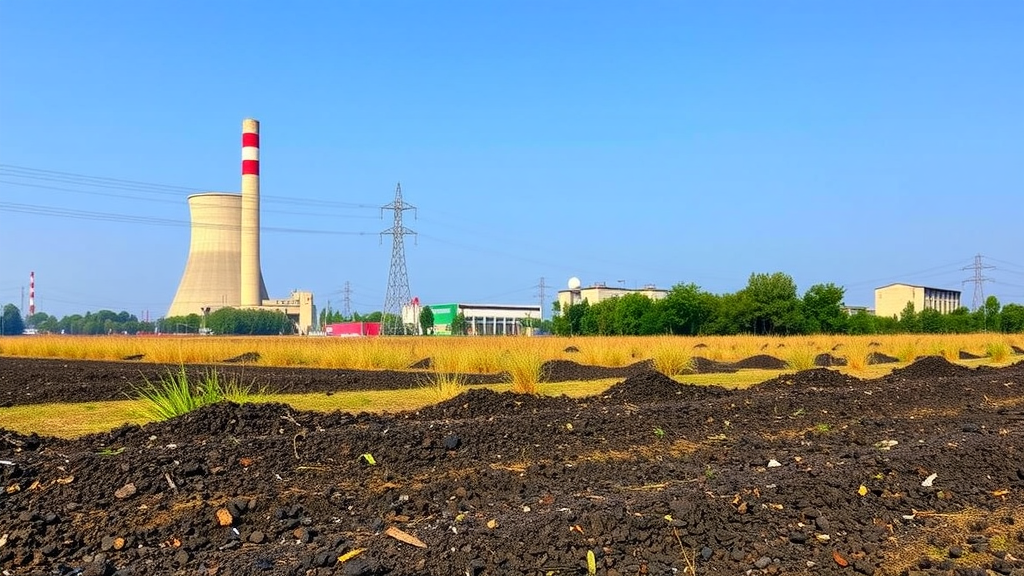
Coal-fired power plants supply a large share of India’s electricity, but they also leave behind one of the country’s most stubborn waste problems: millions of tonnes of fly ash, a fine residue rich in potentially toxic metals that is often dumped in ash ponds and open sites. A new open-access study published in Discover Green Chemistry examines what this means for the land and water surrounding the Udupi Thermal Power Plant (UTPP) in Karnataka, a 1,200-megawatt station on the southwest coast that burns roughly 2.5 million tonnes of imported Indonesian coal each year. Rather than stopping at a pollution audit, the research goes a step further, testing whether the offending ash itself, blended with vermicompost, could be turned into a low-cost soil amendment that locks up heavy metals and boosts crop growth.
The research team, led by Daggupati Sridhar of Siddarth Engineering & Technology and the Manipal Academy of Higher Education, together with Koppala Siva and Are Vigneshwari, chose a demanding setting for the investigation. The plant sits at Padubidri, about eight kilometres inland from the Arabian Sea, in a hydrogeologically sensitive zone of high monsoon rainfall, permeable soils and shallow aquifers. These conditions accelerate the movement of contaminants from the surface into the groundwater that local communities depend on. The plant, operational since 2012, disposes of coal combustion residues that leach metals under intense seasonal rain, making the region a natural laboratory for studying how industrial waste migrates through a coastal landscape.
To capture both the wettest and driest extremes of contaminant mobility, the team sampled groundwater and soil during the monsoon in October 2018 and again in the summer of March 2019. Four locations — Padibettu, two sites at Nagarjuna Gate, and the Main Gate — were selected within a ten-kilometre radial zone of the plant, distributed to the north, south and east. The western direction was deliberately excluded because coastal and harbour activities there could introduce contamination unrelated to the power plant and confound the results. Groundwater was drawn from open wells in active domestic use, avoiding stagnant sources, while soil was collected at two depths of two and four inches near each well to trace vertical movement of metals through the shallow profile.
The analytical workflow combined physical, chemical and biological methods. Soil texture was characterised through dry sieve analysis, moisture content measurements and Atterberg limit tests following ASTM standards, revealing predominantly well-graded silty clay soils of low to medium plasticity. These fine-grained soils matter because their large surface area and clay content govern how much water they hold and how strongly they adsorb trace metals, directly influencing whether contaminants stay put or travel downward. Trace metals — lead, copper, cadmium and nickel — were quantified using atomic absorption spectrophotometry after filtration of water samples and microwave-assisted acid digestion of soil in a mixture of nitric, hydrofluoric and hydrochloric acid at temperatures up to 260 degrees Celsius, ensuring complete recovery of metals from both silicate minerals and organic fractions.
The groundwater results were largely reassuring but carried one warning sign. Water pH ranged from 4.54 to 6.22, below the Bureau of Indian Standards acceptable range of 6.5 to 8.5 for drinking water, a acidity the authors attribute to rainwater interacting with acidic oxides in coal combustion residues. Total dissolved solids climbed in summer, with values at the two Nagarjuna Gate sites exceeding the acceptable limit of 500 milligrams per litre during the dry season, though all samples stayed well within the permissible limit of 2,000. Turbidity remained low throughout. Among the metals, copper stayed comfortably below its 0.05 milligram per litre limit, cadmium appeared only at trace levels, and nickel was mostly undetected. Lead, however, reached 0.0179 milligrams per litre and marginally exceeded the 0.01 milligram per litre acceptable limit at certain locations, particularly during the monsoon, pointing to localised contamination linked to fly ash leaching.
Lead’s exceedance is significant because of its health profile. The element is persistent and non-biodegradable, accumulates in biological tissues, and is associated with neurological, developmental and cardiovascular disorders, with children and pregnant women most vulnerable. The study also documents a clear soil-to-groundwater pathway: locations showing detectable lead and copper in soil leachates showed corresponding metal presence in the underlying wells, indicating vertical transfer through the vadose zone during seasonal recharge. Because residents rely heavily on shallow open wells and borewells for drinking and domestic use, the authors argue that continuous monitoring is essential, especially during and after the monsoon when infiltration and leaching are at their peak.
The second half of the study pivots from diagnosis to treatment. Fly ash, despite its metal content, also carries calcium, magnesium, iron and potassium, and its alkalinity can counteract acidic soils — a liming effect the experiments confirmed. The team amended contaminated agricultural soil with fly ash alone and in combination with vermicompost, then measured how metals behaved. Increasing fly ash proportions raised metal concentrations, confirming ash as a source of trace metals, but the combined fly ash–vermicompost treatments told a different story: copper and nickel concentrations dropped relative to fly ash-only treatments, lead became non-detectable in most combined mixes, and soil pH rose from an acidic 5.53 in untreated soil to between 7.02 and 8.30. The authors attribute this stabilisation to complexation of metals by humic and fulvic acids, adsorption onto organic functional groups, microbial immobilisation and improved soil aggregation.
Biological validation came from greenhouse pots of ragi (Eleusine coracana), a staple millet crop, sown with 25 seeds per pot across eight treatments and monitored over 21 days in weekly intervals. Fly ash alone produced moderate growth gains at lower doses, but root elongation was constrained at higher ash proportions, consistent with sub-lethal metal stress. The standout results came from the balanced blends: 5 percent fly ash with 15 percent vermicompost, and 2.5 percent fly ash with 17.5 percent vermicompost, delivered superior shoot elongation and root development compared with both untreated control soil and ash-only treatments. In contrast, the ash-heavy 15 percent fly ash with 5 percent vermicompost mix performed comparatively poorly, showing that too little organic matter leaves metals from the ash insufficiently stabilised.
The study’s broader significance lies in its integrated framing. Most previous work around thermal power plants has focused on characterising pollution and assessing risk, with little attention to remediation mechanisms validated by living plants. By linking physical soil behaviour, chemical speciation and biological response in a single framework, the researchers demonstrate a circular-economy pathway in which an industrial liability becomes an agricultural input — one that aligns with the United Nations Sustainable Development Goals on clean water, responsible consumption and life on land. The approach is inexpensive, uses materials already on site, and reduces dependence on synthetic fertilisers.
The authors are candid about the limitations. Sampling covered only four locations and two seasons, soil parameters derived from single measurements without replicates limited statistical treatment, and the pot experiments, while controlled, cannot fully reproduce field-scale behaviour over years. They call for expanded spatial and temporal monitoring, formal human health and ecological risk indices, advanced techniques such as ICP-MS and geospatial modelling, and long-term field trials of fly ash–compost amendments. For now, the message from the Udupi coast is measured but hopeful: contamination around the plant remains largely within regulatory limits, yet the persistence and bioaccumulative nature of heavy metals demand vigilance — and the waste that caused the problem may, in carefully balanced doses with compost, become part of the remedy.
Subject of Research: Heavy metal contamination of soil and groundwater near a coal-fired power plant and the use of fly ash–vermicompost amendments for soil remediation and plant growth
Article Title: Assessment of heavy metal contamination in soil and groundwater near a coal based thermal power plant and evaluation of fly ash and vermicompost as sustainable soil amendments for plant growth
Article References: Sridhar, D., Siva, K., & Vigneshwari, A. (2026). Assessment of heavy metal contamination in soil and groundwater near a coal based thermal power plant and evaluation of fly ash and vermicompost as sustainable soil amendments for plant growth. Discover Green Chemistry, 1(1), Article 14. https://doi.org/10.1007/s44509-026-00016-0
Image Credits: AI Generated
DOI: 10.1007/s44509-026-00016-0
Keywords: fly ash, heavy metals, groundwater contamination, thermal power plant, vermicompost, soil remediation, lead contamination, Udupi, soil pH, ragi, green chemistry, circular economy
Cite Scienmag News
Bethany Barker. (September 23, 2026). Coal Ash and Compost Team Up to Clean Contaminated Soils Near an Indian Power Plant. Scienmag. https://scienmag.com/coal-ash-and-compost-team-up-to-clean-contaminated-soils-near-an-indian-power-plant/
Bethany Barker. "Coal Ash and Compost Team Up to Clean Contaminated Soils Near an Indian Power Plant." Scienmag, 23 September 2026, https://scienmag.com/coal-ash-and-compost-team-up-to-clean-contaminated-soils-near-an-indian-power-plant/. Accessed 23 September 2026.
Bethany Barker. "Coal Ash and Compost Team Up to Clean Contaminated Soils Near an Indian Power Plant." Scienmag. September 23, 2026. https://scienmag.com/coal-ash-and-compost-team-up-to-clean-contaminated-soils-near-an-indian-power-plant/


