


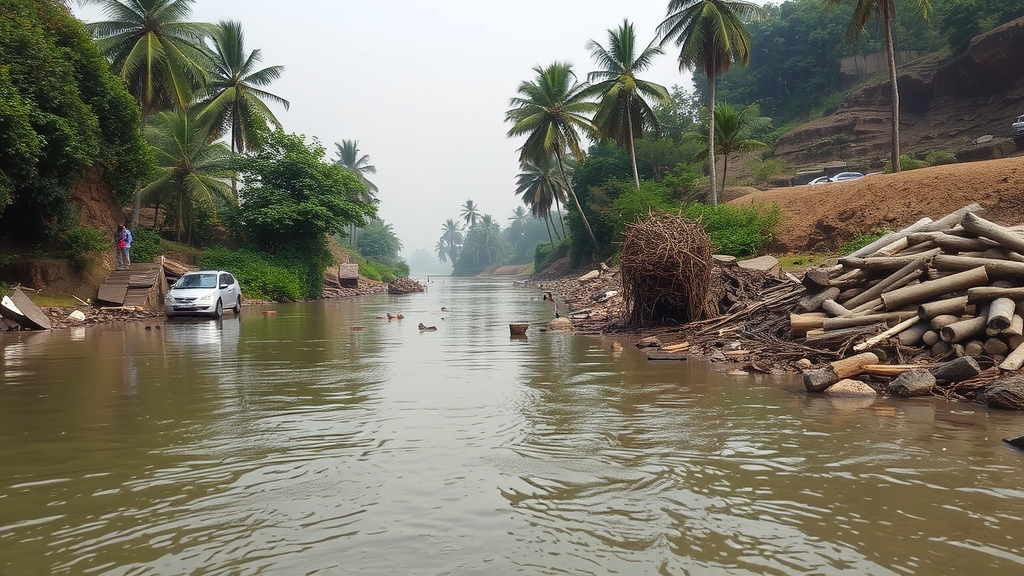
A sweeping new investigation of India’s National Waterway-3 has revealed that cadmium and zinc contamination has reached moderate to severe levels in the lower reaches of one of the country’s most celebrated inland water routes, raising fresh concerns about the ecological health of two internationally protected wetlands that the waterway cuts through. The study, published in the journal Discover Oceans, offers one of the most complete chemical portraits ever assembled for this navigational corridor, which threads through the Ashtamudi Lake estuary and the Cochin estuary, both recognised as Ramsar sites of global wetland importance.
National Waterway-3 stretches roughly 205 kilometres through the southern Indian state of Kerala, with the study focusing on a 168-kilometre navigable segment running from Kollam to the bar mouth of the Cochin estuary. The route carries enormous economic weight: it serves the booming houseboat tourism industry centred on Kollam, Alappuzha and Ernakulam, supports traditional fisheries, and passes through Kuttanad, the famously low-lying region known as the rice bowl of Kerala. Yet the same waters receive untreated urban sewage, industrial effluent from the Periyar and Muvattupuzha river catchments, and discharges linked to shipbuilding and repair activities concentrated near Kochi.
To capture the full chemical complexity of the system, researchers from Cochin University of Science and Technology and the CSIR National Institute of Oceanography sampled water, suspended particulate matter and sediments at seventeen stations along the entire corridor. Each station told a different story. One site sat near a boat jetty influenced by poultry units and medical facilities, another directly beside the titanium-bearing minerals producer Kerala Metals and Minerals Limited at Chavara, where two industrial effluent outlets discharge into the channel, while downstream stations captured the effects of dredging, tidal stagnation and vessel construction near the Marine Science jetty. Water was collected with a Niskin bottle, sediments with a Van Veen grab sampler, and all metal determinations were performed by inductively coupled plasma atomic emission spectroscopy, with certified reference material confirming recoveries between 95 and 105 percent.
The nine metals examined, iron, manganese, chromium, cobalt, nickel, copper, zinc, cadmium and lead, behaved very differently depending on which compartment of the ecosystem they occupied. In the dissolved phase, iron dominated with concentrations reaching 350.63 micrograms per litre during the monsoon, followed by zinc and copper. But the real surprise lay in the particles. Suspended particulate matter and sediments showed striking enrichment, with zinc climbing as high as 4,012 milligrams per kilogram in particulates during the non-monsoon season, and cobalt reaching 582 milligrams per kilogram during the monsoon. This pattern of low dissolved concentrations paired with particle-bound enrichment points to a fundamental truth about estuarine chemistry: metals rarely travel freely in solution for long.
That truth was quantified through partition coefficients, the ratio of a metal’s particulate concentration to its dissolved concentration. Log-transformed values exceeding three for essentially every metal in both seasons indicate an overwhelming affinity for solid phases. The chemistry behind this behaviour is intricate. Salinity, pH, dissolved oxygen and organic matter all shape how metals split between water and particles. Lead, with its small ionic radius, adsorbs efficiently onto suspended solids in both seasons. Copper, unusually, clings to the dissolved phase, likely because it forms stable compounds with water. Cadmium and nickel favour solution, with cadmium forming stable chloro-complexes as salinity rises and nickel binding to dissolved organic matter. Iron and manganese oxyhydroxides, meanwhile, act as microscopic scavengers, co-precipitating and adsorbing other metals onto their surfaces as water chemistry shifts along the salinity gradient.
Seasonality proved decisive. During the southwest monsoon, heavy rainfall dilutes salinity, flushes the estuary and floods the waterway with suspended sediment, so more metals become trapped on particles and partition coefficients rise for elements such as nickel, cobalt and cadmium. In the drier non-monsoon months, higher salinity and pH promote flocculation and sedimentation, driving iron, manganese, zinc and lead onto the particulate phase. Two-way analysis of variance confirmed that these swings were statistically robust, with chromium and cadmium showing extreme seasonal variation in the dissolved fraction, and nickel, cobalt and zinc doing the same in suspended particulates. The takeaway is that any monitoring programme sampling only one season would badly misjudge the true contaminant burden of the system.
To translate raw concentrations into a verdict on pollution, the team deployed a battery of geochemical indices. Enrichment factors normalised to iron, which is naturally abundant and rarely enriched by human activity, revealed very high to extremely high enrichment of cadmium and cobalt in suspended matter during the monsoon and of zinc during the non-monsoon. Contamination factors, the geo-accumulation index and the pollution load index converged on the same conclusion: the upper and central reaches of the waterway remain comparatively clean, with sediment pollution load indices below one, while the downstream segment of the Cochin estuary, fed by the Periyar and Muvattupuzha rivers, crossed the alarming threshold with values at or above one. The potential ecological risk index, which weights cadmium with a toxicity factor thirty times that of zinc, showed very low comprehensive risk in the southern Ashtamudi sector but very high risk in the northern Cochin sector.
Principal component analysis added a source-detective layer to the picture. For dissolved metals, the first component, explaining 39 percent of variance, grouped nutrients such as nitrate, phosphate, ammonium and silicate with iron and chromium, a fingerprint of anthropogenic nutrient and metal inputs travelling together through river runoff. In sediments, one component loaded on nickel, copper, lead and grain size, showing that fine, carbon-rich particles are the principal controllers of metal deposition, while another clustered iron, manganese, cobalt, zinc and chromium, consistent with the scavenging role of iron-manganese oxyhydroxides. Cadmium stood apart, correlating with salinity rather than any single environmental parameter, hinting at discrete industrial sources. Together the statistics point to a mixed origin: natural weathering and tidal cycling on one hand, and agricultural runoff, urban effluent and industrial discharge on the other.
The most consequential findings concern living organisms. When sediment metal concentrations were benchmarked against the National Oceanic and Atmospheric Administration’s sediment quality guidelines, cadmium exceeded the Effects Range-Low threshold at nearly every station in both seasons, with only a couple of exceptions, and chromium exceeded it across most monsoon stations. Concentrations above these thresholds are those at which adverse effects on sediment-dwelling fauna begin to appear with meaningful frequency. The toxic risk index, a consensus-based measure combining threshold and probable effect concentrations, rated the northern sector of the waterway at moderate ecological risk. Because benthic communities sit at the base of estuarine food webs, accumulating metals and passing them upward to fish and, ultimately, to people, these exceedances matter well beyond the mudflats themselves.
The authors also note a striking context for their numbers: measured concentrations were generally lower than those reported in earlier decades of Cochin estuary research, possibly because the catastrophic 2018 Kerala floods scoured and flushed the estuarine system, and because pandemic-era restrictions briefly curtailed industrial discharge. That the waterway still shows severe cadmium and zinc contamination despite these partial resets underscores how persistent the pollution sources are. The study closes with a five-point prescription: continuous seasonal monitoring of all three metal compartments, stricter treatment of effluents entering through the Periyar and Muvattupuzha catchments, environmentally sound dredging practices that avoid remobilising contaminated sediment, tougher regulation of navigation, harbour and shipbuilding activity, and integrated watershed management to protect the Ramsar wetlands. As cargo and tourists increasingly return to this historic waterway, the chemistry of its mud will determine whether the route can carry commerce without quietly carrying poison through the heart of Kerala’s most precious ecosystems.
Subject of Research: Heavy metal contamination and ecological risk in the National Waterway-3 estuarine system of Kerala, South India
Article Title: Geochemical and ecological assessment of heavy metals in a National Waterway in South India
Article References: Ragi, A. S., Gireeshkumar, T. R., Habeeb Rahman, K., Snigtha, S., Abhina, C., Muhammed Aquib, T. P., Nayana, C., & Martin, G. D. (2026). Geochemical and ecological assessment of heavy metals in a National Waterway in South India. Discover Oceans, 3(1), Article 43. https://doi.org/10.1007/s44289-026-00154-0
Image Credits: AI Generated
DOI: 10.1007/s44289-026-00154-0
Keywords: heavy metals, cadmium, zinc, National Waterway-3, Cochin estuary, Ashtamudi Lake, Ramsar wetlands, sediment contamination, partition coefficient, ecological risk assessment, estuarine pollution, Kerala
Cite Scienmag News
Violet Maxwell. (September 23, 2026). Heavy Metal Pollution Builds Up in India’s Scenic National Waterway, Study Warns. Scienmag. https://scienmag.com/heavy-metal-pollution-builds-up-in-indias-scenic-national-waterway-study-warns/
Violet Maxwell. "Heavy Metal Pollution Builds Up in India’s Scenic National Waterway, Study Warns." Scienmag, 23 September 2026, https://scienmag.com/heavy-metal-pollution-builds-up-in-indias-scenic-national-waterway-study-warns/. Accessed 23 September 2026.
Violet Maxwell. "Heavy Metal Pollution Builds Up in India’s Scenic National Waterway, Study Warns." Scienmag. September 23, 2026. https://scienmag.com/heavy-metal-pollution-builds-up-in-indias-scenic-national-waterway-study-warns/


