


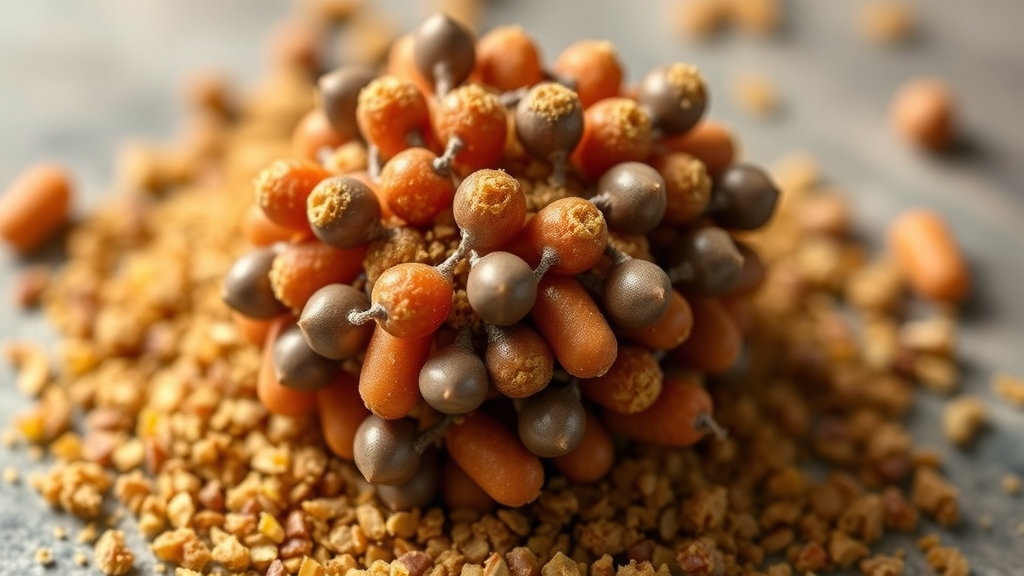
A team of chemists in Iran and Georgia has found a way to make a family of drug-like molecules using a catalyst built partly by a plant. In a study published in the Journal of the Saudi Chemical Society, researchers led by Faramarz Rostami-Charati describe a magnetic nanocomposite catalyst assembled in the water extract of butterbur rhizome, a flowering plant better known for its traditional medicinal uses. The extract acted as both a reducing and stabilizing agent, allowing the team to avoid the harsh chemical reagents normally required to build such nanomaterials.
The catalyst itself is a layered particle with a magnetic iron oxide core wrapped in a silica shell, functionalized with an amino-silane compound called APTES and topped with sulfonic acid groups. This architecture gives the material two useful qualities at once: reactive acidic sites on the surface that can drive organic reactions, and a magnetic core that lets the particles be pulled out of a reaction mixture with a simple magnet rather than by filtration. The team built the material in four steps, starting with iron chloride dissolved in the butterbur extract, then layering on silica, APTES, and finally the sulfonic acid groups through a reaction with 1,4-butane sultone.
Once the catalyst was in hand, the researchers put it to work in a four-component reaction combining α,β-unsaturated compounds, guanidine, activated acetylenic compounds, and methyl iodide. The products are methyliminopyridopyrimidines, a class of fused nitrogen-containing ring systems that sit at the heart of many drug candidates. Pyridopyrimidine frameworks are known to display antibacterial, antiviral, antitumor, antimalarial, and anti-inflammatory properties, making them attractive targets for medicinal chemists. The reaction ran in plain water at room temperature and finished within roughly two to three hours, producing yields between 78 and 92 percent across the series of compounds the team made.
The choice of water as the solvent is more than a nod to environmental fashion. Water can actively accelerate organic reactions through hydrogen bonding at the interface between the aqueous phase and organic reactants, a phenomenon recognized since K. Barry Sharpless’s work on on-water chemistry in 2005. In this case, the reaction performed poorly without a catalyst, and heating the mixture to 100 degrees Celsius offered no improvement over room temperature. Water, it turned out, was the best solvent among those tested, and the catalyst at a loading of just 0.02 grams per reaction delivered the highest yields.
Characterization of the new catalyst was thorough. X-ray diffraction confirmed the cubic crystal structure of the magnetite core with no damage from the coating process, and the average crystallite size came out at about 32.5 nanometers. Electron microscopy showed spherical, uniform core-shell particles, while vibrating sample magnetometry revealed superparamagnetic behavior. The saturation magnetization dropped from 76.4 emu per gram for bare iron oxide to 35.5 emu per gram after coating, but that remained plenty strong for magnetic separation from solution. Energy-dispersive X-ray spectroscopy and elemental mapping confirmed the expected distribution of iron, oxygen, silicon, carbon, nitrogen, and sulfur throughout the material.
The catalyst also proved durable. Thermogravimetric analysis showed that the organic surface groups survive up to roughly 500 degrees Celsius, and hot filtration tests indicated that the catalyst does not leach into solution during reactions, meaning the material is genuinely heterogeneous rather than dissolving and acting from the liquid phase. After each run the particles were collected with a magnet, washed, dried, and reused, with considerable retention of catalytic activity across cycles.
The mechanism behind the catalysis involves cooperative action between Lewis acid and Lewis base sites on the particle surface. Silicon, iron, and the sulfonic acid protons bind to the oxygen atoms of carbonyl groups in the starting materials, increasing the electrophilicity of the carbonyl carbon and making it more vulnerable to nucleophilic attack. Meanwhile, oxygen and nitrogen sites on the surface act as bases, stripping protons from the reactants to form key intermediates. Guanidine first reacts with the unsaturated compound, then the acetylenic component joins in, and finally an intramolecular cyclization closes the ring to form the pyridopyrimidine product.
Having built the molecules, the researchers turned to biology. They tested four of the new compounds for antioxidant activity using the DPPH radical scavenging assay, a standard method that measures a compound’s ability to neutralize a stable free radical. Compound 5c stood out with an IC50 value of 12.56 micrograms per milliliter, meaning it took only that concentration to inhibit half of the DPPH radicals. That compares with 9.26 for the industrial antioxidant BHT and 8.75 for TBHQ, placing the synthetic compound in genuinely competitive territory. A second assay, in which the compound’s ability to reduce ferric iron was measured spectrophotometrically, produced a similar ranking, with TBHQ leading, followed by BHT, then compound 5c.
Antibacterial testing followed using the disk diffusion method against both Gram-positive and Gram-negative bacterial strains, with streptomycin and gentamicin as clinical benchmarks. Six of the compounds, designated 5b, 5c, 5e, 5f, 5i, and 5j, showed strong activity against both categories of bacteria. The largest zone of inhibition was observed against Escherichia coli, a Gram-negative organism whose outer membrane typically makes it harder to kill than Gram-positive species. That a synthetic heterocycle built in water at room temperature can match broad-spectrum antibacterial patterns is the kind of result that catches the attention of drug discovery teams.
The catalyst had one more trick to demonstrate. The team tested its ability to reduce 4-nitrophenol, a toxic water pollutant produced by the dye, pesticide, and pharmaceutical industries, into 4-aminophenol, a far less harmful compound and a useful industrial intermediate. In the presence of sodium borohydride, the catalyst drove the reduction rapidly, with the yellow color of the nitrophenol solution fading to colorless within minutes, confirmed by the disappearance of the 400-nanometer absorbance peak and the appearance of a new peak near 300 nanometers. Without the catalyst, the borohydride alone made no meaningful progress even after 15 hours. Given that global dye and pigment production runs at roughly 700,000 tons per year and that most of these compounds harm aquatic life, a cheap, magnetic, plant-built catalyst that clears such pollutants from water in seconds-to-minutes timescales represents a practical piece of green chemistry with potential well beyond the laboratory bench.
Subject of Research: Green synthesis of iminopyridopyrimidine compounds using a bio-derived magnetic nanocatalyst
Article Title: Green synthesis and evaluation of biological activity of novel iminopyridopyrimidine employing APTES@SiO2@Fe3O4-SO3H as nanocatalyst
Article References: Shirangi, H. S., Hojjati, M., Noorzaei, M., & Rostami-Charati, F. (2026). Green synthesis and evaluation of biological activity of novel iminopyridopyrimidine employing APTES@SiO2@Fe3O4-SO3H as nanocatalyst. Journal of Saudi Chemical Society, 30(4), Article 51. https://doi.org/10.1007/s44442-026-00079-5
Image Credits: AI Generated
DOI: 10.1007/s44442-026-00079-5
Keywords: green chemistry, nanocatalyst, magnetite nanoparticles, pyridopyrimidine, Petasites hybridus, antioxidant, antibacterial, multicomponent reaction, 4-nitrophenol reduction, water as solvent, APTES, sulfonic acid
Cite Scienmag News
Bethany Barker. (September 23, 2026). Butterbur Extract Helps Cook Up Magnetic Catalyst for Drug-Like Molecules. Scienmag. https://scienmag.com/butterbur-extract-helps-cook-up-magnetic-catalyst-for-drug-like-molecules/
Bethany Barker. "Butterbur Extract Helps Cook Up Magnetic Catalyst for Drug-Like Molecules." Scienmag, 23 September 2026, https://scienmag.com/butterbur-extract-helps-cook-up-magnetic-catalyst-for-drug-like-molecules/. Accessed 23 September 2026.
Bethany Barker. "Butterbur Extract Helps Cook Up Magnetic Catalyst for Drug-Like Molecules." Scienmag. September 23, 2026. https://scienmag.com/butterbur-extract-helps-cook-up-magnetic-catalyst-for-drug-like-molecules/


