


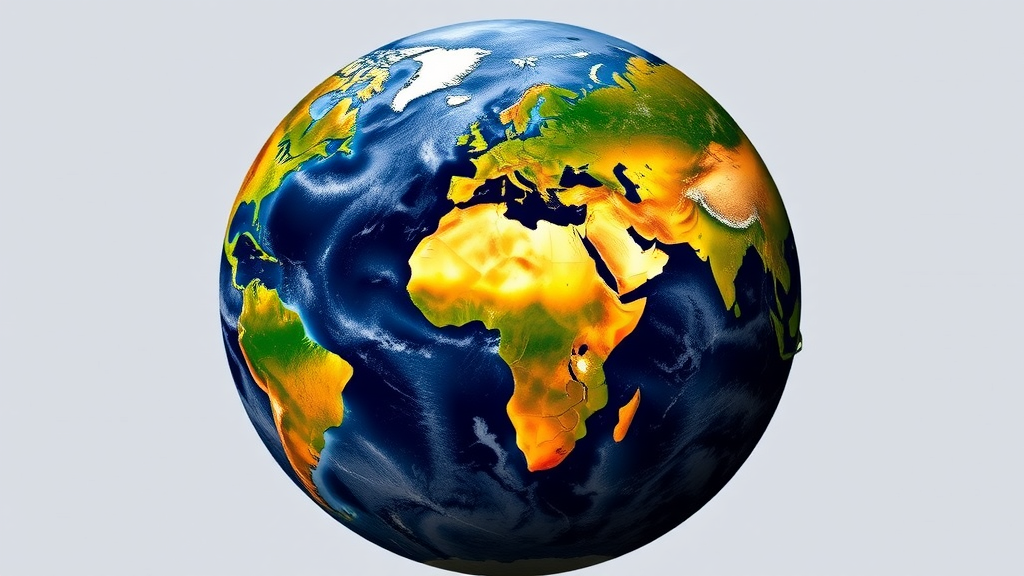
The carbon dioxide released by the world’s largest fossil fuel and cement producers is not a problem that ends when the smokestacks go quiet. A new peer-reviewed study published in PLOS Climate by Frierson and colleagues shows that the historical emissions catalogued in the Carbon Majors dataset, which traces industrial carbon output from 1854 through 2024, will continue to drive global heating for many centuries to come. Using an ensemble of climate model simulations run across a range of future emissions pathways, the researchers demonstrate that the warming already committed by these corporate-scale emitters persists essentially regardless of how humanity chooses to emit in the decades ahead. The finding reframes the legacy of the oil, gas, coal, and cement industries not as a closed chapter of environmental history but as an active, long-lived forcing agent embedded in the Earth system.
The Carbon Majors dataset is the most comprehensive public accounting of industrial carbon dioxide production at the entity level. Rather than attributing emissions to nations or to diffuse economic sectors, it identifies the specific companies and state-owned enterprises whose extraction, refining, and cement manufacturing activities released the greatest volumes of carbon into the atmosphere. Covering more than a century and a half of industrial history, the dataset aggregates the fossil fuel and industry emissions alongside agriculture, forestry, and other land use changes, providing a continuous record that climate scientists can feed directly into Earth system models. This entity-level resolution is what makes the new analysis distinctive: it allows the warming contribution of historically major producers to be isolated and tracked forward in time under different assumptions about the future.
The technical core of the study lies in its use of the Scenario Model Intercomparison Project framework, known as SSP, which defines a set of standardized future emissions trajectories used throughout the climate modeling community. The researchers ran simulations under four of these scenarios, spanning futures from low-emissions pathways consistent with ambitious mitigation to high-emissions worlds of continued fossil fuel expansion. Critically, they also constructed a counterfactual using the intermediate SSP2-4.5 scenario, in which the historical emissions of the Carbon Majors are removed from the forcing record. By comparing the counterfactual world against the real one, the team could quantify precisely how much warming the extracted and combusted carbon of these producers has caused and how much warming it will continue to cause under each future pathway.
The reason historical emissions lock in warming for centuries is rooted in the fundamental chemistry and physics of the carbon cycle. Carbon dioxide is a long-lived greenhouse gas: once emitted, a substantial fraction of it remains airborne for hundreds to thousands of years, because the natural sinks that remove it, primarily the oceans and terrestrial biosphere, operate on slow timescales. The ocean absorbs CO2 through air-sea gas exchange, but the surface waters that take it up mix only gradually into the deep ocean, a process that takes centuries to equilibrate. Meanwhile, the carbonate chemistry of seawater limits how much carbon the ocean can ultimately absorb, and weathering of silicate rocks, the only mechanism that removes carbon on geological timescales, operates over tens of thousands of years. The net effect is that a pulse of CO2 emitted today raises atmospheric concentrations and global temperatures for far longer than human planning horizons.
This persistence distinguishes carbon dioxide from shorter-lived climate forcers such as methane, which breaks down in the atmosphere within roughly a decade. For CO2, the warming response to an emissions pulse is approximately proportional to the cumulative amount emitted, and it does not decay away quickly even if emissions cease entirely. The study’s simulations capture this behavior directly: under every one of the four SSP scenarios examined, the temperature anomaly attributable to the Carbon Majors’ historical emissions remains elevated for many hundreds of years into the future. Even in scenarios where global emissions fall sharply or reach net zero, the committed warming from past production does not disappear. It is baked into the trajectory of the climate system, a thermal and radiative inheritance that future generations cannot opt out of.
The magnitude of this inheritance is substantial when viewed through the lens of corporate accountability. The Carbon Majors accounting has previously shown that a relatively small number of entities, roughly a hundred investor-owned and state-owned producers, are linked to the majority of industrial CO2 emissions since the mid-nineteenth century. The new work extends that accounting into the domain of climate consequence, translating tonnes of extracted carbon into degrees of warming and, crucially, into centuries of duration. The counterfactual simulations under SSP2-4.5 quantify the gap between the world as it is and the world that would exist had these producers’ emissions never occurred, a gap that widens through the twenty-first century and then plateaus rather than closing, because the emitted carbon simply persists.
The dependence on future emissions pathways, highlighted in the study’s title, cuts in an important direction. While the warming already committed by historical emissions cannot be undone on human timescales, the simulations show that the additional warming these emissions will cause in combination with future emissions depends on which pathway humanity follows. In high-emissions scenarios, the Carbon Majors’ legacy carbon compounds with ongoing emissions, pushing temperatures further along a trajectory of severe heating. In low-emissions scenarios, the legacy contribution becomes a larger fraction of the total warming, but the absolute temperature outcomes are far less dangerous. The practical implication is that past emissions set a floor, but future choices determine how much higher the ceiling rises. Mitigation decisions made in the coming decades govern whether the centuries-long legacy of these producers is experienced at 1.5 degrees of warming or at substantially higher levels.
The scientific and legal significance of this work extends beyond climate physics. Attribution science of this kind is increasingly relevant to litigation, regulatory policy, and climate finance, as courts and governments seek to assign responsibility for climate damages. By connecting named producers to quantified, persistent warming under standardized scenarios, the study provides a defensible, model-based bridge between historical industrial activity and future climate harm. The fact that the analysis is published open access in PLOS Climate, conducted without specific external funding, and accompanied by a declaration of no competing interests strengthens its utility as an evidentiary resource. The authors, based in the United States, released the underlying emissions visualization under a Creative Commons license, enabling independent verification of the dataset and the scenario comparisons.
For the broader public, the study’s most striking message is one of timescale. Human institutions, corporate strategies, and political cycles operate on horizons of years to decades, while the consequences of carbon extracted in the nineteenth and twentieth centuries will still be measurably warming the planet in the twenty-sixth and twenty-seventh. The coal burned to power Victorian factories, the oil refined through the twentieth century, and the cement poured into the infrastructure of industrialization are all, in a very literal sense, still in the atmosphere, still trapping radiation, and still committed to warming the Earth long after the companies that profited from them have transformed or vanished. Climate models make this inheritance visible and quantifiable, converting an abstract moral argument about intergenerational responsibility into concrete simulated temperatures across a millennium.
The research also underscores why cumulative emissions, rather than annual emissions alone, are the correct metric for climate policy. Because each tonne of CO2 contributes to warming in proportion to the total accumulated stock of carbon in the atmosphere, the historical production records of the Carbon Majors are not merely archival data; they are active components of the present and future climate forcing. The PLOS Climate simulations demonstrate that under every tested future scenario, from aggressive decarbonization to continued fossil expansion, the carbon already extracted by these producers continues to shape global temperatures for centuries. The study thus closes the loop between historical accountability and future climate outcomes, showing that the decisions of a relatively small set of industrial entities, made over 170 years, have committed the planet to a warming signal whose full duration no living person will see end.
Subject of Research: Centuries-long global warming contribution of historical emissions from major fossil fuel and cement producers under multiple future emissions scenarios
Article Title: The historical carbon emissions of major oil, gas, coal, and cement producers will contribute to global warming for many centuries, per simulations under a range of future emissions scenarios
Article References: The historical carbon emissions of major oil, gas, coal, and cement producers will contribute to global warming for many centuries, per simulations under a range of future emissions scenarios. (n.d.). Original publication
Image Credits: AI Generated
DOI: Not provided
Keywords: Carbon Majors, PLOS Climate, climate modeling, SSP scenarios, carbon dioxide, fossil fuel emissions, historical emissions, global warming, carbon cycle, climate attribution, cement industry, centennial warming
Cite Scienmag News
Sloane Callahan. (September 23, 2026). Carbon Majors’ Historical Emissions Will Keep Warming Earth for Centuries. Scienmag. https://scienmag.com/carbon-majors-historical-emissions-will-keep-warming-earth-for-centuries/
Sloane Callahan. "Carbon Majors’ Historical Emissions Will Keep Warming Earth for Centuries." Scienmag, 23 September 2026, https://scienmag.com/carbon-majors-historical-emissions-will-keep-warming-earth-for-centuries/. Accessed 23 September 2026.
Sloane Callahan. "Carbon Majors’ Historical Emissions Will Keep Warming Earth for Centuries." Scienmag. September 23, 2026. https://scienmag.com/carbon-majors-historical-emissions-will-keep-warming-earth-for-centuries/


