


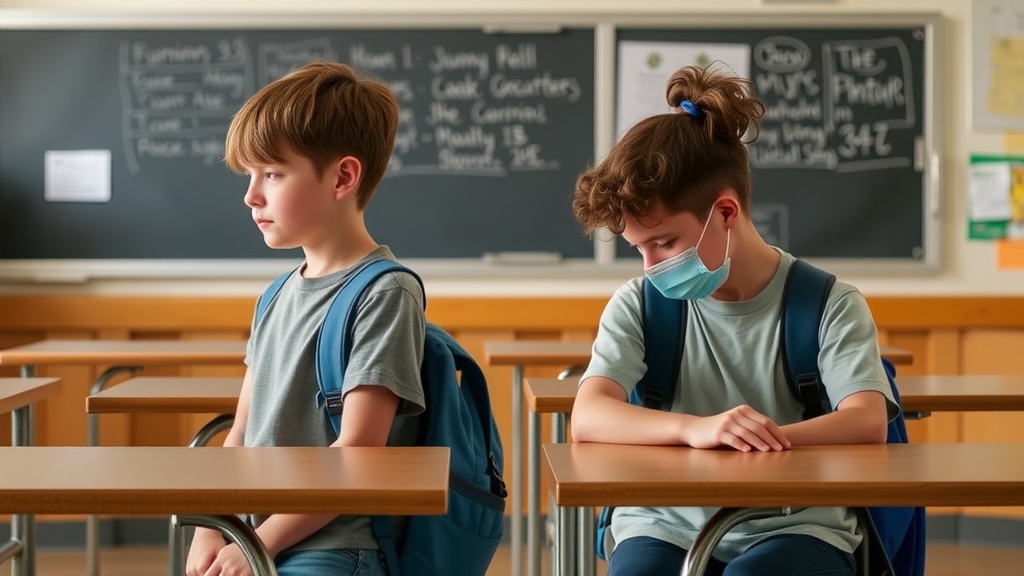
When schools closed their doors during the COVID-19 pandemic, the disruption was global, but the aftershocks have proven anything but uniform. In Gauteng, South Africa, a new qualitative study suggests that the deepest wound left on adolescents may not be the lost classroom time itself, but a quietly accumulating sense that the institutions meant to support them cannot be relied upon. The research, published in Discover Mental Health by Renée Zenadia Ramdin and Nancy Phyllis Makhosazane Mabaso of the University of Johannesburg, examines how institutional dependability — the consistency, predictability and relational continuity of schools and support systems — shaped adolescent mental health and school engagement in the period after lockdowns ended. Its central finding is striking in its simplicity: where young people experienced schools as unreliable, they disengaged, withdrew and became anxious; where schools behaved predictably and communicated clearly, they coped and recovered.
The study adopted an interpretivist qualitative design, drawing on semi-structured interviews and brief questionnaires with 24 participants: 11 adolescents aged 15 to 17, six caregivers and seven educators, recruited across both public and private schools in Gauteng. This triangulated design matters methodologically. By capturing the perspectives of learners, the adults responsible for them at home and the professionals responsible for them at school, the researchers could trace how breakdowns in one part of the system were experienced elsewhere in it. Thematic analysis of the transcripts identified distrust in educational and support systems as a central theme underpinning sustained disengagement — a disengagement that persisted well beyond the formal end of pandemic restrictions.
Theoretically, the authors frame their analysis through Bronfenbrenner’s Bio-ecological Systems Theory, which situates adolescent development within nested layers of context, from immediate relationships with teachers and caregivers to the broader policies and institutional structures that shape those relationships. The framework helps explain why a pandemic-era policy failure is not simply an administrative problem: when distal systems — education departments, health services, social support structures — behave inconsistently, the instability propagates inward, destabilising the micro-level relationships on which teenagers depend for psychological security. The researchers pair this with the principles of Trauma-Informed Care, an approach that treats behavioural signs of distress as adaptations to adversity rather than defiance, and that emphasises safety, trustworthiness and predictability as prerequisites for recovery.
What participants described, in practice, was a cascade of institutional inconsistencies. Learners reported strained relationships with teachers, in which the rapport that anchors classroom learning had frayed during remote schooling and never fully recovered. Caregivers described weak school–home communication, with schools failing to reach out when adolescents stopped attending or began struggling emotionally, leaving families uncertain where to turn. Educators, for their part, pointed to the near-total absence of school-based psychologists and limited access to psychosocial services, meaning that even when distress was recognised, there was often no professional resource to which a struggling learner could be referred. Layered over all of this were persistent inequalities between school contexts, with under-resourced public schools far less able than wealthier private institutions to rebuild routines, provide counselling or re-establish reliable contact with families after the pandemic.
The psychological consequences of this unreliability were consistent across accounts. Adolescents who experienced schools as unpredictable reported anxiety, emotional withdrawal and a marked reduction in school engagement — not as a momentary reaction to lockdown but as a sustained pattern that outlived the disruption itself. In the language of the study, institutional unreliability functioned as a chronic stressor, one that eroded exactly the sense of safety that adolescents needed in order to re-engage with learning after a collective trauma. The researchers also connect these findings to posttraumatic stress, noting that the pandemic years constituted a period of genuine adversity for young people, and that recovery from adversity depends heavily on whether the surrounding environment restores predictability and support.
The counterfactual embedded in the data is equally instructive. Where schools demonstrated predictability — clear expectations, consistent routines, honest and timely communication — and where relational continuity was maintained between learners and teachers, adolescents reported stronger coping and improved wellbeing. In other words, dependability operated as a protective factor. This is a conceptually significant extension of the South African evidence base, which has documented pandemic-related learning losses and mental health burdens extensively but has less often identified the specific institutional qualities that buffer adolescents against those burdens. The study’s contribution is to name institutional dependability itself — rather than merely resources or curriculum catch-up — as a mechanism worth targeting.
The distinction matters because it changes what a plausible intervention looks like. If the problem were purely material, the answer would be funding alone; the study does not minimise resource gaps, but it shows that trust is built or destroyed through everyday institutional behaviour that costs little to change. Teachers who maintain steady, respectful relationships with learners, schools that communicate proactively with homes when a learner’s engagement slips, administrators who follow through on commitments — these relational practices, the findings imply, carry measurable weight in adolescent mental health, and their absence carries a measurable cost.
From these findings the authors derive a set of practical implications that operate at multiple levels of the system. At classroom level, they recommend embedding trauma-informed practices into daily teaching, so that educators recognise distress and respond with predictability and support rather than punitive escalation. At school level, they call for strengthening school-based psychological services, including the presence of school psychologists, so that referral pathways exist in practice and not only on paper. At the interface between institutions, they urge improved school–home collaboration, formalising communication so that caregivers are partners rather than bystanders. And at policy level, they argue for aligning implementation with sustained monitoring, so that policies designed to support learners are actually delivered consistently — because, in their account, inconsistency itself is the injury.
The South African context sharpens the significance of these conclusions. Gauteng’s schools span an extraordinary range of resource levels, and the pandemic amplified pre-existing inequalities rather than creating new ones. A learner in a well-resourced private school who fell behind or struggled emotionally during lockdown was far more likely to encounter a counsellor, a responsive teacher and a structured re-entry plan than a peer in an under-resourced public school. The study suggests that this differential restoration of institutional support has translated into differential recovery of trust and engagement, meaning that post-pandemic mental health disparities among adolescents partly reflect disparities in institutional dependability. Rebuilding trust, on this view, is not a soft aspiration but a concrete equity intervention.
The research, which received no external funding and was approved by the University of Johannesburg Research Ethics Committee under reference SEM 2-2023-047, was conducted with careful ethical safeguards, including written informed consent from adult participants and parental consent alongside adolescent assent for minors. Its qualitative design and modest sample size mean the findings should be read as an in-depth account of lived experience rather than a statistical generalisation — yet it is precisely this depth that reveals the mechanism quantitative surveys can miss: the slow corrosion of trust when institutions that promised support repeatedly fail to deliver it. As education systems worldwide continue to grapple with post-pandemic absenteeism and adolescent distress, this Gauteng study offers a clear and testable proposition: adolescents re-engage when the systems around them become dependable again, and the work of rebuilding that dependability belongs to classrooms, schools, homes and policymakers alike.
Subject of Research: Institutional dependability and adolescent mental health in South African schools after COVID-19
Article Title: Institutional dependability and adolescent mental health in South African schools after COVID-19
Article References: Institutional dependability and adolescent mental health in South African schools after COVID-19. (n.d.). https://doi.org/10.1007/s44192-026-00596-0
Image Credits: AI Generated
DOI: 10.1007/s44192-026-00596-0
Keywords: adolescent mental health, institutional dependability, COVID-19, school disengagement, trauma-informed care, bio-ecological systems theory, South Africa, Gauteng, school psychology, school-home collaboration, educational psychology, trust in institutions
Cite Scienmag News
Glenn Wilkins. (September 23, 2026). Distrust in Schools Is Quietly Shaping Teen Mental Health After COVID-19, Study Finds. Scienmag. https://scienmag.com/distrust-in-schools-is-quietly-shaping-teen-mental-health-after-covid-19-study-finds/
Glenn Wilkins. "Distrust in Schools Is Quietly Shaping Teen Mental Health After COVID-19, Study Finds." Scienmag, 23 September 2026, https://scienmag.com/distrust-in-schools-is-quietly-shaping-teen-mental-health-after-covid-19-study-finds/. Accessed 23 September 2026.
Glenn Wilkins. "Distrust in Schools Is Quietly Shaping Teen Mental Health After COVID-19, Study Finds." Scienmag. September 23, 2026. https://scienmag.com/distrust-in-schools-is-quietly-shaping-teen-mental-health-after-covid-19-study-finds/


