


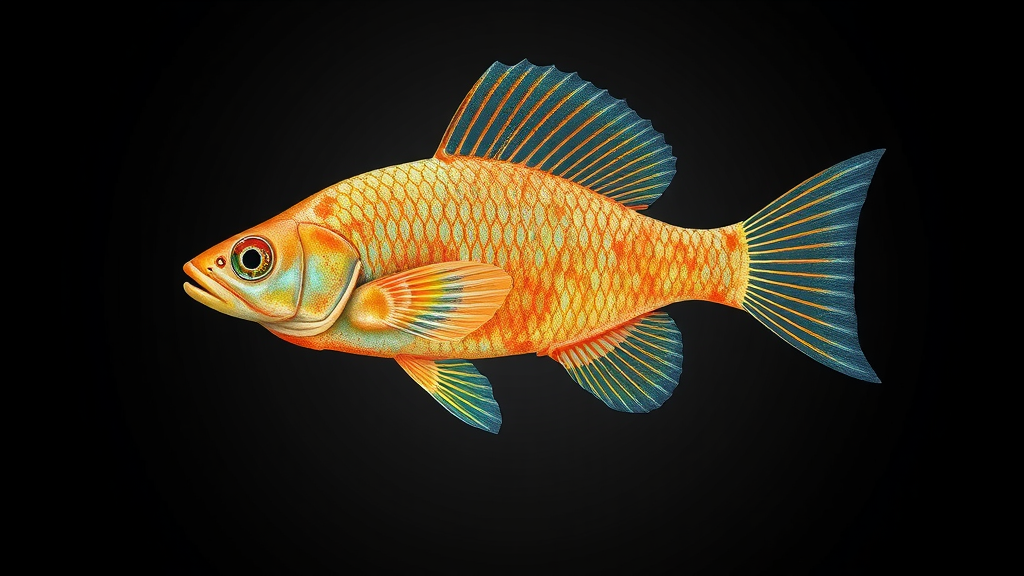
A tiny African fish that races through its entire life in a matter of months has given scientists one of the clearest biochemical portraits of vertebrate aging yet recorded. In a new study published in the journal Biogerontology, researchers Ravindra Pawar and Shicui Zhang of the Ocean University of China measured 27 clinical chemistry markers across the lifespan of the annual killifish Nothobranchius guentheri and found a pattern that is striking in its breadth: 24 of the 27 analytes declined with age, painting a picture of sweeping, multi-system physiological erosion rather than the selective metabolic disturbances familiar from mammalian aging studies.
The findings carry weight because of the peculiar biology of the fish involved. Annual killifishes inhabit ephemeral pools in Africa that dry out seasonally, and evolution has compressed their life cycles accordingly. Nothobranchius guentheri, commonly known as the redtail notho, reaches sexual maturity within weeks and typically lives only a year or so in captivity. This accelerated timetable makes it a powerful model for aging research, allowing scientists to observe in months the processes that unfold over decades in mice or humans. Despite decades of histological work on the species’ liver, kidney and immune organs, no broad biochemical survey of its aging process had previously existed, a gap the new study set out to close.
The experimental design was a cross-sectional one. Male and female fish were sampled at three ages, three, six and nine months, spanning juvenile adulthood through advanced old age for this species, yielding 20 analytical samples of whole-body homogenates. From each sample, the researchers quantified a standard panel of 27 clinical chemistry analytes, the same categories of markers a hospital laboratory measures in human patients: electrolytes such as sodium, potassium, calcium, magnesium and chloride; proteins including albumin and total protein; nitrogenous waste products such as creatinine; enzymes; glucose and fructose; cholesterol fractions; and markers of inflammation.
Age trends were assessed statistically in two complementary ways. Spearman rank correlation tested whether each analyte rose or fell monotonically with age, while two-way analysis of variance partitioned the effects of age, sex and their interaction. The results were dominated by downward slopes. Calcium showed the steepest and most statistically robust decline, with a correlation coefficient of minus 0.573 and a p-value of 0.008, followed by fructose at minus 0.507, albumin at minus 0.486 and magnesium at minus 0.479. Potassium narrowly missed the conventional threshold for significance at minus 0.422 with a p-value of 0.064. Only three markers, adenosine deaminase, C-reactive protein and HDL cholesterol, trended upward, and none of those trends reached statistical significance.
The steep drop in calcium and magnesium suggests a progressive breakdown of mineral homeostasis, a phenomenon long documented in aging humans, where declining bone formation and shifting electrolyte balance accompany frailty and increased mortality risk. The parallel fall in albumin is equally evocative. In humans, serum albumin concentration is one of the most reliable biochemical predictors of health in older people, low levels correlating with inflammation, malnutrition and shortened survival. Albumin also carries antioxidant properties, buffering oxidative damage throughout the circulation, so its age-related decline in the fish may reflect both shrinking synthetic capacity of the liver and a weakening of systemic antioxidant defenses.
Equally telling is what did not rise. In long-lived mammals, aging is typically accompanied by elevations in fasting glucose, circulating lipids and nitrogenous waste products such as urea and creatinine, changes that underpin the metabolic syndrome and chronic kidney decline. The killifish showed the opposite: a generalised downward drift across nearly the entire panel. The authors interpret this pattern most simply as the progressive loss of metabolically active tissue. As organs atrophy and cellular mass diminishes with age, the very substrates those tissues process, sugars, proteins and minerals, decline in parallel, rather than accumulating as waste. This makes the killifish profile qualitatively different from the human clinical picture and suggests that the fish’s terminal decline is driven by systemic attrition rather than by the chronic inflammatory and metabolic overshoot that characterizes mammalian gerontology.
Sex differences did emerge, however. Males carried higher levels of creatinine, carbon dioxide and HDL cholesterol than females, consistent with greater muscle mass and differing renal handling between the sexes. Sex-disparities in kidney disease and aging outcomes are well recognized in human epidemiology, and their appearance in a fish with such a radically different life history hints at deep evolutionary conservation of how male and female vertebrate bodies diverge in their metabolic architecture as they age.
Perhaps the most provocative element of the study is the hypothesis the authors attach to their data. Keepers of annual killifish have long observed an abrupt terminal mortality, fish that appear stable for months and then die suddenly. The new biochemical timeline offers a possible explanation: months of subclinical, invisible decline may proceed until physiological reserves, mineral balance, protein reserves and metabolic capacity, cross a critical threshold beyond which the animal can no longer maintain homeostasis and death follows quickly. The researchers frame this explicitly as a hypothesis for future testing rather than a proven mechanism, but it reframes the killifish’s apparent sudden death as the visible tip of a long biochemical slide.
The authors are candid about the limitations. Sample sizes were small, with 20 analytical samples spanning three ages and both sexes, and the p-values were uncorrected for multiple comparisons across the 27-analyte panel, so individual associations require confirmation in larger or longitudinal cohorts. Whole-body homogenates, while practical for fish of this size, blur tissue-specific signals that plasma measurements in larger animals would resolve. Nevertheless, the panel itself is a significant practical achievement: every marker can be read out within a single generation of the species, meaning the endpoints can serve rapid screening of lifespan-extending interventions such as dietary restriction or pharmacological compounds that have already shown promise in related killifish like Nothobranchius furzeri.
The study also slots into a much larger scientific narrative. Annual killifishes have become central players in geroscience, the interdisciplinary effort to link the biology of aging to chronic disease, and their genomes, evolution under extrinsic mortality and plasticity of lifespan under environmental manipulation have all been documented over the past two decades. What this new work adds is a bridge between molecular hallmarks of aging and whole-organism clinical chemistry, showing that even a vertebrate engineered by evolution for a compressed life undergoes a measurable, multi-system biochemical decline. For researchers hunting interventions that preserve physiological function rather than merely extend time, the humble redtail notho now offers a blood-test-style readout of aging itself, deliverable within months rather than decades, and a reminder that the body’s collapse with age may take different chemical routes in different lineages while obeying strikingly similar rules of gradual, systemic loss.
Subject of Research: Age-related biochemical profiling of the annual killifish Nothobranchius guentheri
Article Title: Age-related biochemical profiling reveals multi-system physiological decline in the annual fish Nothobranchius guentheri
Article References: Pawar, R., & Zhang, S. (2026). Age-related biochemical profiling reveals multi-system physiological decline in the annual fish Nothobranchius guentheri. Biogerontology, 27(5), Article 151. https://doi.org/10.1007/s10522-026-10493-2
Image Credits: AI Generated
DOI: 10.1007/s10522-026-10493-2
Keywords: Nothobranchius guentheri, annual killifish, aging biomarkers, clinical chemistry, serum albumin, mineral homeostasis, whole-body homogenate, physiological decline, geroscience, Biogerontology, Age-related, biochemical
Cite Scienmag News
Beatrice Stafford. (September 23, 2026). Killifish Chemistry Study Maps the Body-Wide Breakdown of Aging. Scienmag. https://scienmag.com/killifish-chemistry-study-maps-the-body-wide-breakdown-of-aging/
Beatrice Stafford. "Killifish Chemistry Study Maps the Body-Wide Breakdown of Aging." Scienmag, 23 September 2026, https://scienmag.com/killifish-chemistry-study-maps-the-body-wide-breakdown-of-aging/. Accessed 23 September 2026.
Beatrice Stafford. "Killifish Chemistry Study Maps the Body-Wide Breakdown of Aging." Scienmag. September 23, 2026. https://scienmag.com/killifish-chemistry-study-maps-the-body-wide-breakdown-of-aging/


