


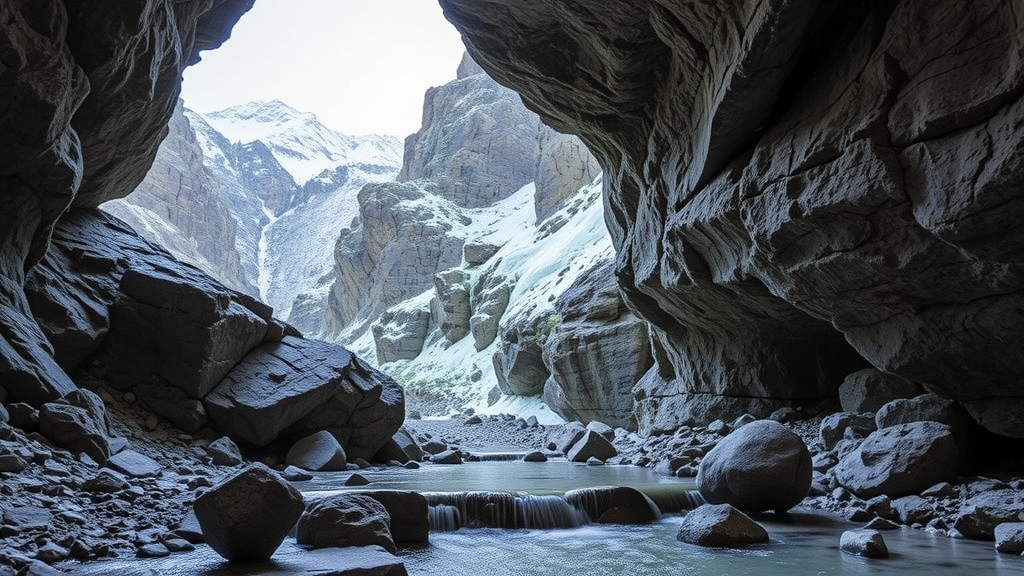
High in the Swiss Alps, a small valley called the Vallon de Réchy has become the testing ground for one of the most pressing questions in mountain hydrology: what happens to the water locked inside mountains when the climate that feeds it begins to change? A new study published in Hydrogeology Journal offers a detailed, technically grounded answer, and its findings carry a measure of reassurance alongside a sobering shift in when that water will arrive. Using a fully integrated surface–subsurface hydrological model, researchers led by Marie Arnoux of the Centre de Recherche sur l’environnement Alpin have quantified, for the first time in this setting, exactly how groundwater stored in different geological formations buffers the streamflow response of an alpine catchment under extreme climate change.
Alpine catchments are often described as water towers for humanity, and the description is literal. Snow that accumulates through winter is released during spring and summer melt, sustaining rivers across entire downstream valleys during the dry months when lowland agriculture, hydropower and drinking water systems need it most. But warming temperatures are dismantling this arrangement. Snow cover durations are shortening, melt is starting earlier, and a rising share of winter precipitation falls as rain instead of snow. Previous work cited in the study suggests that snow storage in the Swiss Alps may decline by roughly fifty percent even at elevations above 3000 meters by the end of the century, while at lower elevations snow may barely accumulate at all. The consequences ripple downstream: winter flows rise, spring and summer flows fall, and the annual runoff peak arrives earlier in the year.
What has been missing from most projections, the authors argue, is an explicit treatment of geology. Groundwater has long been under-represented in mountain hydrology, partly because alpine aquifers are heterogeneous and hard to observe, and partly because modeling them requires solving coupled surface and subsurface flow equations at high spatial resolution. Yet recent field studies have shown that groundwater can be a major contributor to mountain streamflow, stored disproportionately in unconsolidated Quaternary deposits such as moraines, talus slopes, alluvial fans and rock glacier sediments. The critical open question has been where, precisely, this water resides and to what extent it can cushion the blow of a warming climate on streamflow.
To answer it, the research team built a spatially explicit model of an 11-square-kilometer catchment in the Pennine domain of the Valais region, ranging from 2150 to 3148 meters in elevation. The valley’s geology is typical of alpine glacial landscapes: quartzite, gneiss and calcschist bedrock carved by glaciers into a staircase of rock basins separated by riegels, with the lower basins filled by moraine, alluvium and peat. Talus deposits and rock glacier sediments mantle the slopes. The model domain extends 285 meters below the surface and discretizes the catchment into more than 75,000 triangular prism elements, with fine vertical resolution near the ground surface to capture infiltration and unsaturated flow. Quaternary deposit thickness was mapped from geophysical surveys and sediment cores, reaching roughly 20 meters in the flat valley bottoms and thinning systematically on steeper slopes.
The simulations were performed with HydroGeoSphere, a physically based integrated model that simultaneously solves Richards’ equation for three-dimensional variably saturated subsurface flow and the depth-averaged Saint–Venant equations for surface flow, allowing water to exchange between stream and aquifer at every node. Snow accumulation and melt were handled with a degree-day approach calibrated against a sophisticated assimilated snowpack product built from more than 300 Swiss monitoring stations. The model was tuned against three years of observed discharge, hourly water levels in three piezometers, and catchment-averaged snow water equivalent, achieving a Nash–Sutcliffe efficiency of 0.63 for discharge during calibration and 0.73 during an independent validation period. Importantly, the authors acknowledge that equifinality, the problem of multiple parameter sets producing similar behavior, cannot be fully resolved with the sparse data available in alpine terrain, so the analysis focuses on storage changes and relative contributions rather than absolute values.
The model was then driven with two RCP 8.5 climate scenarios drawn from the Swiss Climate Change Scenarios 2018 dataset, both selected for their pronounced spring warming to maximize the effect on snowmelt. The projections imply mean annual temperature increases of 4.8 to 6.4 degrees Celsius by the 2085 period. Under these extreme conditions, the simulations show snow water equivalent collapsing to below 60 millimeters on average by the end of the century, with the seasonal maximum arriving one to two months earlier than today. Evapotranspiration rises steadily by about 45 millimeters per year. Mean annual groundwater storage across the whole catchment declines by roughly 110 to 130 millimeters, driven overwhelmingly by a slow, continuous depletion of water stored in the low-permeability bedrock, while storage in the Quaternary deposits remains comparatively stable on an annual basis.
The seasonal picture is more nuanced and, in some respects, encouraging. Groundwater storage in Quaternary deposits increases in winter and decreases in summer under future conditions, and by 2085 summer discharge drops sharply, by roughly 38 to 45 percent in August and 45 to 55 percent in September depending on the scenario. Yet the proportionality matters: in those same months, groundwater storage in the Quaternary deposits declines by only about 10 to 14 percent. The asymmetry reveals the buffering function. The valley-fill aquifers are recharged by precipitation, snowmelt, stream infiltration during high flows, and upwelling water from bedrock, then release it gradually during dry periods. In effect, the sediments act as a reservoir that smooths out the violent seasonal swings imposed by the loss of the snowpack, so that streamflow responds more dramatically to climate change than the groundwater store that sustains it.
Perhaps the most consequential finding concerns the timing of low flows. Today, the driest period in such catchments occurs in winter, when the landscape is frozen and snowmelt has yet to begin. The simulations show that the annual minimum seven-day discharge progressively migrates out of winter and into late summer, alternating between the two seasons between 2062 and 2091 and settling firmly into summer after 2092. Strikingly, the future summer low flows remain higher than the current winter low flows even under these extreme projections, although after sequences of very dry summers, such as the hypothetical consecutive drought years embedded in one scenario, the two converge uncomfortably. The authors caution that because mean annual precipitation does not decline in their projections, prolonged multi-month precipitation deficits could exhaust the buffering capacity quickly, since the shallow Quaternary aquifers react rapidly to changes in recharge.
A systematic sensitivity analysis sharpened the understanding of which geological units do the heavy lifting. When hydraulic conductivity in the moraine and talus units was lowered by an order of magnitude, groundwater storage in those units increased and low flows rose, demonstrating that these coarse, heterogeneous deposits primarily regulate the catchment’s buffering capacity. Conversely, raising bedrock conductivity drained deep storage and released more water to streams, showing that bedrock controls the slow release of water during dry periods even though its seasonal storage fluctuations are small. Alluvium, with its limited spatial extent, played a minor role in peak flows, and bedrock barely influenced high-flow dynamics at all. Together, the sensitivity experiments establish a complementary division of labor: Quaternary deposits set the buffer, bedrock supplies the deep reserve.
The study’s authors are careful to frame their model as a process-based exploration of a representative small alpine catchment rather than a deterministic forecast for one specific valley. Because Quaternary landforms such as moraines and talus recur across alpine regions worldwide, the qualitative conclusions likely generalize to other non-glacierized mountain catchments, though site-specific geology will always modulate the details. The practical stakes are considerable. Reduced summer flows combined with growing downstream demand could produce water shortages later this century, and the findings make a clear case that low-flow projections must incorporate geological structure and groundwater dynamics, elements routinely omitted from mountain water resource assessments. As snowpacks shrink and the alpine water cycle reorganizes, the invisible reservoirs scattered through rock and sediment beneath the peaks may prove to be the last line of defense for the rivers that half of humanity depends upon.
Subject of Research: The buffering role of groundwater storage in Quaternary deposits and bedrock on alpine catchment discharge under climate change
Article Title: Groundwater storage in Quaternary deposits and bedrock buffers the discharge response of a small alpine catchment to climate change
Article References: Arnoux, M., Cochand, F., Brunner, P., Schaefli, B., Winstral, A., & Hunkeler, D. (2026). Groundwater storage in Quaternary deposits and bedrock buffers the discharge response of a small alpine catchment to climate change. Hydrogeology Journal. https://doi.org/10.1007/s10040-026-03157-5
Image Credits: AI Generated
DOI: 10.1007/s10040-026-03157-5
Keywords: alpine hydrology, groundwater storage, climate change, snowmelt, Quaternary deposits, bedrock, low flows, HydroGeoSphere, Swiss Alps, integrated surface-subsurface modeling, streamflow, moraine
Cite Scienmag News
Sloane Callahan. (September 23, 2026). Hidden Rock and Ice Age Sediments Act as Water Vaults Shielding Alpine Streams From Climate Change. Scienmag. https://scienmag.com/hidden-rock-and-ice-age-sediments-act-as-water-vaults-shielding-alpine-streams-from-climate-change/
Sloane Callahan. "Hidden Rock and Ice Age Sediments Act as Water Vaults Shielding Alpine Streams From Climate Change." Scienmag, 23 September 2026, https://scienmag.com/hidden-rock-and-ice-age-sediments-act-as-water-vaults-shielding-alpine-streams-from-climate-change/. Accessed 23 September 2026.
Sloane Callahan. "Hidden Rock and Ice Age Sediments Act as Water Vaults Shielding Alpine Streams From Climate Change." Scienmag. September 23, 2026. https://scienmag.com/hidden-rock-and-ice-age-sediments-act-as-water-vaults-shielding-alpine-streams-from-climate-change/


