


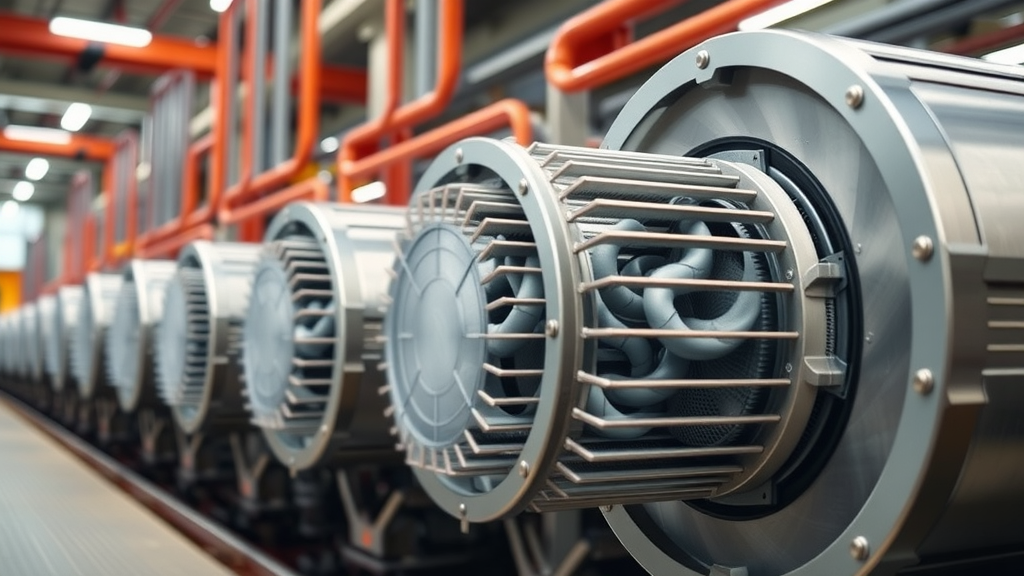
Dust is an invisible adversary for the power electronics that drive modern rail transit. Inside the traction converters that propel electric trains, forced-air cooling systems rely on aluminum heatsinks and fans to strip away the enormous heat generated by switching power semiconductors. Over weeks and months of service, fine particles accumulate at the air inlet and on the delicate fins of these heatsinks, quietly choking the airflow and raising the operating temperature of devices that were never designed to run hot. Left unchecked, this slow suffocation can push insulated-gate bipolar transistors and their diodes toward overheating faults, threatening the reliability of entire fleets. A research team led by Jie Chen and Hao Jia, publishing in the journal Results in Engineering, has now unveiled an intelligent monitoring method that can diagnose the severity of heatsink blockage online, without dismantling equipment or adding a single new sensor to the converter.
The stakes of this problem are higher than they might appear. Conventional maintenance practice calls for regular offline cleaning of cooling systems according to fixed schedules, regardless of whether dust has actually accumulated to a harmful degree. This conservative approach drives up costs and wastes labor, yet it still cannot guarantee that a badly clogged heatsink between cleanings will be caught in time. What engineers really want is continuous, condition-based monitoring: a way to know, in real time, exactly how blocked a heatsink has become. The obstacle is that measuring the blockage directly is surprisingly difficult. The physical quantity that betrays a dusty heatsink is its thermal resistance, the efficiency with which heat flows from the power module into the moving air. As dust builds up, thermal resistance rises, and device temperatures climb. Extracting that resistance from temperature data, however, is a notoriously ill-posed task under real operating conditions.
Earlier physics-based monitoring techniques attacked the problem by building mathematical models of the heatsink and fitting them to measured temperatures, often using iterative schemes such as Gauss-Newton estimation or frequency-domain analysis of the thermal network. These methods share a painful common requirement: they need to know, very precisely, how much power is being dissipated in the converter at every instant. Computing that power loss demands high-speed sampling of voltages and currents, plus access to internal control signals such as the conduction duty cycles of the switches. Retrofitting existing converters with the sensors and data links necessary to provide this information is expensive and intrusive, which is precisely why such techniques have struggled to leave the laboratory. Meanwhile, the high thermal capacitance of a massive heatsink means its temperature changes sluggishly, so short windows of data contain little dynamic information to work with, while rapidly fluctuating train power profiles smear the temperature signal with confounding variation.
The new method, which the authors call VMD-NN, pairs variational mode decomposition with a neural network to sidestep both obstacles at once. Variational mode decomposition, or VMD, is an adaptive signal-processing technique that breaks a complicated signal into a small set of intrinsic mode functions, each confined to a narrow band of frequencies. Unlike older recursive decompositions such as empirical mode decomposition, VMD formulates the task as a constrained variational optimization problem, solved through the alternating direction method of multipliers with a quadratic penalty factor and Lagrange multipliers. Every mode is simultaneously optimized with an explicit bandwidth constraint, which suppresses mode mixing and prevents the cumulative errors that plague recursive sifting. Applied to the slowly wandering temperature trace of a heatsink, VMD can tease apart the component tied to the underlying thermal resistance from the ripples injected by ever-changing power dissipation, effectively letting the algorithm treat the erratic power profile as if it were replaced by a steady average.
Choosing the right number of modes is critical to making VMD work. Too few, and meaningful information is filtered away; too many, and closely spaced center frequencies cause mode mixing or noise amplification. The team devised a simple correlation-coefficient procedure: starting with two modes, they decompose the signal and check two statistical tests, the correlation of each mode with the original temperature record and the correlations among the modes themselves. If any mode correlates weakly with the source signal, below a threshold of 0.1, or if two modes correlate too strongly with each other, the count is reduced; otherwise it is incremented and the process repeats. In their experiments on a three-phase inverter with a forced-air cooling system, this procedure converged on three modes, and Hilbert spectral analysis confirmed the choice. The third mode alone carried 98.43 percent of the signal energy in the band below 0.0005 hertz, exhibited the lowest sample entropy of the three, and showed no frequency drift over time, exactly the signature expected of the fixed thermal inertia of a cooling system whose blockage degree is not changing.
With the temperature feature in hand, the remaining challenge was to estimate average power dissipation without peeking inside the converter’s control system. Here the authors exploited an elegant chain of inference rooted in the physics of space-vector pulse-width modulation, the standard switching scheme for traction inverters. The conduction duty cycle depends on the modulation ratio and the voltage vector angle, both of which can be reconstructed from the AC-side frequency of the inverter. That frequency, in turn, leaves a fingerprint on the DC-link current: during certain switching states the DC current reads zero, and in all other states it equals the maximum absolute value of the three phase currents. By analyzing this pattern in the DC current, the method infers the phase currents and hence the AC frequency, from which the duty cycle follows. Combined with the DC-link voltage, this is enough to compute turn-on and turn-off energy losses, conduction voltage drops, and ultimately the average power dissipation, using nothing more than the current and voltage sensors every converter already possesses.
These four quantities, the VMD-extracted temperature characteristic component, the ambient temperature, the DC voltage, and the DC current, feed a fully connected neural network with two hidden layers of 64 units each and tanh activations, trained with the Adam optimizer at a learning rate of 0.0001 and early stopping to prevent overfitting. The network’s single output is the blockage degree itself. Training data came from a purpose-built experimental platform comprising a three-phase inverter and its forced-air cooling system, tested at blockage degrees spanning the full range from 0 to 100 percent, with power dissipation varied every 100 milliseconds by modulating the modulation ratio. The extracted temperature component rose monotonically with blockage degree across all cases, a relationship the authors show is exactly what the heatsink’s transient thermal model predicts, since a higher thermal resistance drives a higher steady-state temperature for any given power level. This monotonicity confirms that the dominant mode genuinely encodes the thermal resistance-capacitance dynamics rather than artifacts of the decomposition.
The performance figures are striking. On the training set the network achieved a mean square error below 0.0001, an average blockage error of 1 percent, and a maximum error of 8 percent. On an independent test set in which the blockage degree stepped from 20 to 40, 60, and finally 80 percent every 30 minutes, the steady-state error never exceeded 8 percent, and the method responded to each change in under 180 seconds. Ten repeated experiments yielded tight 95 percent confidence intervals at every blockage level, for instance a mean estimate of 0.1903 for a true value of 0.2, underscoring the reproducibility of the approach. Online inference takes roughly 25 milliseconds per sample on the test hardware, comfortably faster than the one-second sampling interval, and the trained model occupies less than 5 megabytes of memory, small enough for low-cost edge devices and embedded controllers. Head-to-head comparisons against a physics-based Gauss-Newton scheme, a plain artificial neural network, a long short-term memory network, and a hybrid convolutional-LSTM architecture showed the VMD-NN method achieving the lowest mean square error at 3.53 percent and the smallest maximum absolute error at 7.61 percent, with a response latency of 180 seconds that was competitive with the fastest rival while demanding only low sampling rates.
The broader implications reach well beyond one laboratory rig. Because the method requires no new sensors, no high-speed data acquisition, and no access to proprietary control signals, it can be deployed as a software upgrade on converters already in service, turning fixed-interval cleaning into condition-based maintenance that responds to the actual state of the dust filter. The authors note that their validation focused on dust blocking the inlet filter, the most common failure mode, and that other faults such as fan degradation or fin obstruction were not directly tested, although the underlying thermal-resistance logic suggests the framework could generalize with further study. If the approach migrates from the test bench to real trains, the humble heatsink may finally gain the digital nervous system it has lacked, catching a slow-motion dust disaster long before it becomes a delayed departure or, worse, an overheated power module stranded in service.
Subject of Research: An online variational mode decomposition and neural network method for identifying the blockage degree of dust-clogged heatsinks in rail transit traction converter air-cooling systems.
Article Title: A VMD-NN based blockage degree identification method for air-cooling systems
Article References: Chen, J., Jia, H., Xie, J., & Kang, Y. (2026). A VMD-NN based blockage degree identification method for air-cooling systems. Results in Engineering, 32, Article 112995. https://doi.org/10.1016/j.rineng.2026.112995
Image Credits: AI Generated
DOI: 10.1016/j.rineng.2026.112995
Keywords: VMD, neural network, heatsink blockage, traction converter, air-cooling systems, thermal resistance, rail transit, condition monitoring, variational mode decomposition, power electronics, predictive maintenance, dust accumulation
Cite Scienmag News
Denise Maddox. (September 23, 2026). AI Spots Dust-Clogged Heatsinks in Train Converters Using Variational Signal Decomposition. Scienmag. https://scienmag.com/ai-spots-dust-clogged-heatsinks-in-train-converters-using-variational-signal-decomposition/
Denise Maddox. "AI Spots Dust-Clogged Heatsinks in Train Converters Using Variational Signal Decomposition." Scienmag, 23 September 2026, https://scienmag.com/ai-spots-dust-clogged-heatsinks-in-train-converters-using-variational-signal-decomposition/. Accessed 23 September 2026.
Denise Maddox. "AI Spots Dust-Clogged Heatsinks in Train Converters Using Variational Signal Decomposition." Scienmag. September 23, 2026. https://scienmag.com/ai-spots-dust-clogged-heatsinks-in-train-converters-using-variational-signal-decomposition/


