


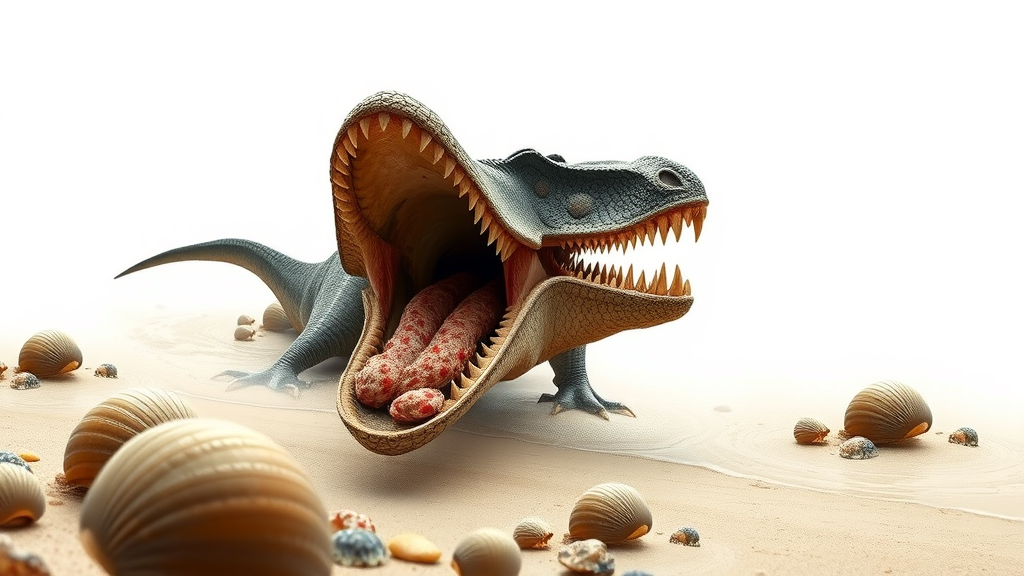
Some of the most enduring images of the Jurassic seas involve plesiosaurs gliding through open water, their impossibly long necks sweeping the depths for prey. Now, a remarkable set of fossils recovered from beneath the North Sea suggests these celebrated marine reptiles had one more behavioural quirk in common with animals alive today: they apparently travelled to shallower, sheltered near-shore waters specifically to rid their stomachs of the hard, indigestible remains of their meals. The evidence comes in the form of more than twenty fossilised regurgitation pellets, or regurgitalites, recovered from drill cores taken off the Norwegian coast, and it is prompting palaeontologists to reconsider how these sea monsters used the ancient coastlines they shared with dinosaurs.
The study, published in Geological Magazine by Cambridge University Press, was conducted by Dr Dirk Knaust, a palaeontologist who specialises in the trace fossils left behind by invertebrates. Over the past three decades, Knaust has examined several thousand metres of drill core samples drawn from North Sea wells operated by Equinor ASA, the Norwegian energy company that employs him. Much of the fossil vomit material he analysed came from cores collected during the development of a subsea CO2 storage site near the Troll gas and oil field. The investigated material originates from Middle to Upper Jurassic shallow- and marginal-marine deposits on the Horda Platform offshore Norway, including the Krossfjord, Fensfjord, Heather and Sognefjord formations of the Viking Group, in quadrants 31 and 32 of the Troll Field area. What began as routine commercial core logging turned into one of the most detailed behavioural portraits ever assembled for an extinct marine reptile.
The pellets themselves are striking objects. Ranging in size from a walnut to a mango, and in some cases reaching ten centimetres or more across, they are dense clumps of compacted skeletal debris bound together in a matrix that once consisted largely of mucus. Inside them, Knaust identified bivalve shells, serpulid shells — the hard, tube-like dwellings constructed by filter-feeding worms — crinoids, the stalked invertebrates that anchored themselves to the sea floor, and belemnites, the hard internal remains of squid-like cephalopods. This mixture points decisively toward an animal that specialised in devouring hard-shelled and exoskeleton-bearing prey from the sea floor. Crucially, the producing animal also had to be large enough to expel regurgitated clumps of this size, immediately narrowing the field of candidate culprits.
The behavioural interpretation rests on a subtle but powerful ecological paradox. The shellfish identified within the vomit required the stable salinity of open marine water to survive. Yet the deposits in which the pellets were fossilised formed in a river delta, an environment where incoming freshwater continually altered salt levels, rendering it impossible for such salinity-sensitive creatures to live there. The shellfish could not have inhabited the delta, so their remains could not have been vomited there by an animal that had just fed in place. The logical conclusion, Knaust argues, is that the predator hunted in deeper offshore waters, consumed shelled prey from the sea floor, and then swam toward shore — into the delta environment — before vomiting up the compacted, indigestible material. The behaviour parallels that of modern fur seals and marine crocodiles, though with one important distinction: while those animals haul themselves onto land, plesiosaurs, constrained by their weight and body shape, probably remained submerged in shallow water as they regurgitated.
Understanding why such fragile traces survived at all requires appreciating the taphonomic odds stacked against them. Vomit, unlike bone, is soft, dispersed and rapidly destroyed. As Knaust explains, these pellets endured partly because they were so densely compacted and coated in mucus, but even so, most would have been completely broken apart by waves and tides. The exceptional specimens recovered from the cores survived because clusters were quickly buried by sediment delivered by the rivers feeding the delta. Others came to rest in burrows abandoned by crustaceans on the sea floor, where the shelter of the sediment-filled structures allowed them to be partially preserved and ultimately fossilised. Without these fortuitous burial events, the entire record of this behaviour would have dissolved back into the mud.
Distinguishing fossilised vomit from fossilised faeces — coprolites — is its own technical challenge, and Knaust approached it systematically. Regurgitalites contain a higher proportion of undigested food remains, show scattered and irregular shapes rather than the coherent form of faecal masses, and display a distinctive mineralogy. Throughout the research, he compared the Norwegian specimens with previously studied vomit fossils documented over the last century across Europe and North America. This comparative framework matters, because most recent research into fossilised regurgitations has focused on vertebrates eating other vertebrates. According to Knaust, this is the first time plesiosaur vomit, and the shellfish preserved within it, have been identified, making the material an unusually direct window into the diet and digestive physiology of these animals, which lacked the crushing teeth needed to process shell and skeletal material and instead compacted it in the stomach for expulsion, much as owls do today with their pellets.
Identifying the culprit demanded an exercise in systematic exclusion. Knaust began with invertebrate suspects such as cephalopods, the group that includes squid, octopus and cuttlefish, but the size and composition of the vomit did not match. Among vertebrates, fish regurgitations would have been far too small. Moving up the food chain, he evaluated sharks and crocodiles, both abundant in the region during the Jurassic. One coprolite found near the vomit in a core likely came from a crocodile, and one tantalising clue — a bone recovered just centimetres from the fossilised vomit and coprolites — initially appeared to be from a dinosaur. CT scanning revealed instead that it belonged to an ichthyosaur, a group of dolphin-like marine reptiles unrelated to plesiosaurs. That discovery briefly raised the possibility that the vomit and faeces belonged to an ichthyosaur, but many other marine animals had to be considered, and the composition of their vomit differs. Crucially, Jurassic sharks and crocodiles hunted fish rather than grazing the sea floor for shellfish, and no fish skeletons appeared in the fossilised vomit. The plesiosaur, Knaust concluded, most closely matches both the size and the feeding profile of the vomit producer.
The identification carries particular weight because of what plesiosaurs represent in the history of life. Measuring anywhere from two to thirteen metres in length, they rank among the most successful marine reptiles ever to have evolved, surviving more than 140 million years and weathering multiple extinction events. The specific group implicated in the Norwegian vomit, the cryptoclidid plesiosaurs, grew between four and eight metres long and lived from the Middle Jurassic to the Early Cretaceous, roughly 174 to 100.5 million years ago. Earlier research into plesiosaur anatomy and movement had already suggested that these long-necked reptiles angled their heads downward to collect shellfish from the sea floor. The vomit pellets now provide behavioural confirmation of that feeding strategy, and they do so from an environment — a river delta — rather than the open marine settings where most plesiosaur fossils are found.
There may be wider implications for fossil hunters closer to home. Plesiosaur skeletons have been recovered across the world, but the United Kingdom stands out as a particular hotspot, and Knaust, an enthusiast for collecting along England’s Jurassic Coast, believes the same shoreward-vomiting behaviour could have occurred around Britain and many other coastlines. During Jurassic times, the offshore location of the well that yielded the fossils and the rock outcrops along the cliffs of southern England lay within the same narrow sea, an arm of ocean comparable to the North Sea today. That shared palaeogeography means the Norwegian cores may effectively preview what similar deposits in southern England could hold. Meanwhile, the delta itself was a lively place: while dangers lurked in the deeper water, two-legged predatory dinosaurs and long-necked herbivores roamed the delta lands nearby, and Knaust and his colleagues have identified parts of their footprints in some of the extracted cores, adding a terrestrial counterpoint to the marine story preserved just metres away.
For Knaust, the findings represent less an endpoint than an opening. The research adds a new category of evidence — direct digestive traces — to the anatomical and sedimentological clues that palaeontologists use to reconstruct how extinct animals behaved, fed and moved through their worlds. It demonstrates that seemingly mundane commercial core material, drilled for energy infrastructure, can preserve subtle biological interactions over stretches of time measured in tens of millions of years. And it shows that even the least glamorous of fossil traces, the compacted leftovers of an ancient meal, can carry genuine behavioural information: where an animal hunted, where it rested, and how it managed the indigestible consequences of a shellfish diet. As Knaust himself notes, this is still just the beginning, and there is a great deal more to learn from picking through what extinct animals threw up after dinner.
Subject of Research: Fossilised plesiosaur regurgitalites from Jurassic delta deposits offshore Norway revealing shoreward vomiting behaviour in marine reptiles
Article Title: Queasy sea monsters swam to shore to vomit, Jurassic fossils reveal
Article References: Queasy sea monsters swam to shore to vomit, Jurassic fossils reveal. (n.d.). Original publication
Image Credits: AI Generated
DOI: Not provided
Keywords: plesiosaurs, regurgitalites, fossilised vomit, Jurassic, coprolites, marine reptiles, North Sea, cryptoclidids, palaeontology, river delta deposits, shellfish prey, Geological Magazine
Cite Scienmag News
Violet Maxwell. (September 23, 2026). Jurassic Fossil Vomit Reveals Plesiosaurs Swam Shoreward to Regurgitate Prey Shells. Scienmag. https://scienmag.com/jurassic-fossil-vomit-reveals-plesiosaurs-swam-shoreward-to-regurgitate-prey-shells/
Violet Maxwell. "Jurassic Fossil Vomit Reveals Plesiosaurs Swam Shoreward to Regurgitate Prey Shells." Scienmag, 23 September 2026, https://scienmag.com/jurassic-fossil-vomit-reveals-plesiosaurs-swam-shoreward-to-regurgitate-prey-shells/. Accessed 23 September 2026.
Violet Maxwell. "Jurassic Fossil Vomit Reveals Plesiosaurs Swam Shoreward to Regurgitate Prey Shells." Scienmag. September 23, 2026. https://scienmag.com/jurassic-fossil-vomit-reveals-plesiosaurs-swam-shoreward-to-regurgitate-prey-shells/


