


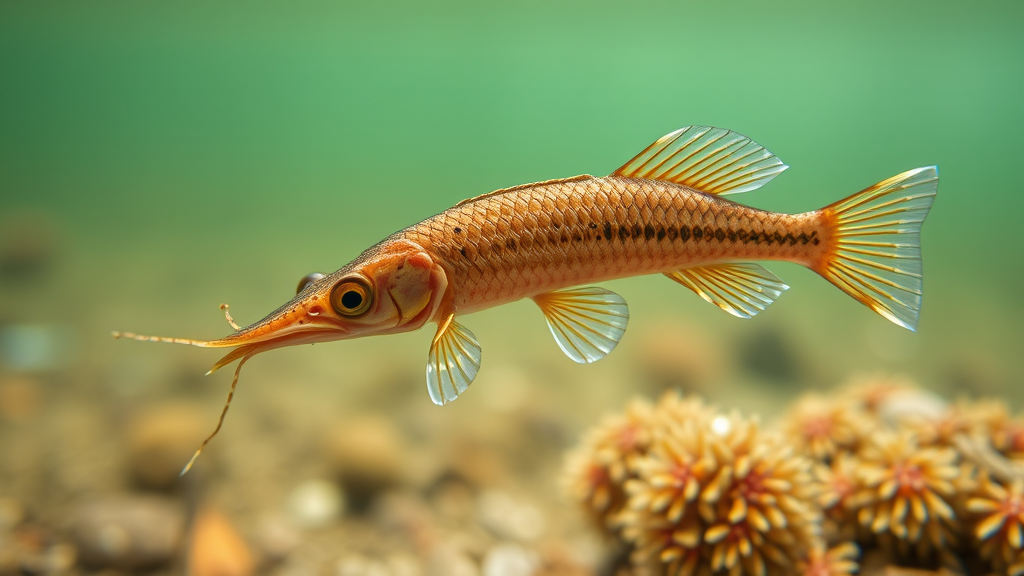
In the industrial waters of the Corpus Christi Inner Harbor in Texas, a small, unassuming fish is quietly rewriting what scientists know about rapid evolution. The Gulf killifish, Fundulus grandis, has long been a resident of estuaries along the Gulf of Mexico, but new research reveals that populations living in one of the most contaminated waterways on the Texas coast have evolved a striking degree of resistance to some of the most persistent pollutants humans have ever produced. The finding, published in the journal Ecotoxicology, marks only the second documented cluster of pollution-adapted Gulf killifish populations, and it offers a vivid real-time demonstration of evolution operating on decadal rather than geological timescales.
The Corpus Christi Inner Harbor is no ordinary estuary. Home to the sixth largest port in the United States and ringed by petrochemical and industrial facilities along the Tule Lake Channel, the harbor’s sediments carry a heavy burden of contaminants of concern, including mercury, lead, zinc, polycyclic aromatic hydrocarbons, and polychlorinated biphenyls, commonly known as PCBs. The levels of PCB contamination found there are comparable to those measured in the most heavily industrialized inland stretches of the Houston Ship Channel, a waterway already famous among toxicologists for producing pollution-resistant fish. For killifish living in the Inner Harbor, these dioxin-like compounds represent a powerful and unrelenting selective pressure.
Dioxins, furans, PAHs, and PCBs share a common mode of action that makes them particularly dangerous to developing fish. They activate the aryl hydrocarbon receptor, or AHR, a transcription factor that responds to foreign chemicals and switches on a battery of detoxification genes, including cytochrome P4501A, or CYP1A, a critical enzyme in Phase I metabolism. The AHR pathway is highly conserved across animal taxa, but fish carry multiple copies of the AHR gene, and in teleosts the AHR2 copy is the most functionally important for responding to dioxin-like compounds. Paradoxically, while the pathway exists to detoxify xenobiotics, its chronic activation causes severe developmental malformations, including devastating heart deformities in fish embryos. Experiments in zebrafish have shown that knocking down AHR2 actually protects embryos from dioxin-induced cardiac toxicity, a biological irony that hints at how resistance might evolve.
That hint has been borne out repeatedly in killifish. Atlantic killifish, Fundulus heteroclitus, living near EPA Superfund sites along the Atlantic Coast have independently evolved resistance to persistent pollutants, and genomic studies show that genes in the AHR signaling pathway are recurrent targets of natural selection in these adapted populations. The Gulf killifish, the Atlantic species’ close sister, has followed a similar path in the Houston Ship Channel, where twelve populations have been characterized. Populations closest to the most industrialized section of the channel display strong resistance to PCB-induced cardiac teratogenesis, and many carry a 77-kilobase genomic deletion spanning the AHR1a and AHR2a genes, a deletion that likely entered the species through a recent hybridization event with Atlantic killifish, possibly mediated by accidental human transport of fish or larvae.
The new study, led by Rachel B. Walkup and colleagues at Baylor University, asked whether a similar evolutionary story had unfolded some 200 miles away in the Corpus Christi Inner Harbor. The researchers collected fish from two contaminated sites, Tule Lake and Up River Road, in April 2022, and compared their embryos with two previously characterized Galveston Bay populations: Vince Bayou, an adapted and resistant population from the Houston Ship Channel, and Smith Point, a non-adapted reference population. Because Gulf killifish show high site fidelity and limited gene flow between populations, the geographic separation between the two bays raised a compelling question: had the Corpus Christi fish evolved resistance independently, or did they share ancestry with their adapted Houston cousins?
To find out, the team exposed embryos from all four populations to varying doses of PCB126, a potent model AHR agonist, and scored heart deformities at 144 hours post fertilization. The results were dramatic. Embryos from the Smith Point reference population developed significant cardiac deformities starting at just 5 micrograms per liter, while the Vince Bayou population showed no significant deformities at any tested dose. The two Corpus Christi populations fell squarely in between: significant heart deformities appeared only at 50 micrograms per liter for Up River Road embryos and 100 micrograms per liter for Tule Lake embryos. When the researchers calculated the concentration that caused deformities in half of the embryos, the EC50 values for the Corpus Christi populations were approximately 300 times higher than those of the reference population, placing them at a resistance level comparable to intermediate-high populations from the Houston Ship Channel.
The mechanism behind this resistance appears to involve a blunted AHR pathway. Using an in ovo EROD assay, which measures fluorescent resorufin produced by CYP1A activity in the embryos’ urinary bladders, the researchers found that both Corpus Christi populations had significantly lower basal CYP1A activity than the reference population and reduced maximal inducibility following PCB126 exposure. Notably, basal and maximal CYP1A activity did not differ significantly within any adapted population, indicating a compressed range of pathway responsiveness. Across the Corpus Christi populations and twelve previously characterized Galveston Bay populations, basal and maximal CYP1A activity were strongly linearly correlated, and EC50 values for cardiac deformity were strongly correlated with maximal CYP1A inducibility. This pattern suggests that downregulation of the AHR pathway is the common engine of resistance across all of these adapted populations, even those separated by hundreds of miles of coastline.
Yet the study also uncovered a puzzling wrinkle. While the population-level correlation between CYP1A inducibility and cardiac protection was robust, individual CYP1A activity did not reliably predict whether a given embryo would develop heart deformities. Individual CYP1A responses varied enormously within the Corpus Christi populations, spanning the range observed between the sensitive reference population and the highly resistant Vince Bayou population. To explain this discrepancy, the researchers propose a theoretical model in which cardiac deformity begins once CYP1A activity declines to roughly half of its peak on the descending side of the dose-response curve. Because individual fish within an adapted population sit at different points along a continuum of AHR responsiveness, they reach that toxic threshold at different PCB concentrations, which is why a single CYP1A measurement at one dose cannot predict an individual embryo’s fate. The model also acknowledges other possible contributors, including variation in contaminant uptake, oxidative stress responses, and partial desensitization that uncouples receptor activation from downstream transcription.
The discovery of a second cluster of adapted Gulf killifish populations carries implications well beyond the Texas coast. It demonstrates that similar pollution regimes can drive the evolution of comparable adaptive traits in geographically isolated estuarine populations, reinforcing the emerging view that rapid evolutionary adaptation to toxic pollution is a repeatable and predictable phenomenon. Whether the Corpus Christi resistance arose independently, through shared ancestry, or via gene flow from Houston Ship Channel populations remains an open question that future population genomic and proteomic analyses will need to resolve, particularly since intermediate-high resistant populations in Galveston Bay show resistance despite carrying the introgressed AHR deletion at low frequencies, hinting that additional, possibly AHR-independent mechanisms may be at work. As industrial contamination continues to reshape coastal ecosystems worldwide, the Gulf killifish now stands alongside its Atlantic cousin as a powerful model for evolutionary toxicology, a living record of how wildlife can, at least sometimes, outrun the poisons humans leave behind.
Subject of Research: Evolved pollution tolerance in Gulf killifish populations from the Corpus Christi Inner Harbor, Texas
Article Title: Evolved pollution tolerance in Gulf killifish (Fundulus grandis) from the Corpus Christi Inner Harbor, Texas, USA
Article References: Walkup, R. B., Swearingen, C., Steele, L. R., Greer, K. E., Kim, J., & Matson, C. W. (2026). Evolved pollution tolerance in Gulf killifish (Fundulus grandis) from the Corpus Christi Inner Harbor, Texas, USA. Ecotoxicology, 35(7), Article 164. https://doi.org/10.1007/s10646-026-03144-2
Image Credits: AI Generated
DOI: 10.1007/s10646-026-03144-2
Keywords: Gulf killifish, evolutionary toxicology, PCB resistance, aryl hydrocarbon receptor, CYP1A, Corpus Christi Inner Harbor, cardiac teratogenesis, pollution adaptation, EROD assay, Houston Ship Channel, estuarine contamination, rapid evolution
Cite Scienmag News
Gavin Prescott. (September 23, 2026). Gulf Killifish Evolve Remarkable Resistance to Industrial Pollution in Texas Harbor. Scienmag. https://scienmag.com/gulf-killifish-evolve-remarkable-resistance-to-industrial-pollution-in-texas-harbor/
Gavin Prescott. "Gulf Killifish Evolve Remarkable Resistance to Industrial Pollution in Texas Harbor." Scienmag, 23 September 2026, https://scienmag.com/gulf-killifish-evolve-remarkable-resistance-to-industrial-pollution-in-texas-harbor/. Accessed 23 September 2026.
Gavin Prescott. "Gulf Killifish Evolve Remarkable Resistance to Industrial Pollution in Texas Harbor." Scienmag. September 23, 2026. https://scienmag.com/gulf-killifish-evolve-remarkable-resistance-to-industrial-pollution-in-texas-harbor/


