


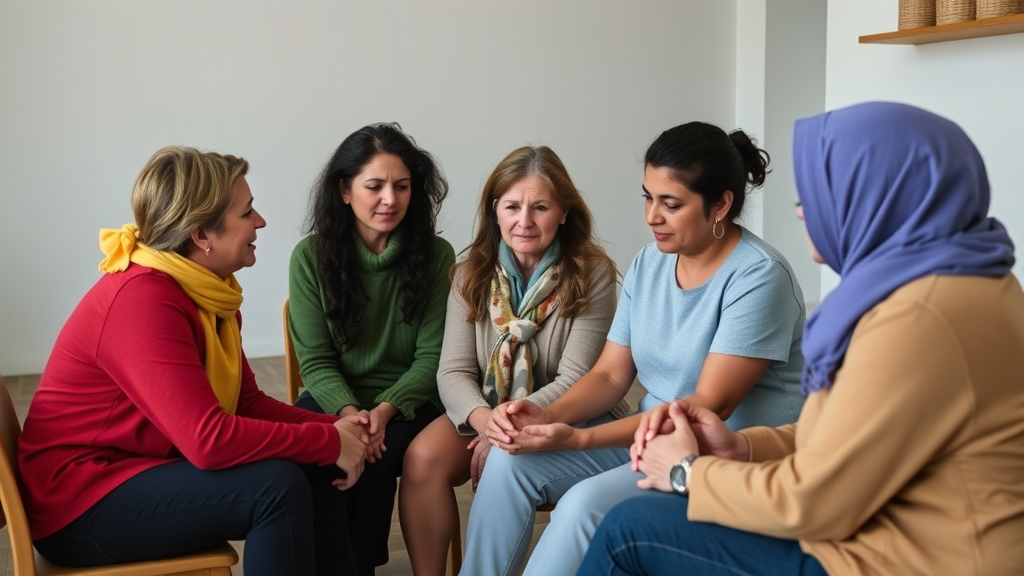
For people living with bipolar disorder, one of the most corrosive symptoms is often not mania or depression itself, but the profound loneliness that shadows both. A new qualitative study from Chile now offers a vivid, ground-level account of how community-based peer support groups are helping to dismantle that isolation, one conversation at a time. The research, published in the Community Mental Health Journal, examined the experiences of participants in Peer Support Circles—known in Spanish as Círculos de Apoyo entre Pares, or CAPs—a pioneering intervention run by a community organization in Santiago for individuals diagnosed with bipolar disorder.
The study, led by Alemka Tomicic and Javiera Duarte of Diego Portales University together with colleagues from the Fundación Círculo Polar, set out to understand how these groups are perceived by the people who take part in them: what benefits they deliver, what conditions allow them to function well, and what challenges they face. Rather than measuring outcomes with scales and statistics, the researchers turned to in-depth semi-structured interviews with 17 participants—7 peer supporters and 10 peer participants—capturing the texture of lived experience that quantitative trials often miss.
Methodologically, the team anchored its analysis in Constructivist Grounded Theory, an approach that treats knowledge as co-constructed between researchers and participants rather than simply extracted from them. Interview transcripts were coded iteratively, with categories emerging from the data itself, and the research team performed intersubjective validation, comparing interpretations across analysts to guard against individual bias. This rigorous qualitative machinery matters because the study’s central claim—that peer groups lower the barrier of isolation through relational safety and peer-driven meaning-making—rests on the credibility of how those accounts were gathered and interpreted.
Three main analytical categories emerged from the data. The first concerned the benefits of participating in the CAPs, which participants described as spaces of genuine emotional connection, mutual recognition, and practical learning about living with the condition. The second identified the conditions that enable the groups to work effectively, including trust, shared language, and the legitimacy that comes from being facilitated by people who have themselves navigated bipolar disorder. The third mapped the challenges and limitations the circles confront, from sustaining momentum over time to the fragility of initiatives that depend heavily on volunteer energy and community goodwill.
The central phenomenon that crystallized across interviews was the groups’ capacity to dissolve isolation. Participants repeatedly described the revelation of discovering others who truly understood their experience—an epiphany captured in the study’s title, drawn from the sentiment of realizing “I’m not the only one.” In clinical terms, the researchers interpret this as relational safety: an environment in which disclosure does not carry the risk of judgment, and where the ordinary anxieties of explaining one’s moods, medications, and hospitalizations to a skeptical world simply fall away.
Beyond emotional relief, the study found that the CAPs operate as engines of identity reconstruction. Participants described moving from a self-concept organized around illness and deficit toward one organized around agency and shared experience. Notably, the community organization uses the Spanish term conscientes—roughly, “those who are aware”—to describe participants, deliberately contrasting it with “patients” to emphasize self-knowledge and active participation rather than passive receipt of care. The researchers acknowledge that this term carries cultural and symbolic weight that resists direct translation into English, but its spirit permeates the findings: the circles are not merely support groups but platforms for rebuilding a self and re-entering community life.
The findings arrive amid a growing international evidence base for peer support in mental health. Systematic reviews, including a 2024 umbrella review in BMC Medicine, have documented the effectiveness, implementation challenges, and lived experiences of peer support approaches across mental health conditions, and the World Health Organization has issued guidance supporting peer support groups run by and for people with lived experience. Yet bipolar disorder presents specific challenges—cyclical mood episodes, stigma that can be internalized as self-stigma, and social withdrawal during both depressive and manic phases—that make the Chilean findings particularly relevant. Prior research has shown that stigma surrounding bipolar disorder is pervasive and that self-stigma can be as damaging as public discrimination, eroding self-efficacy and discouraging help-seeking.
What makes the Chilean model distinctive is its community grounding. The CAPs emerged not from a hospital or a ministry directive but from a community-based organization working alongside people with the diagnosis, and the study itself was a collaboration between academic researchers and the foundation’s own members. The authors are careful about this proximity: several co-authors are affiliated with the organization where the study took place, so the research process was overseen by lead investigators unaffiliated with the foundation and independently supported by the Millennium Institute for Research on Depression and Personality, a non-profit consortium of Chilean universities. That governance structure was designed to protect the neutrality of the analysis while preserving the intimate access that community-embedded research makes possible.
The study’s implications reach into health policy. In Chile, where psychiatric epidemiological studies have documented substantial prevalence of mental disorders and where hospitalizations for bipolar affective disorder have drawn recent attention, peer-led models offer a complementary layer to pharmacological treatment and psychotherapy rather than a replacement for them. The authors argue that such models advance recovery-oriented care—a framework, originating in the psychosocial rehabilitation literature of the 1990s, that defines recovery not as symptom elimination but as a meaningful life lived with or despite a condition. But they also stress that peer initiatives cannot thrive on passion alone: institutional support, stable funding, and formal recognition are essential to sustain the circles and maximize their impact.
The limitations of the study are those inherent to its design. Qualitative research with 17 participants in a single community organization cannot claim statistical generalizability, and the sensitive nature of the data—protected by informed consent and ethical approval for this specific project—means the underlying interviews cannot be shared publicly. Yet the strength of the approach lies precisely in its depth: by tracing how relational safety, shared meaning-making, and identity work unfold inside the circles, the study offers clinicians, policymakers, and peer organizations a detailed map of why peer support works when it works, and what it needs to keep working. For the people in the circles, the message is simpler and more human. In a condition that so often convinces its sufferers that they are alone, the discovery that they are not may be the most powerful therapeutic agent of all.
Subject of Research: Peer support groups for people with bipolar disorder in Chile
Article Title: “I’m Not the Only One”: A Qualitative Study on the Experiences of Peer Support for Bipolar Disorder in Chile
Article References: Tomicic, A., Duarte, J., Valenzuela, M. J., Verni, M., Lima, B., Herrera, I., Encina, F., Gal, F., & Valenzuela, R. (2026). “I’m Not the Only One”: A Qualitative Study on the Experiences of Peer Support for Bipolar Disorder in Chile. Community Mental Health Journal. https://doi.org/10.1007/s10597-026-01718-2
Image Credits: AI Generated
DOI: 10.1007/s10597-026-01718-2
Keywords: bipolar disorder, peer support, mental health, psychosocial recovery, grounded theory, community intervention, Chile, stigma, qualitative research, social isolation, recovery-oriented care, Only
Cite Scienmag News
Glenn Wilkins. (September 23, 2026). Peer Support Groups Help People With Bipolar Disorder Break the Grip of Isolation in Chile. Scienmag. https://scienmag.com/peer-support-groups-help-people-with-bipolar-disorder-break-the-grip-of-isolation-in-chile/
Glenn Wilkins. "Peer Support Groups Help People With Bipolar Disorder Break the Grip of Isolation in Chile." Scienmag, 23 September 2026, https://scienmag.com/peer-support-groups-help-people-with-bipolar-disorder-break-the-grip-of-isolation-in-chile/. Accessed 23 September 2026.
Glenn Wilkins. "Peer Support Groups Help People With Bipolar Disorder Break the Grip of Isolation in Chile." Scienmag. September 23, 2026. https://scienmag.com/peer-support-groups-help-people-with-bipolar-disorder-break-the-grip-of-isolation-in-chile/


