


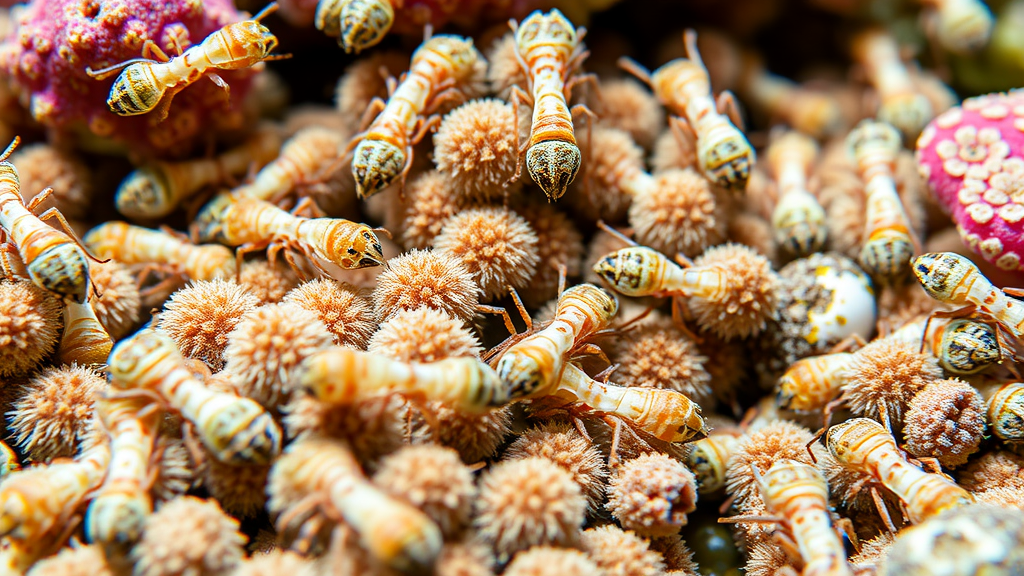
A remote scattering of coral islands in the South China Sea has yielded the first complete inventory of its ant fauna, and the results carry a pointed message about how modern human activity reshapes even the most isolated ecosystems. Researchers from the South China Botanical Garden of the Chinese Academy of Sciences surveyed seven islands of the Xisha archipelago, a tropical coral island chain that faces climate change, rising seas and intensifying human pressure. Their study, published in the journal Biological Diversity, catalogued twenty-one ant species across seventeen genera and five subfamilies, a modest sounding number that nonetheless represents a landmark for one of the least studied corners of Chinese biodiversity. Roughly seventy percent of the species recorded proved to be native taxa, while the remaining thirty percent were exotic arrivals. Behind that simple split lies a detailed portrait of an island system in which geography, vegetation and, above all, disturbance by people combine to determine which ants can gain a foothold and which cannot.
Compiling the inventory required a fusion of classical and molecular techniques. The team combined careful morphological taxonomy, the traditional bedrock of ant systematics, with species delimitation based on COI DNA barcoding, a molecular approach that uses a standardized segment of the mitochondrial cytochrome c oxidase I gene to separate closely related or cryptic forms. This dual strategy matters on small islands, where worker ants are often morphologically variable and where a single overlooked species could distort the ecological picture. By cross-checking what the microscope revealed against what the barcode sequences suggested, the researchers were able to disentangle how geography, vegetation cover and human disturbance mold the composition of island ant assemblages. The work thus delivers not merely a checklist but an analytical framework, one that treats each island as a natural experiment in colonization, extinction and community assembly played out over a small and biologically depauperate landscape.
The headline numbers conceal some genuinely surprising patterns. Across the seven islands surveyed, ant species richness showed only marginally positive and statistically non-significant correlations with the distance to the nearest neighboring island. That outcome runs counter to classic island biogeography theory, which since the pioneering work of MacArthur and Wilson has predicted that isolation should strongly suppress species richness, because distant islands are harder for dispersing organisms to reach. On the Xisha Islands, isolation appears to matter far less than expected for ants, a group whose winged queens can travel considerable distances and whose colonies are notorious stowaways in human cargo. Even more striking, no measured environmental variable could significantly explain the overall composition of ant communities across the archipelago. In an era when ecologists increasingly seek tidy statistical relationships between environment and biodiversity, the Xisha data are a reminder that young, disturbed, human-penetrated island systems can defy textbook expectations.
What did emerge clearly was the fingerprint of anthropogenic disturbance. This factor stood out as the key driver boosting the colonization of exotic ant species across the archipelago. The contrast between islands could hardly be sharper. Highly disturbed Yongxing Island, the administrative and logistical hub of the archipelago, hosted three exotic ant species, including two of the world’s most notorious invaders, the fire ants Solenopsis invicta and Solenopsis geminata. By contrast, the islands with low levels of disturbance contained at most a single non-native ant species. The pattern aligns with a growing body of evidence that human infrastructure, supply shipments and habitat modification act as conveyor belts for tramp ant species, which thrive in the open, disturbed microhabitats that construction and cultivation create. For a fragile coral archipelago, the arrival of aggressive, competitively dominant fire ants is not a trivial addition to a species list but a potential restructuring force for the entire terrestrial food web.
Vegetation, by contrast, exerted a negligible influence on ant species richness and on the proportion of exotic species present. This finding is notable because plant community structure is often invoked as a central filter for insect assemblages, shaping microclimate, nesting sites and food availability. On the Xisha Islands, where native vegetation is naturally sparse and where coconut plantings and other introduced flora have altered much of the green cover, the ant communities appear relatively insensitive to these differences. The implication is that on such a young and inherently depauperate landscape, the sorting of ant species is governed less by the fine details of habitat than by which species manage to arrive, and whether disturbance has opened the door for them to establish. That interpretation strengthens the case for focusing management attention on pathways of introduction rather than solely on habitat restoration.
The ecological roles performed by the ants themselves add a further layer of significance. Most of the Xisha ant fauna consists of ground-dwelling omnivores, generalists that forage across the soil surface for a wide range of resources. Yet these generalists are far from ecologically inert. Up to seventy-five percent of the recorded ant species engage in mutualistic relationships with hemipteran insects, the sap-sucking bugs such as scale insects, mealybugs and aphids whose sugary honeydew ants harvest in exchange for protection. Such mutualisms can cascade through island ecosystems, influencing plant health both positively and negatively depending on the hemipteran species involved. In addition, many of the recorded taxa display potential pollination and seed dispersal functions, services that are critically important for the depauperate plant communities of coral islands, where every effective mutualist partner counts. On islands with short lists of native animals, ants may shoulder ecological duties that would be distributed among many more groups on the mainland.
Conspicuously absent from the inventory were any endemic ant species, a finding consistent with the archipelago’s young geological origin. Coral islands such as those of the Xisha chain are geologically ephemeral features, built up by reef organisms and reshaped by storms and sea-level fluctuations, and they have simply not existed long enough for distinctive endemic lineages to evolve. This youthfulness is precisely what makes the archipelago scientifically valuable and ecologically vulnerable at the same time. Because the native biota is drawn entirely from colonists, the system is unusually open to new arrivals, including the invasive ones. As climate change and sea-level rise squeeze the available habitat even further, the balance between native colonists and exotic invaders becomes ever more consequential. The new inventory therefore establishes vital baseline data against which future change can be measured, whether that change stems from warming, from further development, or from the continued spread of introduced species.
From these baselines flow concrete management recommendations. The researchers warn that preventing the spread of invasive fire ants from highly disturbed islands such as Yongxing toward the less disturbed, more intact islands of the archipelago should be treated as an urgent conservation priority. Fire ants are capable of displacing native ants, preying upon or outcompeting ground-nesting wildlife, and imposing agricultural and public health costs, so their containment on a chain of small islands where inter-island traffic is manageable is a realistic goal rather than a distant aspiration. Quarantine and inspection of goods moving between islands, together with targeted monitoring of ant communities on the least disturbed islets, emerge from the study as practical tools. The work also underscores the value of investing in biodiversity surveys on small tropical islands, which are often skipped by large-scale sampling programs precisely because they seem biologically modest.
The authors are candid about the limits of the current study and the directions it opens. Sampling constraints inherent to short, logistically demanding expeditions on remote islands mean that some species, particularly rare or seasonally active ones, may have gone unrecorded, and the reliance on a single genetic locus for molecular delimitation leaves room for refinement. The team points toward future multilocus genomic research, which would use many independent genetic markers to resolve species boundaries and population histories with far greater confidence, and toward field-based functional validation of the ecological roles inferred for the ants, from seed dispersal experiments to direct measurement of hemipteran mutualisms. Such follow-up work would convert this first inventory into a dynamic monitoring program. For now, the Xisha study stands as a timely demonstration that on the world’s smallest and most fragile islands, the fate of native biodiversity is decided less by distance and isolation than by what people choose to move, build and protect.
Subject of Research: Ant community structure and exotic species colonization on the Xisha Islands, a tropical coral archipelago in the South China Sea
Article Title: Ant diversity of the Xisha islands: Community structure, exotic species colonization, and ecological functions in a tropical coral archipelago
Article References: Ant diversity of the Xisha islands: Community structure, exotic species colonization, and ecological functions in a tropical coral archipelago. (n.d.). Original publication
Image Credits: AI Generated
DOI: Not provided
Keywords: ants, Xisha Islands, South China Sea, invasive species, fire ants, island biogeography, biodiversity, coral islands, mutualism, seed dispersal, DNA barcoding, anthropogenic disturbance
Cite Scienmag News
Patricia Pace. (September 22, 2026). Ants on Remote Coral Islands Reveal Human Activity as Gateway for Invasive Species. Scienmag. https://scienmag.com/ants-on-remote-coral-islands-reveal-human-activity-as-gateway-for-invasive-species/
Patricia Pace. "Ants on Remote Coral Islands Reveal Human Activity as Gateway for Invasive Species." Scienmag, 22 September 2026, https://scienmag.com/ants-on-remote-coral-islands-reveal-human-activity-as-gateway-for-invasive-species/. Accessed 22 September 2026.
Patricia Pace. "Ants on Remote Coral Islands Reveal Human Activity as Gateway for Invasive Species." Scienmag. September 22, 2026. https://scienmag.com/ants-on-remote-coral-islands-reveal-human-activity-as-gateway-for-invasive-species/


