


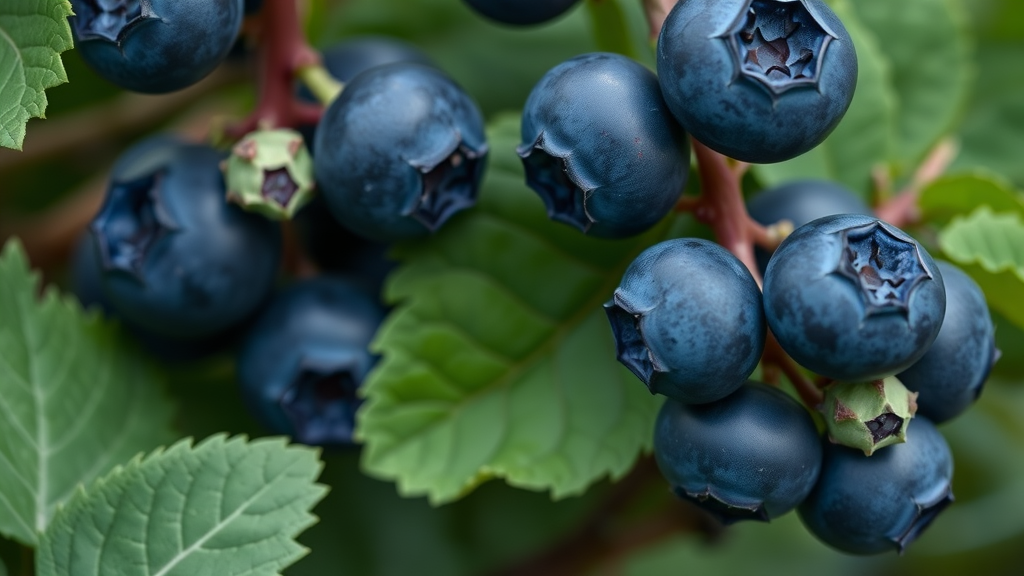
A team of Canadian researchers has reported the first systematic effort to identify and evaluate bacteriophages—viruses that kill bacteria—against strains of the Pseudomonas syringae complex recovered from highbush blueberry plants in southwestern British Columbia. The study, published in Microbial Biotechnology, describes a multi-stage screening pipeline that spans host-range analysis, comparative genomics, environmental stability testing, laboratory killing assays and validation on detached blueberry leaves. The authors show that carefully assembled phage cocktails can suppress populations of the pathogen on leaf surfaces over periods of up to ten days, offering proof of principle for a biocontrol strategy aimed at one of the most economically important berry crops in Canada.
The Pseudomonas syringae complex is a phylogenetic group comprising at least fifteen bacterial species and more than sixty host-specialized pathovars that collectively cause disease in over 180 plant species, including virtually all economically relevant crops. In highbush blueberry (Vaccinium corymbosum), infections manifest as blight of leafy tissues or cankers of woody tissues, both of which reduce plant health and productivity. Disease development depends on the transition of the bacterium from an epiphytic phase, in which cells remain adhered to plant surfaces, to an endophytic phase involving colonization of internal structures and the release of tissue-destroying virulence factors. Environmental conditions common in British Columbia—cool temperatures, high humidity and frequent precipitation—favour the growth and motility of epiphytic populations and thereby increase the likelihood of endophytic infection, making strategies that reduce surface populations before infection establishes an attractive line of defence.
The economic stakes are considerable. Global blueberry production reached roughly 2.14 billion kilograms in 2024, and Canada is the fourth-largest producer worldwide, accounting for nearly one-sixth of global output. Canadian blueberry exports were valued at approximately CAD $695 million in 2024, representing more than 65 percent of all Canadian fruit exports. Nearly 94 percent of the country’s highbush blueberry production occurs in British Columbia, where conditions favourable to the crop simultaneously favour bacterial growth and dispersal on plant surfaces. Traditional management has relied on copper-based biocides, but this approach damages the natural environment, can stunt plant growth through interference with the rhizosphere microbiome, and has been losing efficacy due to the spread of plasmid-borne copper resistance genes. Mitigation is often limited to the costly and unsustainable practice of pruning or culling infected plants.
Against this backdrop, the research team isolated bacteriophages from wastewater samples and from Pseudomonas syringae complex-infected blueberry plants collected at sites in the lower mainland and Okanagan valley regions, ultimately obtaining nineteen relatively stable phage isolates. Because phage predation by individual phage species is generally restricted to a subset of target strains and readily selects for resistant subpopulations, cocktail formulations of multiple distinct phages are typically employed to expand host range, improve efficacy and forestall resistance. The researchers used a semiquantitative spotting analysis to score infection interactions between each phage and a panel of twenty bacterial strains on a scale from zero to four, then excluded seven isolates—deemed weak specialists—that fell below median thresholds for both the number and strength of interactions. Twelve candidate phages advanced to genomic and functional characterization.
Whole-genome sequencing revealed extensive phylogenomic diversity among the candidates. Three isolates proved to be variants of a species within the genus Unosvirus, three were clonal duplicates belonging to Pifdecavirus, and a further group of four—three clonal and one diverged—may represent a novel species within an as-yet-undefined genus most closely related to Pseudomonas phage QdP_Psa3. The most striking discovery was phage φCB10, a jumbo phage with a genome of approximately 310 kilobases encoding 476 predicted coding sequences, most of them of unknown function. φCB10 was unrelated to the other lineages, most closely resembled Pseudomonas jumbo phage Psa21 at only 53.2 percent genomic similarity, and may represent the founding member of a novel genus. All twelve candidates were predicted to be obligately lytic, and bioinformatic screening found no lysogeny-associated genes, antimicrobial resistance determinants or metal resistance cassettes—characteristics considered indispensable for safe agricultural biocontrol.
Environmental stability assays revealed considerable heterogeneity among isolates. Exposure to ultraviolet radiation for one hour reduced viable titres of all phages, with the severity depending on wavelength: under UV-A at 365 nanometres, relevant to field conditions, only φCB16 fell below the detection limit, whereas UV-C at 254 nanometres drove the titres of most phages below detection. Freezing at −20 degrees Celsius produced a particularly polarizing split along predicted morphology: the three myovirus-like phages lost roughly 1.6 to 3.4 orders of magnitude in titre within a single day and became undetectable after 30 days, while podovirus-like isolates fared substantially better, with φCB02 and φCB05 showing no significant losses over the full month. This partitioning suggests that virion structural properties may broadly influence environmental persistence, a phenomenon the authors say warrants mechanistic investigation. Notably, some isolates appeared more stable at 22 degrees Celsius than at the conventional 4 degrees Celsius storage temperature, raising questions about the universality of phage storage conventions. Prolonged exposure to highly acidic conditions, potentially relevant given that blueberries thrive in soil at pH 4.0 to 5.5, was among the most consistently destabilizing stresses, although most phages retained functionality over biologically relevant timescales.
To quantify antibacterial activity, the team performed planktonic killing assays against eight virulent bacterial strains, summarizing 64 phage-host pairs with a Growth Reduction Coefficient derived from bacterial growth curves. Individual phage performance varied widely and depended strongly on the strain: the jumbo phage φCB10 achieved the highest median coefficient, 0.943, and was the only phage rated as strong across all targeted hosts, while roughly half of all single-phage interactions were deemed poor. The two most effective phages were variously combined with the four least effective to construct eight cocktails of three to five variants. Although cocktails did not significantly outperform individual phages overall, four formulations—φC_A, φC_B, φC_C and φC_D—achieved median coefficients above 0.75 and were rated as strong across the full host panel, and were carried forward to plant-based testing.
The decisive validation used a detached-leaf model in which young Draper-variety leaves were pretreated with phage cocktails and then inoculated with two highly virulent strains. Bacterial densities were substantially reduced in all pretreated leaves. At early timepoints corresponding to maximal bacterial densities in untreated leaves, the four cocktails induced reductions of 4.5 to 5.5 logs against strain B11 and 3.2 to 5.6 logs against strain B04. At the ten-day endpoint, two cocktails pushed B11 below the detection limit, and two others reduced B04 below detection. A variant of the Growth Reduction Coefficient calculated from bacterial density over time rated all four cocktails as strong against B11, with φC_D also strong against B04. Critically, ex planta performance correlated strongly with in vitro performance, suggesting that planktonic killing assays can serve as a useful proxy for more complex validation models in high-throughput screens.
Measurements of phage densities inside the leaves supported the conclusion that bacterial suppression was driven by ongoing lytic replication rather than a single contact-mediated kill. The mean in situ phage-to-bacterium ratio rose rapidly to a peak of roughly 1.8 × 10⁴ for treatments targeting B11 before decaying by day ten, and endpoint phage-to-bacterium ratios correlated positively with overall treatment efficacy. The authors interpret this as evidence that successful biocontrol depends not only on the killing efficiency of individual phages but also on their capacity to persist within the plant environment and maintain productive infections over extended periods.
The study establishes a framework for the systematic identification and evaluation of candidate phages for agricultural biocontrol, while flagging the questions that remain before field deployment. Detached-leaf assays cannot fully recapitulate whole-plant systems, and the authors emphasize the need to reproduce these results in larger-scale studies with intact plants and, ultimately, under field conditions, alongside assessments of any impacts on plant health or the native phyllosphere microbiome. The mechanisms governing phage susceptibility among bacterial strains also remain poorly understood. Meanwhile, φCB10—with its exceptional antibacterial performance, favourable stability, enormous coding capacity and potential to carry accessory functions capable of circumventing bacterial defence systems such as restriction-modification and CRISPR-Cas—stands out as a particularly compelling subject for future investigation, both as a biocontrol candidate and as a window into the biology of underexplored jumbo phages.
Subject of Research: Isolation and evaluation of bacteriophages for biocontrol of Pseudomonas syringae complex populations on highbush blueberry leaves
Article Title: Bacteriophages Control Epiphytic Pseudomonas syringae Populations in Highbush Blueberry Leaves
Article References: Ball, C., Lauman, P., Xu, T., Guy, T., Dadej, K., Richter, R., Lubberts, M., Cross, K., Ren, M., Latchman, S. R., Burlakoti, R., Deng, X., Fong, K., & Wang, S. (2026). Bacteriophages Control Epiphytic Pseudomonas syringae Populations in Highbush Blueberry Leaves. Microbial Biotechnology, 19(9), Article e70438. https://doi.org/10.1111/1751-7915.70438
Image Credits: AI Generated
Keywords: bacteriophages, phage biocontrol, Pseudomonas syringae complex, highbush blueberry, Vaccinium corymbosum, plant pathology, epiphytic bacteria, jumbo phage, phage cocktails, agricultural biotechnology, British Columbia, leaf blight
Cite Scienmag News
Kristina Jarvis. (September 22, 2026). Viral Cocktails Show Promise for Controlling Blueberry Pathogen on Leaves. Scienmag. https://scienmag.com/viral-cocktails-show-promise-for-controlling-blueberry-pathogen-on-leaves/
Kristina Jarvis. "Viral Cocktails Show Promise for Controlling Blueberry Pathogen on Leaves." Scienmag, 22 September 2026, https://scienmag.com/viral-cocktails-show-promise-for-controlling-blueberry-pathogen-on-leaves/. Accessed 22 September 2026.
Kristina Jarvis. "Viral Cocktails Show Promise for Controlling Blueberry Pathogen on Leaves." Scienmag. September 22, 2026. https://scienmag.com/viral-cocktails-show-promise-for-controlling-blueberry-pathogen-on-leaves/


