


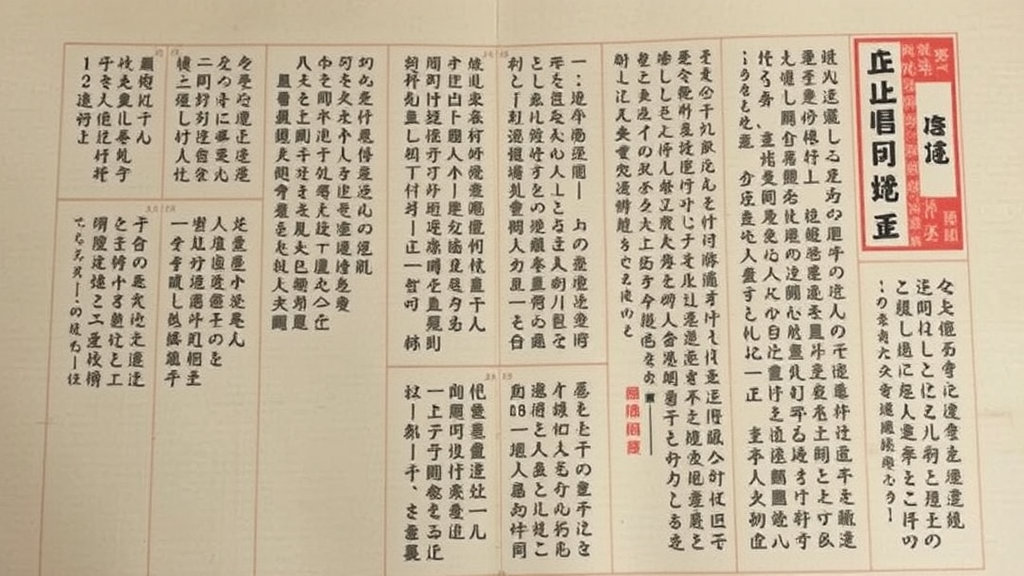
A new study published in Humanities and Social Sciences Communications describes how large language models were used to build a knowledge graph of imperial artifact production during the Yongzheng reign of the Qing dynasty, offering digital humanities researchers a fresh computational window onto one of the most intensively documented workshops in Chinese history. The work addresses a longstanding bottleneck in historical research on craft production: the vast, unstructured Chinese-language archives that record how the imperial court commissioned, supervised, and delivered objects ranging from porcelain and lacquerware to metalwork and textiles.
The imperial workshops of the Qing court, administered through bodies such as the Zaobanchu, generated enormous quantities of routine documentation. Memorials, requisitions, work logs, and delivery records capture the names of craftsmen, the materials they used, the deadlines imposed by the palace, and the judgments of supervising officials. For historians, this material is extraordinarily rich but also extraordinarily difficult to mine. The documents were written in classical Chinese with period-specific terminology, honorific conventions, and abbreviations, and the sheer volume of records makes manual extraction of structured facts a decades-long endeavor for even a well-funded team of archivists.
Knowledge graphs have become a standard tool for organizing such information. A knowledge graph represents entities, for example a craftsman, an object type, a workshop department, or a date, as nodes, and expresses relationships between them as typed edges, such as produced, supervised, requested, or made of. Once built, a graph allows researchers to ask structured questions: which craftsmen worked on both enamel and lacquer in a given year, which materials were most frequently requested for objects destined for particular palace halls, or how production patterns shifted after the death of one supervisor and the appointment of another. The difficulty has always been populating the graph, a task that traditionally required hand-coding rules or annotating large volumes of text by hand.
The researchers turned to large language models to automate this extraction. Modern LLMs, trained on enormous corpora of text, have demonstrated a strong ability to perform information extraction tasks with minimal task-specific training, a property that makes them attractive for low-resource domains such as classical Chinese archival documents where annotated training data is scarce. Rather than training a bespoke model from scratch, the approach described in the study leverages prompting strategies that instruct a general-purpose language model to identify entities and relations in archival passages and to normalize them into a consistent schema designed for the domain of imperial craft production.
Building a reliable pipeline required more than prompting alone. The authors confronted classic problems of LLM-based extraction: hallucinated entities, inconsistent naming of the same person or object across documents, ambiguity in classical Chinese phrasing, and the need to map colloquial or archaic terms onto a controlled vocabulary. Their framework therefore combines the generative strengths of language models with conventional knowledge engineering practices, including schema design, entity normalization and deduplication, and validation steps that check extracted records for internal consistency before they are committed to the graph. The result is a hybrid workflow in which the language model does the heavy lifting of reading unstructured text, while structured constraints keep the output tidy enough for scholarly use.
The choice of the Yongzheng reign as the target domain is historically motivated. Yongzheng, who reigned from 1722 to 1735, is known for close personal supervision of imperial manufacturing and for the high quality and distinctive aesthetic of objects produced under his direction. The workshop records from his reign are comparatively well preserved and internally consistent, which makes them an excellent testbed for computational methods: the density of documented production events provides ample material for extraction, while the known historical context offers a way to sanity-check the resulting graph against what historians already know about the period.
The resulting knowledge graph, once assembled, functions as a navigable map of the imperial production system. Nodes capture not only individual artifacts and their materials but also the institutional geography of the workshops, the networks of craftsmen, and the temporal rhythm of commissions. Such a resource supports quantitative analysis that would be impractical with the raw documents alone. Researchers can trace the lifecycle of an object from initial imperial request through design approval, material allocation, fabrication, revision, and final delivery, and can aggregate thousands of such lifecycles to reveal systemic patterns, for instance seasonal fluctuations in production or the concentration of particular techniques within particular workshop divisions.
Beyond Qing studies, the significance of the work lies in its demonstration of a generalizable method for the digital humanities. Many of the world’s historical archives remain locked in unstructured text, and the combination of large language models with knowledge graph construction offers a template that can be adapted to other corpora, languages, and domains. The study also contributes to an ongoing conversation about rigor in LLM-assisted scholarship. Because generative models can produce plausible but incorrect extractions, the authors emphasize evaluation of extraction quality and the importance of keeping human experts in the loop, particularly for contested or ambiguous readings of historical documents. The graph is best understood not as a replacement for close reading but as an index and hypothesis generator that directs expert attention to the most promising passages.
Limitations acknowledged in work of this kind are worth noting. Extraction accuracy for classical Chinese remains imperfect, entity resolution across hundreds of thousands of records is an open problem, and any schema imposes interpretive choices that shape downstream analysis. The authors position the current graph as a foundation to be extended and refined, with future directions including richer temporal modeling, integration with museum collection databases and surviving physical artifacts, and multimodal linkage between archival text and images of the objects themselves. As large language models continue to improve in multilingual and historical-language capability, pipelines of this type are likely to become a standard part of the historian’s toolkit.
For readers of science news, the study is a vivid example of artificial intelligence moving beyond chatbots and code generation into the archive. A language model trained largely on modern text was adapted to read eighteenth-century palace paperwork and return a structured, queryable model of an entire imperial manufacturing economy. In doing so, it turns stacks of memorials and requisition slips into something closer to a database of the Yongzheng court’s creative life, allowing scholars to see the craftsmen, materials, and decisions behind the treasures that now anchor museum collections worldwide, and pointing toward a future in which the deep past becomes searchable at scale.
Subject of Research: Large language model-driven knowledge graph construction for Qing Yongzheng imperial artifact production
Article Title: Large Language Model-driven knowledge graph construction for Qing Yongzheng imperial artifact production
Article References: Large Language Model-driven knowledge graph construction for Qing Yongzheng imperial artifact production. (n.d.). https://doi.org/10.1038/s41599-026-09040-8
Image Credits: AI Generated
DOI: 10.1038/s41599-026-09040-8
Keywords: large language models, knowledge graph, Qing dynasty, Yongzheng reign, imperial artifact production, digital humanities, information extraction, classical Chinese archives, Zaobanchu, entity normalization, cultural heritage computing, Large
Cite Scienmag News
Courtney Benton. (September 22, 2026). AI Reads Imperial Archives: Language Models Reconstruct Qing Dynasty Craft Records. Scienmag. https://scienmag.com/ai-reads-imperial-archives-language-models-reconstruct-qing-dynasty-craft-records/
Courtney Benton. "AI Reads Imperial Archives: Language Models Reconstruct Qing Dynasty Craft Records." Scienmag, 22 September 2026, https://scienmag.com/ai-reads-imperial-archives-language-models-reconstruct-qing-dynasty-craft-records/. Accessed 22 September 2026.
Courtney Benton. "AI Reads Imperial Archives: Language Models Reconstruct Qing Dynasty Craft Records." Scienmag. September 22, 2026. https://scienmag.com/ai-reads-imperial-archives-language-models-reconstruct-qing-dynasty-craft-records/


