


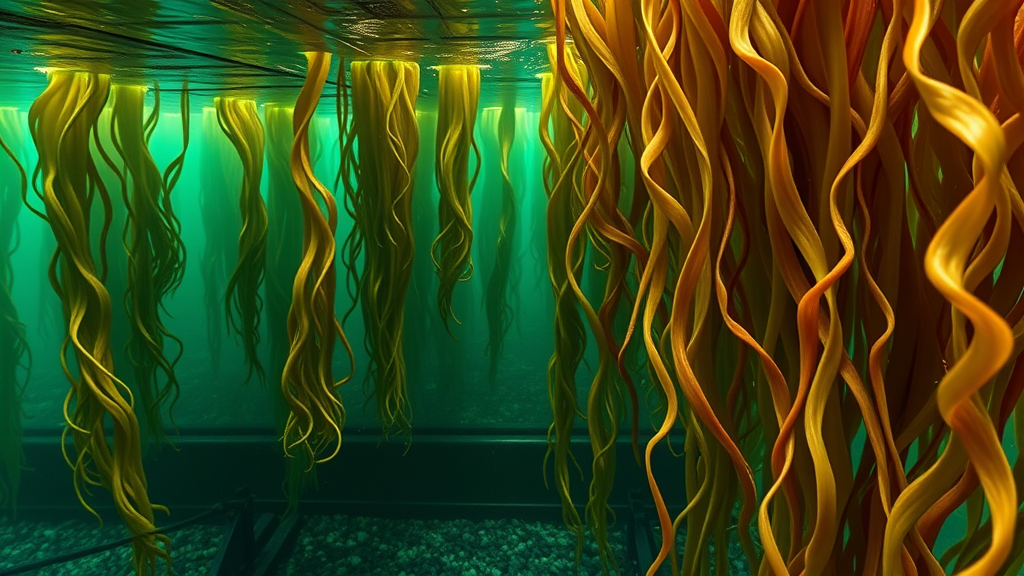
Beneath the cold, tea-colored waters of Chilean Patagonia, the planet’s largest biogenic structures still stand where they stood half a century ago. Giant kelp, Macrocystis pyrifera, weaves its golden canopies through fjords, channels and exposed archipelagos in one of the most remote marine ecosystems on Earth. While kelp forests have collapsed across much of the world’s temperate coastlines over the past fifty years, Patagonia has long been regarded as a quiet exception—a place where Darwin himself marveled at submarine forests that seemed to stretch without end. Now, a remarkable piece of scientific detective work has returned to the exact sites first surveyed in 1972 to ask a deceptively simple question: has anything really changed?
The answer, published in the journal Regional Environmental Change, is a study in contrasts. The kelp itself, it turns out, is still there, in densities that statistically match those recorded more than five decades earlier. But the living community woven around those forests has been quietly rewritten. An invasive sea anemone that did not exist in Patagonian waters in 1972 now smothers hard surfaces across sheltered sites, covering up to 88.4 percent of the seafloor in places. The region’s commercially harvested sea urchin has crashed by as much as 90 percent, its remaining individuals measurably smaller than their ancestors. And one widespread, long-lived urchin species appears to have vanished almost entirely from the study region.
The comparison is possible because of an extraordinary scientific legacy. In 1972, ecologist Paul Dayton sailed aboard the research vessel Hero as part of one of the first quantitative expeditions to describe kelp forest ecology across the breadth of Patagonia. His work, published in the mid-1980s, established the region’s forests as functionally unique—shaped by exposure gradients and largely free of the human disturbance that had transformed kelp ecosystems in the Northern Hemisphere. Dayton’s coordinates, transect designs and written descriptions became a frozen snapshot of a baseline world. In February 2026, a team led by Albert Pessarrodona of the University of Western Australia, working with Rewilding Chile’s Patagonian Megatransect initiative, relocated five of those original forests and replicated the historical sampling with remarkable fidelity, laying the same 25-meter transects along the same isobaths in the shallow subtidal zone.
The expedition surveyed twelve sites in total, spanning a dramatic environmental gradient that begins inside the Aysén fjord, threads through the channel networks of the Chonos Archipelago, and ends at fully wave-exposed oceanic islands. At each site, divers counted and measured kelp holdfasts—the root-like anchors of the plants—while a second diver tallied every mobile invertebrate larger than 2.5 centimeters. Kelp were classified into recruits, juveniles and adults using the same holdfast-diameter criteria Dayton had applied. Herbivore densities were quantified across three depth strata using quadrats, and the cover of every sessile organism was estimated with point-intercept methods. The statistical machinery brought to bear on the comparison was thoroughly modern: generalized linear mixed models with Gamma and Tweedie distributions, site treated as a random effect, and a 5,000-resample bootstrap to generate empirical confidence intervals where historical raw data were incomplete.
The headline finding on the kelp itself was reassurance. Adult giant kelp densities did not differ significantly between 1972 and 2026, and the community patterns across the fjord-to-ocean gradient closely matched the historical descriptions. At offshore sites, the dynamics remained what ecologists call top-down: grazing by the red sea urchin Loxechinus albus, the dominant herbivore by biomass, shapes where kelp can persist, carving urchin barrens at depth and confining forests to shallow boulder tops where wave exposure limits urchin access. Toward the sheltered inner fjord, the rules change. There, abiotic stress—freshwater runoff, low salinity, summer nutrient depletion—suppresses kelp growth, producing stunted, dwarfed plants barely three meters long, and non-consumptive interactions such as competition for space take center stage. The fjord’s shallow surface layer, with salinity dipping as low as 0.6 practical salinity units, excludes grazers that cannot tolerate the brackish conditions, so forests exist near the fjord head entirely devoid of herbivores.
Yet the apparent stability of the kelp itself conceals a subtler warning. Mean adult holdfast diameter was significantly larger in 2026—21.6 centimeters versus 13.6 in 1972—suggesting that today’s forests are dominated by older cohorts, a demographic signature that in other regions has preceded collapse. Recruit densities, meanwhile, were higher in the historical surveys, though the authors caution this likely reflects seasonal timing differences between the November historical sampling and their February expedition rather than a genuine decadal decline in reproduction. In the sheltered inner fjord, kelp populations run on an annual or semi-annual cycle, vanishing each late summer and persisting through a microscopic phase, an adaptation to the nutrient-poor, stratified waters that follow summer warming. Offshore, bathed in nutrient-rich subantarctic water, populations are perennial and reproduce year-round. These life-history differences, the study argues, reveal the fundamental role of geomorphology and oceanography in structuring the entire ecosystem.
The clearest footprints of global change appeared in the animals living among the kelp. Loxechinus albus, the target of the world’s largest sea urchin fishery—roughly 30,000 tons per year in the Aysén region alone—declined by 59 to 90 percent across the depths examined at the historical sites. Depth-specific averages that once ranged from 0.6 to 101 individuals per square meter in 1972 now span just 0.8 to 20. Maximum body sizes have shrunk from more than 10 centimeters to 7.5, a pattern classically associated with intense fishing pressure that removes the largest, oldest individuals. Independent stock assessments indicate standing stocks have fallen 45 to 51 percent since the late 1990s, and the bootstrapping analysis showed that the overwhelming majority of historical density values—between 80 and 94 percent depending on depth—fell outside the contemporary range of variation. Intriguingly, the surveys suggest offshore kelp forests may now be more extensive than Dayton reported, plausibly because reduced urchin grazing has loosened the top-down control that once constrained them—a cascade with consequences no one yet fully understands.
Equally striking is the fate of Pseudechinus magellanicus, a small, long-lived, opportunistic urchin that was ubiquitous in the 1970s at average densities of 1.7 to 30.1 individuals per square meter. In 2026, it was recorded at only four of twelve sites, at densities of essentially zero. Because this species is not commercially harvested, the mechanism behind its disappearance remains a mystery, though the researchers speculate that reduced recruitment—or populations living at the edge of their geographic range—may be involved. Its functional role, grazing on drifting kelp fragments from cryptic refuges in holdfasts and crevices, may already be quietly absent from the system.
Then there is the anemone. Metridium senile, a plumose filter-feeder native to the North Atlantic and North Pacific, first appeared in Chilean Patagonia in 2005. Two decades later, it is common at all but three of the surveyed sites, colonizing gravel, kelp fronds and even the surfaces of mobile invertebrates, and reaching peak cover in the sheltered channels and inner fjord. Its distribution appears governed by physics: oscillatory wave turbulence at exposed sites deforms its tentacle crown and cripples its feeding efficiency, while the low-salinity surface layer of the Aysén fjord falls below its known tolerance of roughly 15 to 37.5 practical salinity units, excluding it from the shallowest inner-fjord habitats. Where conditions suit it, however, it dominates—likely competing with native filter feeders including mussels, barnacles and a rich diversity of indigenous anemones. The study found no simple relationship between anemone cover and kelp recruitment or urchin density, but the authors warn that impacts may be most severe in the annual, sheltered kelp populations that depend on microscopic life stages to persist, and they flag potential effects on commercially important resources.
The broader lesson is one that marine ecologists have learned repeatedly around the world: the canopy can look intact while the forest’s inner machinery is being dismantled. Patagonia’s kelp forests have persisted through five decades of intensifying pressures—industrial fisheries, the explosive expansion of salmon aquaculture, marine invasions, and increasingly extreme climatic events—and the region’s relative climatic stability has likely buffered them from the declines seen elsewhere. But persistence of the foundation species is not the same as health of the ecosystem. The authors argue that protecting these globally significant forests will require conserving not just the kelp itself, but the ecological processes, connectivity and environmental conditions that underpin their resilience. In a region where long-term monitoring has been nearly impossible due to sheer remoteness, this rare half-century resurvey delivers both reassurance and alarm: the forests are still standing, but the fingerprints of the Anthropocene are now pressed firmly into every square meter of the seafloor beneath them.
Subject of Research: Long-term ecological change in Patagonian giant kelp forests assessed by resurveying sites first studied in 1972
Article Title: Footprints of global change in Patagonian kelp forests after half a century
Article References: Pessarrodona, A., Palacios, M., Kaminsky, J., Mora-Soto, A., Dayton, P. K., & Hüne, M. (2026). Footprints of global change in Patagonian kelp forests after half a century. Regional Environmental Change, 26(4), Article 194. https://doi.org/10.1007/s10113-026-02680-1
Image Credits: AI Generated
DOI: 10.1007/s10113-026-02680-1
Keywords: giant kelp, Macrocystis pyrifera, Patagonia, kelp forests, sea urchins, invasive species, Metridium senile, Loxechinus albus, Chile, fjords, marine conservation, historical ecology
Cite Scienmag News
Gavin Prescott. (September 22, 2026). Patagonian Kelp Forests Endure 50 Years, But Human Fingerprints Are Everywhere. Scienmag. https://scienmag.com/patagonian-kelp-forests-endure-50-years-but-human-fingerprints-are-everywhere/
Gavin Prescott. "Patagonian Kelp Forests Endure 50 Years, But Human Fingerprints Are Everywhere." Scienmag, 22 September 2026, https://scienmag.com/patagonian-kelp-forests-endure-50-years-but-human-fingerprints-are-everywhere/. Accessed 22 September 2026.
Gavin Prescott. "Patagonian Kelp Forests Endure 50 Years, But Human Fingerprints Are Everywhere." Scienmag. September 22, 2026. https://scienmag.com/patagonian-kelp-forests-endure-50-years-but-human-fingerprints-are-everywhere/


