


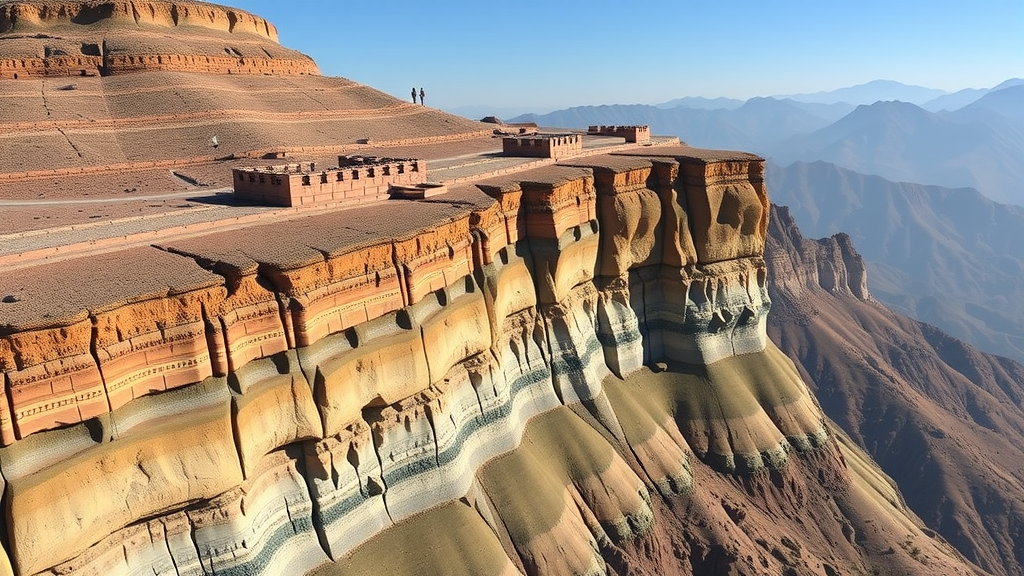
Deep in the misty hills of Nagaland, in a remote corner of Northeast India, geologists have been reading a story written in stone about a world that existed more than 30 million years ago. A new study of the Tikak Parbat Formation, part of the Oligocene Barail Group exposed in the Tiru Valley, has pieced together the mineral fingerprints, chemical signatures and burial history of sandstones and shales that once washed down from ancient mountain ranges. The findings, published in Discover Geoscience, suggest that these sediments were laid down along a stable, passive continental margin remarkably similar in character to the Atlantic-type margins that fringe modern ocean basins, a conclusion that challenges and enriches our understanding of how the sedimentary basins of Northeast India evolved during one of Earth’s most dramatic tectonic episodes.
The research team, led by K. Chiezou of the Geological Survey of India with colleagues from Assam University Silchar and North-Eastern Hill University Shillong, focused on a roughly 70-square-kilometre area in and around the Upper Tiru Valley in Mon district, within the Belt of Schuppen. This belt, a striking morphotectonic unit of northeast-southwest trending imbricate thrust sheets along the western flank of Nagaland, preserves sedimentary successions ranging from the Oligocene to the Quaternary. The Barail Group hosted within it is widely celebrated as a prolific hydrocarbon-bearing unit of the Upper Assam Petroliferous Basin, making any fresh insight into its composition and origin of direct economic as well as scientific interest.
The Tikak Parbat Formation itself is a visually distinctive succession. It alternates thin to thickly bedded, fine to medium-grained sandstones, which display cross-stratification and ripple lamination, with dark grey to black carbonaceous shales and coal seams. The formation is divided into two units: a lower intercalated shale-sandstone sequence between 120 and 215 metres thick, and an upper unit of alternating sandstone, shale and coal. Preserved sedimentary structures, including small-scale channels, lenticular bedding, scour-and-fill features and slumped layers, record a dynamic depositional environment in which sediment was repeatedly reworked, dried, flooded and destabilised.
To interrogate these rocks, the team collected 40 representative samples from the Tiru Valley and prepared thin sections from 39 of them. Using the Gazzi-Dickinson point-counting method, they tallied between 350 and 400 grains per slide to quantify modal mineralogy. Scanning electron microscopy on gold-coated samples at North-Eastern Hill University revealed delicate clay textures invisible to optical microscopy. Twenty of the least-altered samples were then crushed, ground and analysed for major oxides by X-ray fluorescence spectroscopy at the Geological Survey of India in Shillong, providing the chemical backbone for the study’s paleoenvironmental reconstructions.
The petrographic verdict was unambiguous. Quartz dominates the framework of the Tikak Parbat sandstones at roughly 45 percent of total grains, mostly as subangular to subrounded monocrystalline varieties, while rock fragments of igneous, sedimentary and metamorphic origin make up nearly 30 percent. Feldspar, at just under 6 percent, is more commonly potassium-rich than sodic, and many grains show alteration to sericite and clay. With an average recalculated modal composition of Q56 F7 R37, the sandstones classify as lithic arenite to lithic wacke, a composition that immediately hints at derivation from a recycled orogenic source rather than a freshly eroded volcanic arc.
Equally revealing is what the microscopy shows about the rocks’ post-depositional transformation. Mica flakes are kink-bent and ductile rock fragments have squeezed into pseudomatrix, hallmarks of intense mechanical compaction. Quartz cement occurs as syntaxial overgrowths around detrital grains, and iron oxide coats pore walls in reddish-brown films. Under the electron microscope, the team identified authigenic smectite and illite, including mixed-layer illite-smectite intergrowths in which illite nucleates directly on smectite flakes. Because smectite becomes unstable at burial temperatures above roughly 70 to 90 degrees Celsius and converts to illite in the presence of potassium released by dissolving K-feldspar, these textures indicate that the sandstones experienced moderate to deep burial diagenesis or contact with relatively hot pore fluids. Feldspar dissolution, meanwhile, generated secondary porosity, a process of keen interest to petroleum geologists because such pores can host hydrocarbons.
The geochemistry sharpened the picture further. Silicon dioxide ranges from about 49 to 82 weight percent, averaging 69 percent, while alumina averages 15.4 percent. Notably, sodium oxide is consistently lower than potassium oxide, matching the petrographic observation that K-feldspar outnumbers plagioclase, and reflecting the breakdown of unstable minerals during weathering and transport. Weathering indices tell a dramatic tale: the Chemical Index of Alteration averages 86.6 with values up to 89.1, the Chemical Index of Weathering averages 93.4, and the Plagioclase Index of Alteration averages an extraordinary 97.85, close to the theoretical maximum that signifies completely weathered material. On A-CN-K and A-K-C-N ternary diagrams, the samples cluster tightly near the alumina apex, confirming severe depletion of calcium, sodium and potassium in the source terrain.
These indices collectively portray source rocks stripped by intense chemical weathering under a semi-arid to semi-humid climate, conditions that produced chemically mature sediments before they ever reached the basin. The index of chemical variability points to high compositional maturity as well. Discriminant function analysis and SiO2 versus K2O/Na2O plots converge on a single tectonic interpretation: the Tikak Parbat sediments accumulated on a passive continental margin, a setting analogous to an Atlantic-type margin where thick sediment prisms build along trailing edges of continents far from active plate boundaries. Provenance diagrams place the sediment squarely in the recycled orogen field, with subordinate inputs from mixed and transitional continental sources.
The source of all this sediment is the most geologically satisfying part of the story. Trace-mineral evidence, including recycled zoned zircons and abraded quartz overgrowths that survived an earlier sedimentary cycle, alongside the dominance of metamorphic lithic fragments, points to sediment recycled from orogenic belts. The authors identify the flanking collisional systems, the Indo-Burmese or Indo-Myanmar Ranges and the Himalayas, as the principal contributors, with the bulk of the detritus derived from felsic rocks of granitic to rhyolitic composition. An aluminum oxide versus titanium dioxide plot reinforces this, showing low titanium-to-aluminum ratios characteristic of felsic crustal sources, with only a minor mafic, possibly basaltic, contribution.
What makes the study more than an academic exercise is its relevance to energy exploration and to the tectonic history of one of the most complex collision zones on Earth. Previous work had indicated that subsurface Barail sandstones differ significantly from their exposed counterparts in parts of the Belt of Schuppen, so characterising the outcropping rocks fills a genuine gap in regional knowledge. By demonstrating that the Oligocene Tikak Parbat sediments were intensely weathered, compositionally mature, recycled from collisional highlands and deposited on a passive margin that was later overprinted by thrusting, the study provides a calibrated baseline for reservoir prediction, for reconstructing the rise of the Himalaya and its neighbouring ranges, and for understanding how a quiet Atlantic-style continental edge was ultimately crumpled into the imbricate thrust sheets that give the Belt of Schuppen its name. In a handful of sandstones from a Nagaland valley, the rocks have preserved the full arc of that transformation, from placid margin to mountain front.
Subject of Research: Petrology and geochemistry of the Oligocene Tikak Parbat Formation sandstones in the Belt of Schuppen, Nagaland, Northeast India, constraining provenance, paleoweathering and tectonic setting
Article Title: Petrological and geochemical studies of Tikak Parbat Formation, Barail Group in parts of Belt of Schuppen, Nagaland, Northeast India
Article References: Petrological and geochemical studies of Tikak Parbat Formation, Barail Group in parts of Belt of Schuppen, Nagaland, Northeast India. (n.d.). https://doi.org/10.1007/s44288-026-00748-3
Image Credits: AI Generated
DOI: 10.1007/s44288-026-00748-3
Keywords: Tikak Parbat Formation, Barail Group, Belt of Schuppen, Nagaland, Northeast India, sandstone petrography, geochemistry, provenance, paleoweathering, passive continental margin, diagenesis, Oligocene
Cite Scienmag News
Violet Maxwell. (September 22, 2026). Ancient Indian Sandstones Reveal a Hidden Atlantic-Style Margin in the Himalayan Foothills. Scienmag. https://scienmag.com/ancient-indian-sandstones-reveal-a-hidden-atlantic-style-margin-in-the-himalayan-foothills/
Violet Maxwell. "Ancient Indian Sandstones Reveal a Hidden Atlantic-Style Margin in the Himalayan Foothills." Scienmag, 22 September 2026, https://scienmag.com/ancient-indian-sandstones-reveal-a-hidden-atlantic-style-margin-in-the-himalayan-foothills/. Accessed 22 September 2026.
Violet Maxwell. "Ancient Indian Sandstones Reveal a Hidden Atlantic-Style Margin in the Himalayan Foothills." Scienmag. September 22, 2026. https://scienmag.com/ancient-indian-sandstones-reveal-a-hidden-atlantic-style-margin-in-the-himalayan-foothills/


