


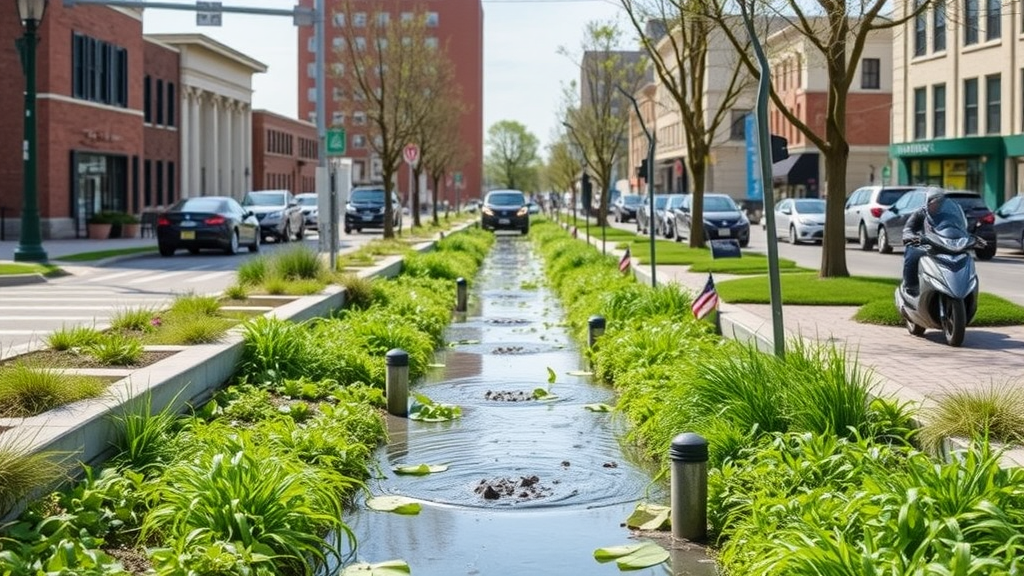
Rain gardens, rain barrels, bioswales and permeable pavements promise to make cities more resilient to the storms that climate change keeps intensifying. Yet across the United States, the spread of these green stormwater infrastructure practices remains stubbornly uneven, with some neighborhoods filling front yards with rain-catching devices while others barely participate at all. A new study published in Nature Cities argues that the difference is not simply a matter of money or awareness, but of three distinct forces that must align before a neighborhood tips into widespread adoption. Using a spatially explicit agent-based model built on household survey, census and parcel-level data from Austin, Texas, researchers show that sustained diffusion requires the simultaneous presence of visible nearby installations, genuine conversion capacity, and social reinforcement through social capital. Remove any one of them, and adoption stalls.
The research team, led by Koorosh Azizi of Tennessee State University and The University of Texas at Austin, together with Margaret Garcia of Arizona State University, Dev Niyogi and R. Patrick Bixler of The University of Texas at Austin, set out to explain why policy support for green stormwater infrastructure has not translated into the collective impact that planners hoped for. Individual household decisions matter, but the hydrological benefits of decentralized stormwater control only materialize at scale, when large fractions of a watershed’s impervious surface are treated. That means the crucial question for cities is not whether a few enthusiastic early adopters will install a rain garden, but whether adoption will diffuse through neighborhoods in a self-sustaining wave.
To answer it, the team constructed one of the most empirically grounded simulations of green infrastructure uptake to date. The model represents individual households as agents, each endowed with socio-demographic attributes drawn from census data, parcel attributes from municipal GIS records, and behavioral traits calibrated against a de-identified household survey. The agents form social networks, exchange influence through peer effects, and update internal psychological states, including awareness of green stormwater practices, personal norms, attitudes toward adoption, and social capital, the web of trust and reciprocity that shapes how neighbors persuade one another. Adoption occurs when a household’s intention crosses an individual threshold, a formulation rooted in established behavioral theory, including the theory of planned behavior and social-cognitive frameworks of observational learning.
What makes the model technically distinctive is its layered experimental design. The researchers staged mechanisms incrementally, from a static baseline in which nothing changes, through layers that separately activate feasibility and affordability constraints, social capital dynamics, and behavioral channels for awareness, norms and attitudes, up to a fully coupled configuration in which gains in one psychological variable carry over into others within each simulation step. Each layer thereby isolates a candidate engine of diffusion, and the city of Austin, divided into its ten council districts, serves as the empirical laboratory. Over 120 simulated time steps, the model tracks how many households adopt two broad classes of practices: structural installations such as rain gardens and permeable surfaces, and lower-cost rain-catching measures such as barrels and cisterns.
The central finding is stark: no single factor is sufficient to trigger widespread adoption. Visibility alone, in the form of neighbors’ visible installations, generates curiosity but not commitment if residents cannot afford or physically manage the conversion. Capacity alone, even when subsidies make practices affordable, produces only scattered adoption if households never see the practice working next door or receive no social encouragement. And social capital without concrete, visible examples and feasible options can reinforce skepticism as easily as enthusiasm. Sustained diffusion emerges only when the three mechanisms operate together, creating a feedback loop in which visible adoption builds social proof, social proof lowers the perceived risk of conversion, and capacity converts intention into installed infrastructure that becomes visible in turn.
Because neighborhoods differ in their endowments of these three ingredients, their adoption trajectories diverge into qualitatively distinct patterns. Some districts exhibit rapid takeoff, with adoption accelerating once a critical mass of installations and social connections is reached. Others show delayed diffusion, where early progress is slow but momentum eventually builds as awareness and networks mature. Still others display episodic growth, alternating bursts of uptake with plateaus, or persistent stagnation, in which adoption never escapes its initial low level. The citywide average, the authors show, masks this heterogeneity almost completely, meaning that aggregate statistics can conceal neighborhoods that need entirely different interventions.
The model also reveals that the dominant psychological mechanism driving adoption shifts over time and across space. In some districts, adoption is sustained chiefly by growing awareness; in others, personal norms, attitudes or social capital take turns leading, sometimes within the same neighborhood as the diffusion process matures. This shifting dominance has practical consequences: a one-size-fits-all campaign that emphasizes environmental messaging may work in one district while doing little in another where the binding constraint is affordability or the absence of visible examples. Diagnostic tools like this model, the authors argue, can help cities identify neighborhood-specific barriers and target resources accordingly, whether through demonstration projects, cost-sharing programs, or community-network building.
The theoretical contribution is equally significant. Diffusion-of-innovations research has long recognized the roles of observability, compatibility and social networks, and studies of rooftop solar adoption have documented peer effects that cluster installations spatially. But green stormwater infrastructure poses a harder test, because it is what the authors characterize as a complex contagion: a behavior whose benefits are collective, whose adoption requires repeated social reinforcement, and whose costs fall on private parcels. By embedding behavioral dynamics, physical feasibility and social network structure in a single spatially explicit framework, the study provides a generative explanation of how those ingredients combine, and it connects the stormwater literature to broader debates about infrastructure inequality and the legacy effects of segregation on urban green space.
The implications for practice are direct. Cities seeking to accelerate green stormwater infrastructure, whether to reduce pluvial flooding, cut pollutant loads, or meet regulatory requirements, should stop asking which single lever works best and start asking whether the three conditions are jointly present. Where visibility is low, demonstration installations and open-garden events can seed social proof. Where capacity is the constraint, reverse auctions, rebates and streamlined permitting can lower the feasibility barrier, an approach consistent with earlier household incentive studies. Where social capital is thin, partnerships with community organizations may be needed to build the trust through which peer influence travels. The Austin model, whose data and code are openly available through Zenodo and GitHub, offers planners a template for testing these strategies in silico before deploying them in the watershed, a step the authors suggest could meaningfully shorten the long wait for green infrastructure to deliver its promised resilience at city scale.
Subject of Research: Agent-based modeling of the social and structural drivers of household adoption of green stormwater infrastructure in cities
Article Title: Sustaining green stormwater infrastructure adoption in cities
Article References: Sustaining green stormwater infrastructure adoption in cities. (n.d.). https://doi.org/10.1038/s44284-026-00520-1
Image Credits: AI Generated
DOI: 10.1038/s44284-026-00520-1
Keywords: green stormwater infrastructure, agent-based model, urban resilience, rain gardens, social capital, diffusion of innovations, Austin Texas, nature-based solutions, urban flooding, household adoption, stormwater management, neighborhood inequality
Cite Scienmag News
Sloane Callahan. (September 22, 2026). Three Forces Decide Whether Green Stormwater Infrastructure Spreads Through a City. Scienmag. https://scienmag.com/three-forces-decide-whether-green-stormwater-infrastructure-spreads-through-a-city/
Sloane Callahan. "Three Forces Decide Whether Green Stormwater Infrastructure Spreads Through a City." Scienmag, 22 September 2026, https://scienmag.com/three-forces-decide-whether-green-stormwater-infrastructure-spreads-through-a-city/. Accessed 22 September 2026.
Sloane Callahan. "Three Forces Decide Whether Green Stormwater Infrastructure Spreads Through a City." Scienmag. September 22, 2026. https://scienmag.com/three-forces-decide-whether-green-stormwater-infrastructure-spreads-through-a-city/


